Veterinary technician: job description, interview questions, and screening workflow
The credential is the easiest thing to verify and the weakest predictor of whether this hire works out. A CVT, LVT, or RVT tells you someone passed the exam. It doesn't tell you whether they catch their own math error when there's no second tech and no pharmacist to double-check the dose, or whether they act instead of freeze when a patient's vitals shift mid-anesthesia and the vet is scrubbed in. At a small practice, precision under time pressure with nobody backing you up is the whole job, and it's exactly what a resume and a license number hide. This guide verifies the credential first, then screens for the thing the credential can't prove.
What a veterinary technician actually does at a small veterinary practice
At a large corporate-owned hospital chain, a technician works a set station, on a rotating team of other techs, with a supervisor coordinating coverage and a full in-house lab staffed separately. At a small, independent veterinary practice, the technician is often the entire clinical support system for the vet on any given day. They induce and monitor anesthesia, run the bloodwork, place the catheter, take the radiograph, and clean up after, sometimes all in the same hour, with nobody else free to double-check their work.
That difference changes what the role actually requires. A technician at a small practice needs the clinical skill the credential certifies, plus the judgment to work without a second tech backing them up. If a patient's vitals shift mid-anesthesia and the vet is scrubbed in, the technician is the one who has to notice, decide, and act. There's less redundancy if something goes wrong, and you find out about a hiring mistake the same day it happens, sometimes mid-procedure.
This is a different role from a veterinary assistant, and the two get confused constantly in small-practice job postings. A veterinary technician is credentialed: they've passed the Veterinary Technician National Exam (VTNE), and depending on your state hold the title CVT, LVT, or RVT. That credential is what legally allows them to monitor anesthesia, place catheters, run diagnostics, and perform dental cleanings under a vet's supervision, largely on their own. A veterinary assistant is unlicensed and works under direct supervision, restraining animals, prepping rooms, and supporting the vet and any techs, without performing the tasks your state reserves for a credentialed technician. If you're hiring for both roles, which most small practices eventually do, keep the postings and the interviews separate. Our guide to hiring a veterinary assistant covers that role on its own. Don't lift language from one posting into the other.
The core responsibilities, in practice:
- Inducing and monitoring anesthesia during surgery and other procedures
- Placing IV catheters and drawing blood, often on a fearful or fractious patient
- Running in-house lab diagnostics, including bloodwork, urinalysis, and fecal exams, and reporting results to the vet
- Taking and processing radiographs
- Performing dental cleanings and prophylaxis under the vet's supervision
- Administering medications and vaccines as directed, and calculating dosages accurately
- Monitoring patients in recovery and flagging anything unusual immediately
- Maintaining accurate treatment records for every patient they touch
At a small practice, a technician's judgment is a big part of what keeps a procedure safe when the vet's attention is split across the day. That's worth naming when you post the role. This isn't "assist the vet." It's "catch what the vet can't watch every second of."
Job description you can post today
Copy this, then adjust the specifics (your hours, your patient volume, your systems) to match your practice.
Veterinary technician
[Practice name] is looking for a credentialed veterinary technician to join our small veterinary practice. You'll work directly alongside our veterinarian, handling the clinical work that keeps every procedure safe and every patient's visit on track.What you'll do
Induce and monitor anesthesia during surgery and other procedures. Place IV catheters and draw blood. Run in-house lab diagnostics, including bloodwork, urinalysis, and fecal exams. Take and process radiographs. Perform dental cleanings and prophylaxis under the vet's supervision. Administer medications and vaccines as directed, and calculate dosages accurately. Monitor patients in recovery and flag anything unusual right away. Keep treatment records current and accurate.What we're looking for
A current veterinary technician credential (CVT, LVT, or RVT, depending on your state) or proof of having passed the Veterinary Technician National Exam (VTNE). Comfort working independently, without another technician available to double-check every step. Calm, clear communication with owners, especially when the news isn't good. Prior experience in a small-practice or general-practice setting is a plus, not a requirement.Schedule
[Insert hours, days, and any on-call or emergency coverage expectations][Insert pay, per your company's policy and any applicable state salary transparency requirements]
10 interview questions, and what a good answer sounds like
1. Walk me through how you monitor a patient under anesthesia during a routine procedure.
You're checking for a real monitoring routine, not a general claim of "keeping an eye on things." A strong answer names specific parameters they track (heart rate, respiration, mucous membrane color, reflexes) and how often they check each one, plus what they'd do if something started to drift. A candidate who can only describe watching a monitor screen, without naming what they're actually watching for, may not have run anesthesia solo before. At a small practice, this is often the single highest-stakes judgment call a technician makes without direct supervision.
2. Are you a CVT, LVT, or RVT, and in which state? Walk me through how you'd verify that for me.
This should come out fast and specific: the exact title, the state, and how you can confirm it, whether that's a license number or a state board lookup. A candidate who's vague about which credential they hold, or hedges with "I'm basically certified," is a flag worth chasing down before you invest more interview time. Verifying this early, the same way you'd verify a license for any clinical role, is the single most important filter for this posting, since it's common for applicants without the right credential to apply to licensed roles anyway.
3. A patient's vitals start to shift mid-procedure and the vet is scrubbed in on another case. What do you do?
This tests whether they can act without a second person to lean on, which is the daily reality at a small practice. A strong answer describes a clear escalation path: what they'd try to stabilize the patient themselves, and the point at which they'd interrupt the vet regardless of what else is happening. A candidate who says they'd "just keep watching and hope it passes," or who can't describe when they'd interrupt a procedure, is telling you they might freeze at the moment it matters most.
4. Walk me through how you'd place an IV catheter on a fearful or fractious patient.
Listen for a real technique: how they'd restrain safely, how they'd adjust their approach if the first attempt didn't go well, and how they read the animal's stress level as they work. A strong answer treats this as routine but not casual. A candidate who describes just "holding them tighter" until it works, with no adjustment or awareness of the animal's stress, may be relying on force instead of skill, which costs you time, trust, and occasionally a bite.
5. Tell me about a time you had to help a vet deliver hard news to a pet owner.
Not every candidate will have delivered the news themselves, and that's fine. Most of the time this is the vet's job. Listen for their role in the moment: staying present, reading the owner's reaction, knowing what to say and what to leave to the vet. A candidate who treats this as entirely outside their job, with nothing to add, may struggle with how emotionally present a small practice needs its whole team to be during a hard appointment.
6. Tell me about a time a patient's condition scared you or you weren't sure what to do next.
Every experienced technician has this story, and the honest ones will tell it plainly. A strong answer names the moment, what they actually did, including asking for help, and what they'd do differently now. A candidate who claims they've never been unsure, or who can't produce a specific example, is either inexperienced or not being straight with you. Technicians who admit uncertainty and act on it are safer than ones who project false confidence.
7. When you're calculating a drug dosage and no one else is around to check your math, how do you catch your own mistakes?
This tests attention to detail under exactly the conditions a small practice actually runs in, with no second tech and no pharmacist double-check. A strong answer names a real habit, like recalculating a second way, reading the number back out loud, or double-checking against the patient's weight before drawing up the dose. A candidate who says they "just double-check it" with no actual method is giving you a platitude, not a process, and dosage errors are one of the costliest mistakes this role can make.
8. This job means unpredictable hours: a surgery running long, an emergency walk-in near closing, holiday on-call rotation. How do you handle that?
Ask directly rather than assuming. A strong answer is specific about past experience with an unpredictable schedule and realistic about what they can and can't commit to. A vague "I'm flexible" from someone who's never worked outside a fixed shift is worth a follow-up question. At a small practice with a thin bench, one technician who can't flex when a procedure runs over creates a real coverage gap that same afternoon, not next quarter.
9. Tell me about a time an owner was upset or distressed in the exam room or the lobby. What did you do?
Listen for whether they stayed calm and focused on the patient and the owner, or got flustered and let the moment escalate. A strong answer includes something specific they said or did to help the owner through it, and how the visit ended. A candidate who blames the owner entirely, or brushes past the question, usually hasn't reflected on how their own reaction shapes a tense room.
10. Why are you interested in working at a small, independent practice instead of a large corporate-owned hospital?
This surfaces whether they understand what they're signing up for. A strong answer names something real: more clinical variety, closer relationships with the vet and regular patients, more autonomy on cases instead of a set station. A candidate who can't articulate a reason beyond "it was available" may be treating this as a placeholder while they look for something else, which matters more at a practice that can't easily absorb turnover.
A scorecard you can score candidates against
Ten questions only help if everyone interviewing is listening for the same thing. Score every candidate on the same six signals, so you're weighing evidence instead of six different gut feelings. Copy this into a doc and fill in a row per candidate.
| What you're scoring | Strong signal | Weak signal |
|---|---|---|
| Anesthesia monitoring | Names the specific parameters they track and how often, plus what they'd do if a value started to drift | Describes "watching the monitor" without naming what they're actually watching for |
| Credential verifiability | States the exact title and state fast, and can point to a license number or board lookup | Vague about which credential they hold, or hedges with "I'm basically certified" |
| Acting solo under pressure | Has a clear line for stabilizing a patient themselves and the point at which they interrupt the vet no matter what | Says they'd "keep watching and hope it passes," or can't say when they'd interrupt |
| Handling under stress | Real catheter or restraint technique, adjusts approach on a fractious patient, reads the animal's stress | Relies on "holding them tighter" with no adjustment or awareness of the animal |
| Self-checking dosage math | Names a real habit: recalculating a second way, reading the number back, checking against the patient's weight | "I just double-check it," with no actual method behind the platitude |
| Honesty about uncertainty | Tells a real story of a moment they weren't sure, what they did, including asking for help | Claims they've never been unsure, or projects confidence with no example |
How to screen veterinary technician candidates without losing a week to it
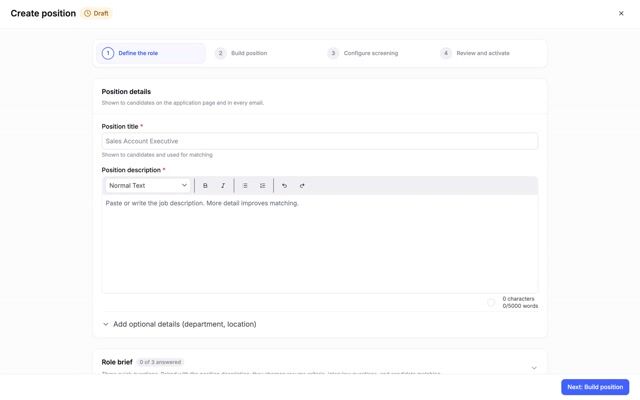
Truffle is an AI screening platform that combines resume screening, one-way video interviews, and talent assessments, so you can build a workflow around what actually matters for a licensed clinical role like this one.
For a veterinary technician, credential verification has to come first, not somewhere in the middle of the process. Healthcare hiring at small practices is competitive on pay for licensed staff, so a slow process costs you candidates as much as a bad screen does. Here's a workflow sized for a small veterinary practice, not a hospital system with its own HR team. For more on healthcare-specific hiring patterns beyond this one role, see our guide to healthcare hiring software.
- Verify the credential before anything else. Confirm the CVT, LVT, or RVT title (whichever applies in your state), the license number, and that it's current, before you schedule an interview. It's common for applicants to apply to licensed clinical roles without the right credential, and catching that in a few minutes saves you a wasted interview slot.
- Resume screening for clinical experience, not just years in the field. Screen for the specific procedures and species they've actually worked with, like anesthesia, dental prophylaxis, or surgical assist, since two candidates with the same years of experience can have very different hands-on exposure. Our resume screening tool handles this without you reading every resume line by line.
- A short one-way video interview before you commit an in-person slot. Ask 2-3 of the scenario questions above, like the anesthesia-monitoring question or the hard-news question, so you can hear how someone actually thinks and communicates before you use up an in-person interview on them. Our one-way video interview tool lets candidates record on their own time, which matters for people already working full clinical shifts elsewhere.
- An attention to detail assessment before you're relying on their math alone. Dosage calculations, treatment records, and lab results all depend on precision under time pressure. Our attention to detail assessment gives you a structured read on that before it's a live patient on the table.
- A working interview or shadow shift. Once someone's cleared credential verification, resume screening, video, and the assessment, bring them in for an actual shift alongside your vet. This is where you confirm what the earlier steps only hinted at.
AI surfaces the evidence. You review it and make the call. It doesn't verify a license for you, that step is still yours to run first, and it doesn't pick who gets hired.
3 questions from the skills check we'd actually run for this role
A skills check only helps if it tests the precision the job needs, not trivia. These three are pulled straight from Truffle's attention to detail assessment, the one we'd point you to for a role where a transposed digit reaches a live patient. They're the kind of item that separates someone careful on a good day from someone reliable late in a long shift. Try them yourself before you decide what "safe to work solo" means for your practice.
1. Two records should be duplicates. Record 1 phone: 415-019-8821. Record 2 phone: 415-019-8281. Everything else matches. What's the issue? Reveal answer
Best answer: the phone number doesn't match. The digits are transposed. It's a two-character difference that's easy to skim past. That's the exact error mode that matters most here: a transposed digit in a patient's weight or a dose looks just as innocent, and catching it before it's drawn up is the difference between a routine day and an incident.
2. Rule: flag any entry that is over $1,000 AND has no approval code. If a code is present, don't flag. Entries: (1) $1,250, no code. (2) $1,040, code APR-77. (3) $980, no code. (4) $1,005, no code. Which should be flagged? Reveal answer
Best answer: entries 1 and 4. Entry 2 clears the threshold but has a code, and entry 3 is under the dollar limit, so both are out. Applying a two-part rule with an exception, without letting the near-misses slip through, is the same discipline a tech uses on a treatment protocol where one condition changes what you're allowed to do.
3. A purchase order reads $2,418.60. The matching invoice reads $2,481.60. Same vendor. What's the discrepancy? Reveal answer
Best answer: the totals don't match. Two digits are transposed. The numbers look almost identical at a glance, which is the point. A tech who reliably spots a flipped pair of digits in a reconciliation is the tech who catches a misplaced decimal in a dosage calculation before it reaches the patient.
The point isn't these three questions. It's that a short, job-relevant skills check tells you in a few minutes what a confident interview can hide: whether someone stays accurate under time pressure when no one else is checking their work. Truffle's AI scores and surfaces the results against the bar you set. You still make the call on who clears it.
Common hiring mistakes for this role
Blurring veterinary technician and veterinary assistant in the posting itself. A generic "vet tech/assistant" listing undersells the credential and clinical judgment this role requires, and pulls in unlicensed applicants who assume the job includes tasks your state reserves for a credentialed technician. Be specific about the credential requirement from the first line of the post, and if you're also hiring for the assistant role, write a separate posting for it.
Skipping credential verification and losing time to unqualified applicants. It's common for people without the right license or credential to apply to clinical roles anyway, sometimes because they misread the posting, sometimes because they're hoping to get considered regardless. Screening for that after you've already scheduled an interview wastes a slot you could have filled with someone actually eligible to do the work. Verify first, every time, even when the resume looks strong.
Holding out for a "perfect" candidate while the clinic runs short-staffed. It's tempting to keep the search open for someone with more years, more species experience, or a specific specialty background. But every week the position sits open is a week your existing team covers the gap, and a short-staffed clinic burns out the technicians and vets you already have. A strong, credentialed candidate who's a solid match now is usually a better bet than an ideal one who might show up eventually.
Moving slowly and losing candidates to whoever pays or moves faster. Pay competition for licensed and credentialed staff is real, and a technician with in-demand experience often has more than one practice interested. If your process drags across weeks of back-and-forth scheduling, you're not just risking one candidate, you're losing them to the practice down the road that called back first.
Not testing judgment before day one, and finding out the hard way. A candidate can sound confident in an interview and still hesitate the first time a patient's vitals actually shift mid-procedure with no one else around to help. Scenario questions and a working shift catch this before it costs you a bad outcome on a real patient.
Hiring the vet this technician will be supporting, too? That's a different hiring bar again: the vet is the one making the diagnosis and the treatment call, not executing under a plan someone else set. See our veterinarian hiring guide for that role specifically.
What should your screening process look like?
Answer six quick questions about how you hire. We'll point you to the screening steps that fit, so you spend your time on the candidates worth a conversation.
What each result looks like
Start with resume screening
You're working through real volume, and the resume still carries signal. Score every resume against your criteria first, so a shortlist surfaces before you spend time on anyone.
- Resume screeningScore every resume against your criteria and surface your strongest matches first.
- One-way interviewsHear how candidates think on a recorded prompt, on their schedule and yours.
7-day free trial. No credit card required.
Lead with one-way interviews
Resumes look interchangeable and phone screens are eating your week. Let candidates answer a recorded prompt on their own time. You watch the moments that matter and decide who's worth a live round.
- One-way interviewsHear how candidates think on a recorded prompt, on their schedule and yours.
- Resume screeningScore every resume against your criteria and surface your strongest matches first.
7-day free trial. No credit card required.
Anchor on talent assessments
For these roles the work matters more than the paper. Put a role-calibrated assessment up front, so you see real, comparable evidence before you book a calendar slot.
- Talent assessmentsSee role-calibrated work before you spend a calendar slot on a live round.
- One-way interviewsHear how candidates think on a recorded prompt, on their schedule and yours.
7-day free trial. No credit card required.
Layer all three signals
Your hiring spans high volume and high stakes, so no single step covers it. Layer all three: score resumes first, hear candidates on a one-way interview, then confirm with an assessment. Each step narrows the field, and you make the call at every stage.
- Resume screeningScore every resume against your criteria and surface your strongest matches first.
- One-way interviewsHear how candidates think on a recorded prompt, on their schedule and yours.
- Talent assessmentsSee role-calibrated work before you spend a calendar slot on a live round.
7-day free trial. No credit card required.