Accountant: job description, interview questions, and screening workflow
The instinct is to hire the candidate who knows your accounting software cold. That's the wrong first filter. Software is a skin you can teach in a week. What you can't teach quickly is the judgment an accountant needs at a small business: the instinct to question a number that looks slightly off, the discipline to document why an entry was made a certain way, and the nerve to tell you something is wrong before it becomes a problem at tax time. At a small company there's no controller checking this person's work and no second accountant to catch what they miss. This guide is built to screen for that judgment, because it's what a polished resume and a QuickBooks certification both hide equally well.
What an accountant actually does at a small business
At a large company, "accountant" is one seat in a department with a controller, a staff accountant, an AP clerk, and an AR clerk, each owning a slice. At a small business or a small accounting firm serving several clients, one accountant often owns the whole close: reconciling every account, posting the adjusting entries, producing the financial statements, and being the person who can explain what the numbers mean to an owner who isn't fluent in GAAP.
The core responsibilities, in practice:
- Owning the month-end close: reconciliations, adjusting entries, and tying out every account before the books are called final
- Maintaining the general ledger and making sure transactions are coded correctly, not just recorded
- Producing financial statements (P&L, balance sheet, cash flow) that are accurate enough to hand to a lender, an investor, or a tax preparer without a disclaimer
- Explaining variances in plain language: why gross margin moved, why a expense line jumped, what it means for the owner's decisions
- Managing fixed assets, depreciation schedules, and inventory costing where relevant
- Catching errors before they compound: a miscoded transaction in March is a two-minute fix; the same error found in December is a mess
- Coordinating with an outside CPA or tax preparer at year-end, handing off clean books instead of a shoebox
The technical accounting isn't usually the hard part for someone with real experience. The hard part is judgment under low supervision: knowing when a number needs a second look, documenting the reasoning so a future reviewer (including the owner) can follow it, and being comfortable telling an owner "this doesn't look right" instead of quietly hoping it resolves itself.
Job description you can post today
Copy this, then adjust the specifics (your software, your close calendar, your reporting cadence) to match your company.
Accountant
[Company name] is looking for an accountant to own our monthly close and keep our financials accurate and current. You'll be the person who makes sure our numbers are right, not just recorded, and can explain what they mean.What you'll do
Own the month-end close: reconciliations, adjusting entries, and tying out every account. Maintain the general ledger and make sure transactions are coded correctly. Produce monthly financial statements and flag anything that looks off before it becomes a problem. Manage fixed assets and depreciation schedules. Coordinate with our outside CPA at tax time with clean, documented books.What we're looking for
Real close-cycle experience: you've owned reconciliations and adjusting entries, not just data entry. Comfort explaining a variance or a judgment call in plain language to someone who isn't an accountant. Good judgment about when something needs a second look versus when it's routine. Proficiency with [your accounting software] and Excel. A CPA or CPA-track background is a plus but not required if you can demonstrate the skill.Schedule
[Insert hours and any close-week flexibility needs][Insert pay range, per your company's policy and any applicable state salary transparency requirements]
10 interview questions, and what a good answer sounds like
1. Walk me through how you close the books at month-end, start to finish.
You're checking for a real process, not a vague gesture at "reconciling everything." A strong answer moves in order: reconcile cash and key accounts first, post accruals and adjusting entries, review the trial balance for anything out of balance or unusual, then produce statements and do a final sanity check against the prior month. A weak answer skips straight to "I run the reports" without describing any of the work that makes those reports trustworthy.
2. Your trial balance is out of balance by $1,250. How do you find the error?
Good candidates think out loud about isolating the problem: check if $1,250 (or half of it, $625) shows up as a transposed or miscoded entry, since out-of-balance amounts are often a signature of a specific kind of mistake, not a random gap. A weak answer says they'd "look through everything" with no strategy for narrowing the search.
3. Tell me about a time you caught an error someone else made, before it became a real problem.
This is looking for a real story with a decision point: what tipped them off, what they checked, and how they raised it. A candidate who can't produce a concrete example, or who describes noticing something and letting it go, is a risk in a role where they're often the only check in the process.
4. Explain the difference between accrual and cash basis to me as if I've never taken an accounting class.
This tests plain-language communication, which matters as much as the technical answer at a small company where the accountant talks directly to a non-finance owner. Listen for a simple, concrete explanation ("cash basis records money when it moves, accrual records it when it's earned or owed, so accrual can show a profit even in a month with no cash coming in") rather than textbook jargon repeated without translation.
5. Walk me through a bank reconciliation where the bank and book balances don't tie out, even after accounting for outstanding checks and deposits in transit.
Strong candidates treat a mismatch as a signal, not a nuisance: they'd flag that something is still unaccounted for and go looking for it (an unrecorded fee, a duplicate entry, a timing error) rather than forcing the numbers to match or writing off the difference. A candidate who suggests plugging the gap with an adjustment just to make it balance is a real flag.
6. How do you decide whether an expense should be capitalized as an asset or expensed immediately?
Good answers reference the company's capitalization policy and materiality, not a hard-and-fast rule memorized from a textbook. Listen for judgment: a $50 stapler is never a capital asset regardless of the theoretical useful life, and the answer should reflect an understanding of why that threshold exists (it's not worth tracking depreciation on something immaterial).
7. Tell me about the most complicated month-end close you've handled, and what made it hard.
This surfaces real experience with complexity: multiple adjusting entries, a system migration, a year-end close with inventory or fixed asset disposals, or catching up books that were behind. A vague answer ("they're all pretty similar") suggests limited exposure to anything beyond routine, predictable closes.
8. An owner asks you why gross margin dropped 4 points this month. Walk me through how you'd find the answer.
You want to hear an investigative process, not a guess: check for changes in cost of goods sold, pricing, product mix, or a one-time item, then isolate which factor actually explains the movement before reporting back. A weak answer jumps straight to an explanation without describing how they'd verify it.
9. How do you document your work so someone else, including the owner, could follow your reasoning later?
At a small company, there's often no one reviewing this person's work in real time, so documentation is the substitute for a second set of eyes. Good answers describe a habit: notes on judgment calls, support for reconciling items, a clear trail for anything non-routine. "I just remember why I did things" is a risk, since institutional memory walks out the door when this person eventually does.
10. Why are you interested in being the only accountant at a small business, rather than one of several on a larger finance team?
This checks whether they understand what they're signing up for: more ownership and variety, but also no backup and no one to catch what they miss. A candidate who can't name a real reason beyond "it was the job that was open" may be underprepared for the isolation this role actually involves.
A scorecard you can score candidates against
Ten questions only help if everyone on your side is listening for the same signals. Score every candidate on the same six dimensions, so you're comparing evidence instead of six different gut feelings. Copy this into a doc and fill in a row per candidate.
| What you're scoring | Strong signal | Weak signal |
|---|---|---|
| Close-cycle process | Describes a real, ordered close process: reconcile, adjust, review trial balance, produce statements, sanity check | Vague gesture at "reconciling everything," no clear sequence or checks |
| Error-detection logic | Treats an out-of-balance amount or a mismatch as a specific signal to investigate, not a nuisance to plug | Would force numbers to balance with a plug entry, or has no strategy for isolating an error |
| Plain-language communication | Explains a technical concept or a variance to a non-finance owner in simple, concrete terms | Falls back on jargon without translating it, or can't explain the "why" behind a number |
| Judgment under low supervision | Has a real story of catching an error or flagging a concern before it became a problem | Can't produce a concrete example, or describes noticing something and letting it go |
| Documentation habit | Documents reasoning and support so someone else could follow the work later | Relies on memory alone, no real documentation habit |
| Fit for solo ownership | Understands and wants the ownership and variety of being the only accountant, no backup | Can't articulate a real reason for choosing this over a bigger finance team |
How to screen accountant candidates without losing a week to it
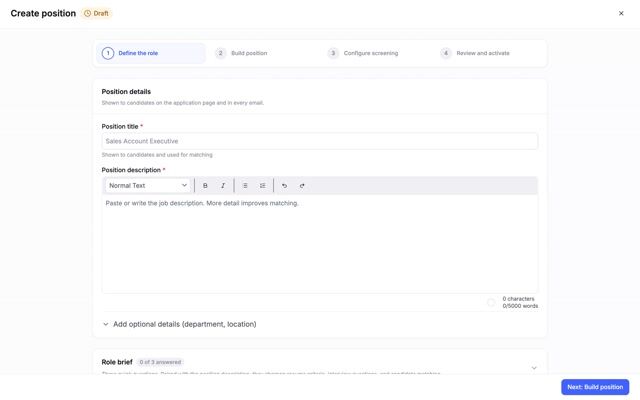
Truffle is an AI screening platform that combines resume screening, one-way video interviews, and talent assessments, so you can build a screening workflow around what actually matters for a role you can't afford to get wrong: the person you're trusting with your numbers.
Accounting and finance roles pull a lot of resumes that look similar on paper: same software listed, same generic "detail-oriented" language, same certifications. What a resume can't show is whether someone actually reasons through a close or just executes rote steps. A short skills check that mirrors real close-cycle scenarios separates the two long before you spend live interview time.
A workflow that fits a small business or small accounting firm hiring one accountant:
- Resume screening first. Cut obvious mismatches on software, years of close-cycle experience, and industry background before you spend time on anyone. This is also where you handle volume, since accounting roles at small businesses can pull a large number of similar-looking applications.
- A short one-way video interview for your first real look. Ask 2-3 of the scenario questions above, like the trial balance question or the plain-language accrual explanation, so you can hear how someone actually reasons through a problem before committing any live interview time.
- A role-based skills check instead of trusting the resume. Our free accountant test uses real close-cycle scenarios (journal entries, reconciliations, error detection) with a clear rubric you score yourself, so you see actual technical judgment instead of a list of software names on a resume.
- A live conversation only for candidates who clear the first three steps. By the time you're on a call, you already know they can reason through a close and communicate clearly. The live conversation is for fit and final judgment calls, not for discovering for the first time whether they know the work.
Our resume screening and one-way video interview tools handle the first two steps in one place, with AI that surfaces your strongest matches against the criteria you set. You review the evidence and decide. It doesn't pick for you.
3 sample questions to try for this role
A skills check only helps if it tests judgment, not memorized definitions. These three come from our free accountant test question bank. Try them yourself before you decide what "job-ready" means for your opening.
1. You record a vendor invoice for $4,800 for utilities, to be paid next month. Which entry is correct at invoice receipt? Reveal answer
Best answer: debit Utilities Expense $4,800, credit Accounts Payable $4,800. The expense is incurred now, but cash hasn't moved yet, since payment comes next month. A candidate who credits cash instead of accounts payable is confusing when an expense is incurred with when it's paid, a distinction that matters every time your books need to reflect what's actually owed.
2. Payroll of $18,000 is paid every Friday. The month ends on Wednesday, and three days of that week's pay haven't been accrued yet. What's the month-end adjusting entry? Reveal answer
Best answer: debit Wages Expense $10,800, credit Wages Payable $10,800 (18,000 ÷ 5 days × 3 days worked). This is a classic accrual scenario: the expense belongs to the month the work happened, not the month the check clears. A candidate who books the full $18,000, or skips the accrual entirely because "it's not due yet," is missing a distinction that shows up in nearly every close.
3. The bank statement shows $52,400. Your books show $49,900. Outstanding checks are $6,700, deposits in transit are $8,200, and there's a $60 bank fee not yet recorded. Does this reconciliation balance? Reveal answer
Best answer: no, it doesn't balance, and that's the point. Working the bank side (52,400 − 6,700 + 8,200 = 53,900) against the book side (49,900 − 60 = 49,840) leaves a $60 gap that isn't explained by the fee alone. The right move is to flag the mismatch and keep looking, not to force the numbers together. A candidate who "solves" this by adjusting a number to make it balance is exactly the risk this question is built to surface.
The point isn't these three questions specifically. It's that a short, scenario-based skills check tells you in under an hour what a resume and a friendly interview can hide: whether someone actually reasons through the close or just goes through the motions. Use them in your own interview or as a short take-home. Truffle's built-in assessments cover judgment, personality and work style, not right-answer skills tests, so keep a check like this as your own step. You still make the call on who clears it.
Common hiring mistakes for this role
Screening for software fluency instead of accounting judgment. QuickBooks, Xero, and Excel are teachable in a week to someone who already understands the underlying accounting. The reverse isn't true. Weight real close-cycle reasoning above a list of software names on a resume.
Not testing plain-language communication. At a small company, the accountant often explains numbers directly to an owner who isn't fluent in GAAP. A technically strong candidate who can only talk in jargon will leave you as confused as before, just with better-looking spreadsheets.
Treating a certification as a substitute for a work sample. A CPA or a bookkeeping certificate tells you someone studied and passed a test. It doesn't tell you whether they'll catch a $1,250 transposed entry or a bank reconciliation that quietly doesn't balance. Test the actual skill.
Underestimating how much this hire runs on trust. Unlike a role with a manager reviewing daily output, an accountant at a small business often works with minimal oversight. Probe directly for documentation habits and real stories of catching their own or someone else's mistakes, since that's the evidence a resume can't provide.
What should your screening process look like?
Answer six quick questions about how you hire. We'll point you to the screening steps that fit, so you spend your time on the candidates worth a conversation.
What each result looks like
Start with resume screening
You're working through real volume, and the resume still carries signal. Score every resume against your criteria first, so a shortlist surfaces before you spend time on anyone.
- Resume screeningScore every resume against your criteria and surface your strongest matches first.
- One-way interviewsHear how candidates think on a recorded prompt, on their schedule and yours.
7-day free trial. No credit card required.
Lead with one-way interviews
Resumes look interchangeable and phone screens are eating your week. Let candidates answer a recorded prompt on their own time. You watch the moments that matter and decide who's worth a live round.
- One-way interviewsHear how candidates think on a recorded prompt, on their schedule and yours.
- Resume screeningScore every resume against your criteria and surface your strongest matches first.
7-day free trial. No credit card required.
Anchor on talent assessments
For these roles the work matters more than the paper. Put a role-calibrated assessment up front, so you see real, comparable evidence before you book a calendar slot.
- Talent assessmentsSee role-calibrated work before you spend a calendar slot on a live round.
- One-way interviewsHear how candidates think on a recorded prompt, on their schedule and yours.
7-day free trial. No credit card required.
Layer all three signals
Your hiring spans high volume and high stakes, so no single step covers it. Layer all three: score resumes first, hear candidates on a one-way interview, then confirm with an assessment. Each step narrows the field, and you make the call at every stage.
- Resume screeningScore every resume against your criteria and surface your strongest matches first.
- One-way interviewsHear how candidates think on a recorded prompt, on their schedule and yours.
- Talent assessmentsSee role-calibrated work before you spend a calendar slot on a live round.
7-day free trial. No credit card required.