Operations coordinator: job description, interview questions, and screening workflow
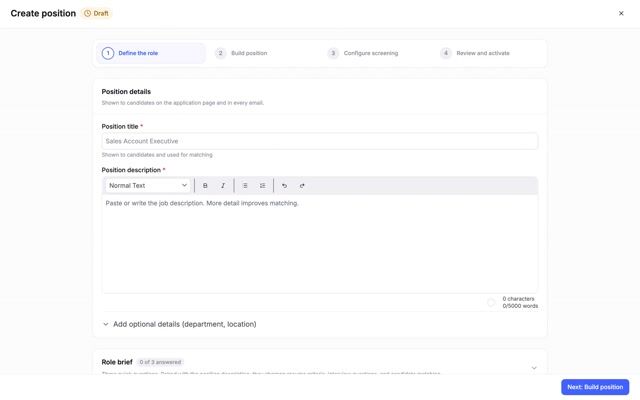
Most owners hire an operations coordinator based on who seems the most "on it" in a 30-minute conversation. That's a weak signal, because almost everyone can sound organized for 30 minutes. What actually determines whether this hire works out is whether they follow through on the tenth recurring task the same way they did on the first, whether they escalate a stalled vendor before it becomes a crisis, and whether they can juggle two genuinely competing priorities without letting the quiet, unglamorous one slip. None of that shows up in a friendly interview. This guide is built to screen for the track record behind the confidence, because that's what a resume and a good first impression both hide equally well.
What an operations coordinator actually does at a small business
At a company with a full operations department, an operations coordinator handles a narrow, defined slice, with specialists and managers checking their work at multiple points. At a small business, one person often coordinates the moving parts across the whole operation: vendors, scheduling, recurring processes, and the small but constant stream of things that need tracking so nothing falls through.
The core responsibilities, in practice:
- Coordinating with vendors and outside partners: scheduling, following up, catching a problem before it becomes a disruption
- Keeping recurring processes actually recurring: the weekly inventory check, the monthly compliance task, the things that only matter when they're skipped
- Tracking multiple projects or workstreams at once, and knowing which one needs attention today versus which can wait
- Communicating status clearly to the owner or manager, especially when something is behind or at risk
- Building or maintaining the systems (a tracker, a checklist, a shared calendar) that make the operation legible to more than one person
- Escalating problems early enough to actually fix them, instead of only surfacing a crisis once it's unavoidable
- Adapting when priorities shift suddenly, without losing track of everything else already in motion
The individual tasks in this role aren't usually complicated on their own. The hard part is sustained reliability across dozens of small threads at once, with no one else checking whether the quiet, unglamorous ones got done. That's exactly the thing a friendly interview and a well-written resume can't reliably show you.
Job description you can post today
Copy this, then adjust the specifics (your industry, your tools, your team structure) to match your company.
Operations coordinator
[Company name] is looking for an operations coordinator to keep our day-to-day running smoothly. You'll juggle vendor coordination, recurring processes, and the small but essential tasks that keep the business moving, and know how to prioritize when everything feels urgent at once.What you'll do
Coordinate with vendors and outside partners, following up and catching problems early. Keep recurring processes (inventory checks, compliance tasks, scheduled maintenance) actually happening on schedule. Track multiple workstreams and communicate status clearly, especially when something is at risk. Build and maintain simple systems (trackers, checklists) so the operation isn't dependent on memory alone. Escalate problems early, before they become urgent.What we're looking for
A real track record of following through on recurring responsibilities without being reminded. Comfort juggling competing priorities and communicating trade-offs clearly. A personal system for staying on top of commitments (a checklist, a tracker, whatever works for you), not just a claim of being organized. Prior experience in our industry is a plus but not required.Schedule
[Insert hours and any on-site or availability requirements][Insert pay range, per your company's policy and any applicable state salary transparency requirements]
10 interview questions, and what a good answer sounds like
1. Walk me through your personal system for making sure a recurring task doesn't get forgotten.
You're checking for a real, specific system, not a general claim of being organized. A strong answer describes something concrete: a checklist, a calendar block, a tracker they check daily. A weak answer says "I just remember" or "I'm naturally organized" with no actual mechanism behind it.
2. Tell me about a time a project stalled because someone else was late, and how you handled it.
Good answers describe escalating early, before the deadline was actually at risk, rather than waiting and hoping it resolved itself. Listen for a specific timeline: when they noticed, when they raised it, and what they did next. A candidate who describes waiting until the last minute is showing you exactly how they'll handle the next stalled vendor.
3. You have two urgent tasks due today: one is high-visibility but low-risk, the other is low-visibility but high-risk if it's wrong. How do you decide what to do first?
Strong candidates prioritize the high-risk task and communicate the plan clearly, rather than defaulting to whatever gets noticed most. A weak answer either just does things in the order they arrived, or asks for an extension without proposing any trade-off.
4. Tell me about the most complicated set of moving pieces you've had to track at once, and how you kept it all straight.
This surfaces real experience with genuine juggling, not a hypothetical. Listen for specifics: how many threads, what the system was, and what happened when something almost slipped.
5. Describe a time you noticed a small problem with a vendor or process before anyone else did, and what you did about it.
Good answers show proactive attention: what tipped them off, and what action they took before it became a bigger issue. A candidate who can't produce a real example may be reactive rather than proactive, a real risk in a role built around catching things early.
6. How do you decide what to escalate to your manager or the owner, versus what you handle yourself?
Strong answers describe a real line: they handle routine judgment calls themselves and escalate when something is high-stakes, ambiguous, or outside their authority, explaining the reasoning rather than a blanket rule ("I always ask" or "I never ask").
7. Tell me about a time your priorities got completely reshuffled with no warning. How did you adjust?
This tests adaptability without losing track of what was already in motion. Listen for whether they describe re-triaging quickly and communicating the change to anyone affected, versus getting flustered or quietly dropping something without telling anyone.
8. What's a system or process you've built from scratch to solve a real problem, not one you inherited?
Good candidates can point to something concrete they created (a tracker, a checklist, a new way of coordinating with a vendor) and explain what problem it solved. A candidate who's only ever followed existing systems may struggle when nothing formal exists yet, which is common at a small business.
9. Tell me about a time you made a mistake that fell through the cracks. What happened, and what did you change afterward?
Everyone drops something eventually. What matters is whether they own it honestly and describe a real change to their system afterward, rather than denying it ever happened or blaming someone else.
10. Why are you interested in a role where you're the main person holding the operational pieces together, rather than one of several specialists on a bigger team?
This checks whether they understand the scope and pace of the role: broad and constant, without a team of specialists dividing the load. A candidate who can't name a real reason may be underprepared for how much this role touches at once.
A scorecard you can score candidates against
Ten questions only help if everyone on your side is listening for the same signals. Score every candidate on the same six dimensions, so you're comparing evidence instead of who seemed the most "on it" in the room. Copy this into a doc and fill in a row per candidate.
| What you're scoring | Strong signal | Weak signal |
|---|---|---|
| Personal reliability system | Describes a specific, concrete system (checklist, tracker, habit) for staying on top of commitments | Claims to be organized with no actual mechanism described |
| Escalation timing | Real story of raising a stalled issue early, before it became urgent | Waits until the last minute, or can't produce a real example |
| Prioritization under pressure | Prioritizes real risk over visibility, and communicates the trade-off clearly | Defaults to whatever is loudest or most visible |
| Proactive attention | Concrete example of catching a small problem before anyone else noticed | Only describes reacting after a problem was already visible to others |
| Adaptability | Re-triages quickly when priorities shift and communicates the change to those affected | Gets flustered, or quietly drops something without telling anyone |
| Owning mistakes | Honestly describes a real dropped task and a specific change made afterward | Denies ever dropping anything, or blames someone else |
How to screen operations coordinator candidates without losing a week to it
Truffle is an AI screening platform that combines resume screening, one-way video interviews, and talent assessments, so you can build a screening workflow around what actually matters for a role where reliability, not credentials, is the real qualification.
Operations coordinator postings tend to pull a wide range of similar-looking resumes, since the job description often reads generically ("detail-oriented," "multitasker") across many companies. A resume alone can't show you whether someone actually follows through consistently or just describes themselves well.
A workflow that fits a small business hiring one operations coordinator:
- Resume screening first. Cut obvious mismatches on relevant experience and any specific tool or process requirements before you spend time on anyone.
- A short one-way video interview for your first real look. Ask 2-3 of the scenario questions above, like the stalled-project question or the competing-priorities question, so you hear how someone actually talks through follow-through and escalation before committing any live interview time.
- A workplace behavior check instead of guessing from a friendly conversation. Our free workplace behavioural assessment surfaces real tendencies around reliability, ownership, and prioritization under pressure, exactly the traits a 30-minute interview struggles to reveal on its own.
- A live conversation only for candidates who clear the first three steps. By the time you're on a call, you already have real evidence of how someone follows through and prioritizes. The live conversation is for fit and final judgment, not for discovering for the first time whether they're actually reliable.
Our resume screening and one-way video interview tools handle the first two steps in one place, with AI that surfaces your strongest matches against the criteria you set. You review the evidence and decide. It doesn't pick for you.
What the workplace behavioural assessment surfaces for this role
Reliability and follow-through aren't well captured by a single right-or-wrong quiz question, since the "right" answer depends on your specific operation and priorities. Instead, our free workplace behavioural assessment uses realistic work scenarios to surface three signals that matter directly for this role:
- Self-management systems, not just intent. One scenario asks whether a candidate maintains a personal tracking habit (a checklist, a calendar, a Kanban board) to keep commitments from slipping, surfacing whether reliability is backed by an actual system or just good intentions.
- Ownership and escalation instincts. Another scenario probes whether someone escalates a stalled dependency early or waits until a deadline is genuinely at risk, the same instinct that separates a coordinator who catches problems from one who only reports them after they've already happened.
- Prioritization under competing pressure. A third scenario presents two urgent, conflicting tasks (one high-visibility, one high-risk) and surfaces whether a candidate defaults to whatever gets noticed most or reasons through actual risk and communicates the trade-off.
The point isn't a pass/fail score. It's a structured look at tendencies a resume and a short interview can't reliably surface on their own. Inside Truffle, the same idea runs as a Situational Judgment assessment: you rank how you'd want each scenario handled, every applicant answers the same ones, and you see where each lands next to their resume and interview. You still make the call on who's the right fit.
Common hiring mistakes for this role
Hiring for a confident, can-do interview presence. Almost anyone can sound organized and reliable for 30 minutes. Ask for specific past examples and a real system, not just a confident claim.
Not testing escalation timing. A coordinator who waits until a problem is unavoidable before raising it provides much less value than one who flags it early. This is a specific, testable behavior, not a vague personality trait.
Overweighting industry-specific experience. The core skill (sustained follow-through across many threads) transfers across industries. Requiring your exact industry background can filter out strong candidates for a skill that's actually learnable on the job.
Skipping a behavioral check because the role feels "soft." Reliability and prioritization judgment feel intangible, which makes it tempting to rely on gut feel from an interview alone. A structured behavioral assessment gives you a more consistent read across every candidate, instead of six different impressions from six different conversations.
What should your screening process look like?
Answer six quick questions about how you hire. We'll point you to the screening steps that fit, so you spend your time on the candidates worth a conversation.
What each result looks like
Start with resume screening
You're working through real volume, and the resume still carries signal. Score every resume against your criteria first, so a shortlist surfaces before you spend time on anyone.
- Resume screeningScore every resume against your criteria and surface your strongest matches first.
- One-way interviewsHear how candidates think on a recorded prompt, on their schedule and yours.
7-day free trial. No credit card required.
Lead with one-way interviews
Resumes look interchangeable and phone screens are eating your week. Let candidates answer a recorded prompt on their own time. You watch the moments that matter and decide who's worth a live round.
- One-way interviewsHear how candidates think on a recorded prompt, on their schedule and yours.
- Resume screeningScore every resume against your criteria and surface your strongest matches first.
7-day free trial. No credit card required.
Anchor on talent assessments
For these roles the work matters more than the paper. Put a role-calibrated assessment up front, so you see real, comparable evidence before you book a calendar slot.
- Talent assessmentsSee role-calibrated work before you spend a calendar slot on a live round.
- One-way interviewsHear how candidates think on a recorded prompt, on their schedule and yours.
7-day free trial. No credit card required.
Layer all three signals
Your hiring spans high volume and high stakes, so no single step covers it. Layer all three: score resumes first, hear candidates on a one-way interview, then confirm with an assessment. Each step narrows the field, and you make the call at every stage.
- Resume screeningScore every resume against your criteria and surface your strongest matches first.
- One-way interviewsHear how candidates think on a recorded prompt, on their schedule and yours.
- Talent assessmentsSee role-calibrated work before you spend a calendar slot on a live round.
7-day free trial. No credit card required.