Real estate agent: job description, interview questions, and screening workflow
A real estate license proves someone passed a test. It says nothing about whether they can survive the part of the job that actually kills most agents: generating their own business and getting told no, over and over, without quitting or leaning on someone else's leads to pay the bills. Most of what lands in your inbox looks the same: an active license, a broker sponsorship history, maybe a "top producer" line that turns out to trace back to a franchise or team that fed them leads they never generated themselves. None of it tells you what you actually need to know before you hand someone a desk, a sign, and your brokerage's name: whether they'll go build their own pipeline, or whether they'll spend 90 days riding your floor time and referrals and then wash out with nothing to show for it. Most new agents don't fail because they can't pass the license exam. They fail because they can't generate their own leads, can't handle rejection long enough to make prospecting work, and don't have a follow-up system, three things a resume can't show and a license exam doesn't test. This guide is built to screen for those three things specifically, not for the credential everyone in your pile already has.
What a real estate agent actually does at a small brokerage
At a large national franchise, a new agent often gets a lead-generation program, an in-house marketing team, and a structured onboarding cohort. At a 5-30 agent independent brokerage or a small team, most of that doesn't exist. There's no marketing department building a pipeline for every agent. Whatever floor duty or referral leads the brokerage does provide are a supplement, not the plan. The agent's business is, in large part, whatever business they go make.
That's a different job than the title suggests. The core responsibilities, in practice:
- Prospecting and building their own pipeline, sphere of influence, past clients, referrals, cold outreach, open houses, geographic farming, expired and for-sale-by-owner listings
- Following up with buyer and seller leads consistently, often for months before someone is actually ready to transact
- Running showings, listing appointments, and open houses, and representing the brokerage's brand in every one of them
- Pricing property using local comps and market data, and advising sellers when their expectations don't match the data
- Negotiating offers and guiding clients through inspection, appraisal, financing contingencies, and closing
- Keeping their pipeline and client communication organized in a CRM or system, so leads don't go cold from neglect
- Staying current on disclosure requirements, contract deadlines, and local market conditions
That last point about the pipeline matters more than it sounds. There's no sales manager watching a dashboard at a small brokerage. You find out a new agent's pipeline is empty when they tell you, or when three months go by with no closings. This role is worth distinguishing from adjacent titles you might also be hiring for: a real estate agent originates and closes sales, while a property manager or leasing agent manages and leases units that already exist in a portfolio. If you're not sure which one your opening actually is, see our breakdown of property manager vs. leasing agent.
Job description you can post today
Copy this, then adjust the specifics (your split, your lead sources, your training and mentorship) to match your brokerage.
Real estate agent
[Brokerage name] is looking for a licensed real estate agent to build a book of business with our team. You'll prospect and manage your own pipeline of buyers and sellers, guide clients from first contact through closing, and represent our brokerage at every step.What you'll do
Prospect and build your own pipeline through your sphere, referrals, and outreach, in addition to any floor duty or company-provided leads. Follow up with buyer and seller leads consistently, including the ones who aren't ready to transact for months. Run showings, listing appointments, and open houses. Price listings using real comps and guide sellers through realistic expectations. Negotiate offers and manage clients through inspection, appraisal, and closing. Keep your pipeline and client communication organized in our CRM so nothing slips through.What we're looking for
An active, sponsorable real estate license in good standing. A real system for prospecting and following up, not just a willingness to "network." The ability to handle rejection without giving up on a lead or a prospecting method after the first few no's. Comfort pricing and negotiating without a manager scripting every conversation.Schedule
[Insert expectations, e.g. full-time availability including evenings and weekends for showings, floor duty rotation][Insert commission split, fees, and any company-provided leads or resources, per your brokerage's policy and any applicable state disclosure requirements]
11 interview questions, and what a good answer sounds like
1. Walk me through your last five closed deals. Where did each lead actually come from?
You're checking for real, deal-by-deal specificity, not a general claim of being a "hustler." A strong answer names a source for each deal: sphere of influence, a referral, a past client, an expired listing, cold prospecting, an open house sign-in. A weak answer stays vague ("I just built relationships") or every deal traces back to leads a team or brokerage fed them, which tells you exactly what happens to their production when that supply disappears.
2. Tell me about your first 90 days after getting licensed. What did you actually do to build a pipeline from zero?
Good answers describe a real activity plan: calling their sphere, door-knocking, working an expired-listings list, open houses, a geographic farm, consistent social media outreach. Watch for candidates who can't describe concrete daily or weekly activity from that stretch. Someone who waited for leads to come to them in their first 90 days is describing the exact pattern behind a 90-day washout.
3. Describe a stretch where you got nothing but no's, weeks of cold calls or door-knocking with no results. What did you do?
Everyone who's actually prospected has a story like this. A strong answer names a real stretch and what kept them going, a specific activity target they held themselves to, a mentor, a habit they didn't drop when the response was bad. A candidate who can't produce a real example, or who describes abandoning a prospecting method the first time it got hard, is telling you how they'll handle the same stretch on your roster.
4. Walk me through your follow-up system for a lead who isn't ready to buy or sell for six months or a year.
This is where most agents actually lose business. A strong answer describes a real cadence: a CRM with scheduled touches, a drip of useful information, a personal check-in on a set interval, not "I just keep in touch." A lead usually goes cold not because they never wanted to transact, but because nobody followed up when they were finally ready. "I probably would've moved on" is an honest answer, and also a real signal about how much business slips away on this person's watch.
5. Tell me about a deal that fell apart. What happened, and what did you do next?
You want a real story with specifics: financing fell through, the inspection killed it, a seller got cold feet. Listen for what they did afterward, recontacted the buyer, kept prospecting instead of dwelling. A candidate who blames the client, the lender, or the market every single time, with no mention of their own role, will talk about your lost deals the same way.
6. A prospect says "just send me the listings" and doesn't want to meet. What do you actually say back?
This brush-off shows up constantly, and how someone handles it tells you a lot. A strong answer reframes rather than complying outright: a clarifying question about what they're actually looking for, an offer of a short call to understand timeline, something beyond a generic search link. A candidate who says "I'd just email them listings" is telling you they'll let a soft no end the relationship, which is exactly how a pipeline stays empty.
7. How would you price a home when you don't have strong recent comps nearby?
Good answers describe a real process: expanding the radius or the time window, adjusting for condition and upgrades, checking pending sales, consulting a broker or appraiser when the data is genuinely thin. A candidate who can't describe how they'd research this is likely to overprice a listing (it sits) or underprice it (the seller loses money), and either way it becomes your brokerage's problem.
8. Tell me about a time you had to deliver bad news to a client, a rejected offer, a failed inspection, a low appraisal.
Listen for how directly they delivered it: promptly, with a next step ready, versus how much they softened or delayed the conversation. A candidate who describes putting off a hard call, or dressing up bad news so much the client didn't understand the real situation, is a risk for your brokerage's reputation the first time a deal goes sideways.
9. How do you track your pipeline and past clients today? What's actually in your CRM or system?
Good answers get specific about the tool and what's in it: contact info, last-touch date, notes on where each lead is in the process, a scheduled next touch. "I keep it in my head" is an answer some agents genuinely give, and it's a real risk, nothing transfers if this person leaves, and leads slip through cracks a system would have caught.
10. Why leave your current brokerage, or why join a small team instead of a bigger franchise?
A strong answer is specific and coherent: wants more mentorship, wants a different split, wants a team lead who'll actually develop them, their current brokerage doesn't provide the training or support they need. Vague or inconsistent answers, especially after a short stint, are worth a direct follow-up before you move forward.
11. Walk me through an average week for you, hour by hour.
This surfaces how much of the week is actually prospecting versus administrative work versus client-facing time. A candidate who can't account for meaningful prospecting time in a normal week, even a slow one, is describing a business that isn't being built, no matter how good the rest of the interview sounded.
A scorecard you can score candidates against
Eleven questions only help if everyone interviewing is listening for the same signals. Score every candidate on the same six, so you're comparing evidence instead of comparing who told the best story.
| What you're scoring | Strong signal | Weak signal |
|---|---|---|
| Self-generated business | Can break down recent deals by lead source, several traced to their own sphere or prospecting | Every deal traces back to team or company-fed leads, or can't name real sources |
| Prospecting activity | Describes a concrete plan for building a pipeline from zero, specific activities and cadence | Vague on activity, describes waiting for leads to come to them |
| Resilience to rejection | Produces a real stretch of rejection and names what kept them prospecting through it | No real example, or abandoned a prospecting method after it got hard |
| Follow-up discipline | Concrete cadence or system for long-timeline leads, scheduled touches, not "I just keep in touch" | No system, keeps track "in their head," admits leads go cold |
| Objection handling | Reframes a "just send me the listings" brush-off instead of complying and disappearing | Sends a link and moves on, lets a soft no end the conversation |
| Ownership when deals go sideways | Names their own role in a lost deal, delivers bad news directly and promptly | Blames the client, lender, or market every time, avoids or delays hard conversations |
How to screen real estate agent candidates without losing a week to it
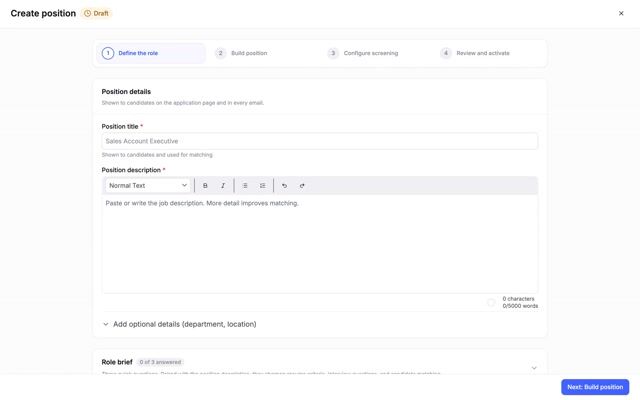
Truffle is an AI screening platform that combines resume screening, one-way video interviews, and talent assessments, so you can build a workflow around what actually predicts whether an agent produces: self-generated activity, resilience, and follow-up, not license status alone.
A single agent opening at a small brokerage can pull candidates ranging from newly licensed people with zero transaction history to experienced agents between brokerages, all of whom look roughly the same on paper. A workflow that fits a small team:
- License and resume check first. Verify the license is active and sponsorable, and use the resume to note production history where it exists, but treat this as a floor, not a ranking. Resume screening software handles the initial pass so you're not reading every application yourself before dinner.
- A one-way video interview before you spend a live call. Ask 2-3 of the scenario questions above on video, the lead-source question and the "just send me the listings" objection both work well here, so you can hear real prospecting logic before you commit calendar time. A one-way video interview also gives you an early look at how someone will actually sound to a prospect on their own call.
- A sales assessment before the live interview, not after. A resume can claim production. A structured assessment tests how someone actually opens a cold conversation, handles a brush-off, and manages a pipeline. Our sales assessment blueprint lays out scenarios and scoring you can adapt for exactly this.
- A live conversation and a reference check with a past broker or team lead, for finalists only. By the time you're on a call, you already have evidence on prospecting, objection handling, and follow-up. Use the reference check to confirm the lead-source breakdown the candidate gave you, not just their dates of affiliation.
See our screening workflow built for real estate brokerages for how these steps fit together for this specific role. AI surfaces the evidence, resume, video responses, assessment scores, side by side, so you're not piecing it together from memory across a pile of applications. It doesn't decide who gets a desk. You review the evidence and make the call.
3 questions from the skills check we'd actually run for this role
A skills check only helps if it tests the behaviors that actually predict production, not general sales trivia. These three are adapted from Truffle's sales assessment blueprint, the assessment we'd point you to for this role, translated into real estate scenarios. They're scored against specific behaviors, the same ones the blueprint scores for, not a single "correct" script. Try them yourself before you decide what "ready to prospect" means for your opening.
1. You're calling on an expired listing. The homeowner picks up and says "you've got 30 seconds, what is this?" Deliver an opener that earns permission to ask one question. Reveal what "good" looks like
Score for permission-based framing, a clear reason the call is relevant to this specific homeowner, composure under a curt or annoyed response, and the quality of the one question they ask once they get permission. A candidate who launches straight into a pitch, or who can't recover their composure after a cold "why are you calling me," is showing you exactly how they'll handle the hundredth expired listing call, not just this one.
2. A prospect who found you online says "just send me the listings, I don't want to meet." Respond in two exchanges max, and try to secure a short call or a showing. Reveal what "good" looks like
Score for reframing instead of complying outright, respectful persistence without becoming pushy, a specific micro-commitment (a time, a next step), and who ends up controlling what happens next. A candidate who just agrees to send listings and moves on has shown you a brush-off will end the relationship every time, which is a direct predictor of an empty pipeline.
3. You're given a rough call log from a buyer conversation: they liked two homes but aren't ready to make an offer, and mentioned a move date "sometime next spring." Log it. Reveal what "good" looks like
Score for completeness, accuracy, judgment about what stage this lead is actually in, and process discipline, specifically whether they set a concrete next-touch date instead of leaving it open-ended. "Sometime next spring" logged with no scheduled follow-up is how a warm buyer goes cold. This is the exact discipline that separates agents who convert long-timeline leads from agents who lose them.
The point isn't these three exercises specifically. It's that a short, job-relevant skills check surfaces in twenty minutes what a resume and a friendly interview can hide: whether someone actually reaches for the right move when a prospect pushes back or goes quiet. AI scores and surfaces the results against the bar you set. You still make the call on who gets the desk.
Common hiring mistakes for this role
Over-indexing on license and certifications instead of production evidence. A license tells you someone passed a test and can legally practice. It doesn't tell you whether they can generate a pipeline from nothing or survive a bad month. Weight the lead-source and prospecting questions above a clean license number.
Not checking whether production numbers were self-generated. A candidate's total transaction count means very little without knowing where those leads came from. Someone whose entire book was fed to them by a team or a franchise's lead program may have never actually built a pipeline on their own, which is the exact skill your brokerage needs from them now.
Posting "unlimited earning potential" instead of a real commission structure. A vague pay line filters out exactly the disciplined candidates who want to understand the split and the fees before they commit, and attracts the ones who'll agree to anything and churn out fast. Publish real numbers.
Skipping the reference check because the interview went well. A polished interview is not proof of a real pipeline. A quick call with a past broker or team lead, asking specifically about lead sources and follow-up habits, catches the gap between what a candidate says and what they actually did.
Assuming an agent from a big franchise will thrive without the lead flow they're used to. Someone who's only ever worked leads a national brand's marketing budget generated for them may struggle when the job is "build your own business." Ask directly how they'd replace that lead flow before you assume the experience transfers.
What should your screening process look like?
Answer six quick questions about how you hire. We'll point you to the screening steps that fit, so you spend your time on the candidates worth a conversation.
What each result looks like
Start with resume screening
You're working through real volume, and the resume still carries signal. Score every resume against your criteria first, so a shortlist surfaces before you spend time on anyone.
- Resume screeningScore every resume against your criteria and surface your strongest matches first.
- One-way interviewsHear how candidates think on a recorded prompt, on their schedule and yours.
7-day free trial. No credit card required.
Lead with one-way interviews
Resumes look interchangeable and phone screens are eating your week. Let candidates answer a recorded prompt on their own time. You watch the moments that matter and decide who's worth a live round.
- One-way interviewsHear how candidates think on a recorded prompt, on their schedule and yours.
- Resume screeningScore every resume against your criteria and surface your strongest matches first.
7-day free trial. No credit card required.
Anchor on talent assessments
For these roles the work matters more than the paper. Put a role-calibrated assessment up front, so you see real, comparable evidence before you book a calendar slot.
- Talent assessmentsSee role-calibrated work before you spend a calendar slot on a live round.
- One-way interviewsHear how candidates think on a recorded prompt, on their schedule and yours.
7-day free trial. No credit card required.
Layer all three signals
Your hiring spans high volume and high stakes, so no single step covers it. Layer all three: score resumes first, hear candidates on a one-way interview, then confirm with an assessment. Each step narrows the field, and you make the call at every stage.
- Resume screeningScore every resume against your criteria and surface your strongest matches first.
- One-way interviewsHear how candidates think on a recorded prompt, on their schedule and yours.
- Talent assessmentsSee role-calibrated work before you spend a calendar slot on a live round.
7-day free trial. No credit card required.