Administrative assistant: job description, interview questions, and screening workflow
Most administrative assistant postings ask for "strong Microsoft Office skills" and call it a day. At a small business, that's testing for the wrong thing entirely. You're not hiring someone to slot into a department with a manager checking their work every afternoon. You're hiring the person who quietly keeps a dozen small commitments moving with almost no one watching, and who has to use real judgment about what's urgent, what can wait, and what needs to stay confidential. The thing that sinks this hire is almost never a thin spreadsheet skill. It's a resume that lists tasks without ever showing whether the person follows through on them without being reminded. This guide is built to screen for follow-through and judgment, because those are what actually decide whether this hire works out, and they're exactly what a bullet-point resume hides.
What an administrative assistant actually does at a small business
At a large company, administrative support is its own function, with a shared services team, a ticketing system for requests, and a manager who checks in daily. At a small business, one administrative assistant usually supports an entire team or office on their own, reporting to an owner, office manager, or a handful of people who each think their request is the priority.
The core responsibilities, in practice:
- Managing shared calendars and scheduling meetings across people with different availability
- Handling correspondence: answering routine emails, drafting messages for a manager's review, routing anything that needs a decision above their level
- Maintaining files and records, both digital and physical, so anyone on the team can find what they need
- Data entry and basic recordkeeping: updating spreadsheets, logging expenses, tracking vendor contacts
- Ordering supplies and coordinating with vendors, from office supplies to equipment repairs
- Supporting meetings: preparing materials, taking notes, following up on action items
- Handling confidential information, from HR paperwork to financial documents, with real discretion
The technical bar for this role is rarely the hard part. Most candidates can build a spreadsheet or draft an email. The hard part is judgment: knowing what's actually urgent when three people each say their request is the priority, following through on a task without a reminder, and staying quiet about the things that need to stay quiet. At a small business, no one is double-checking this person's work in real time, so the follow-through has to be real, not a habit they perform when someone's watching.
Job description you can post today
Copy this, then adjust the specifics (your hours, your tools, who this role reports to) to match your company.
Administrative assistant
[Company name] is looking for an administrative assistant to keep our team's day-to-day operations running smoothly. You'll manage calendars, handle correspondence, maintain records, and support the small details that let the rest of us focus on our work.What you'll do
Manage and coordinate calendars across the team. Answer and route incoming calls and emails, drafting responses for review when needed. Maintain digital and physical filing systems. Handle data entry and basic recordkeeping. Order office supplies and coordinate with vendors. Prepare materials and take notes for meetings, and follow up on action items. Handle confidential information (HR, financial, or client records) with discretion.What we're looking for
A track record of following through on tasks without needing reminders. Comfort making judgment calls about what's urgent and what can wait, especially when multiple people are asking for things at once. Real discretion with sensitive information. Working proficiency with common office software (we'll test this, not just take your word for it).Schedule
[Insert hours, e.g. Monday-Friday, 9am-5pm, in office][Insert pay range, per your company's policy and any applicable state salary transparency requirements]
10 interview questions, and what a good answer sounds like
1. Walk me through how you'd organize a shared inbox with 40 unread messages from three different people on the team.
You're checking for a real triage process, not a vague "I'd stay organized." A strong answer sorts by urgency and who needs a response first, flags anything that needs someone else's decision, and has a clear plan for working through the rest without losing track. A weak answer describes reading messages in order with no sorting logic at all.
2. Tell me about a task you were given with vague or incomplete instructions. How did you handle it?
This role runs on ambiguous requests. Listen for someone who asked clarifying questions before guessing, or made a reasonable judgment call and flagged their assumption afterward. A candidate who either froze without more instructions or barreled ahead without checking anything is telling you how they'll handle the next unclear request from you.
3. Describe a time you caught a scheduling conflict or a mistake before it became a problem.
You want a real, specific story: what they noticed, how they caught it, what they did about it. This tests the kind of quiet vigilance that makes this role valuable. A candidate who can't produce a real example, or whose story is really about someone else catching the mistake, is a weaker signal.
4. Three people each tell you their request is the most urgent one today. How do you decide what to work on first?
Good answers describe real triage logic: what actually has a deadline, what happens if each task waits, whether there's a quick way to unblock more than one person at once. Watch for candidates who say "whoever asked first" or "I'd do them in the order they came in," which suggests they haven't had to actually manage competing priorities under pressure.
5. Tell me about a time you had access to sensitive or confidential information. How did you handle it?
This role sees things a lot of the company doesn't: HR issues, financial details, private client information. A strong answer shows they understood what needed to stay confidential without being told every time, and didn't discuss it even in low-stakes moments like casual conversation. A candidate who treats this question lightly, or can't distinguish what should and shouldn't be shared, is a real risk.
6. Walk me through how you'd set up a recurring meeting for four people with different schedules and time zones.
This should come out as an ordered process: checking everyone's actual availability instead of guessing, accounting for time zone differences explicitly, picking a cadence that survives someone's calendar changing. A candidate who's vague here, or who has never actually owned scheduling across multiple people, may not have done this work independently before.
7. What's your system for tracking tasks so nothing falls through the cracks?
Good answers mention a real system, even a simple one: a running task list, a shared calendar with reminders, color-coded flags in an inbox. This matters more than it sounds, because there's no one else at a small business catching what this person misses. "I just remember things" with no system at all is a genuine flag for a role built on dozens of small, easy-to-forget commitments.
8. Tell me about a mistake you made and caught yourself, before anyone else noticed.
This tests self-checking, not perfection. Everyone makes mistakes; the question is whether they catch their own. Listen for a real example and what they did about it (fixed it, flagged it, changed their process afterward). A candidate who claims they've never made a mistake worth mentioning is either not being honest or hasn't done enough of this work yet.
9. A vendor or a coworker is being difficult with you on the phone. How do you handle it?
This role fields friction that never reaches the owner's desk if it's handled well. A strong answer stays calm, doesn't escalate the tone, and knows when to loop in someone with more authority versus when to resolve it directly. A candidate who gets visibly rattled describing the scenario, or who says they'd just hand it off immediately, may struggle with the day-to-day friction this job actually involves.
10. Why are you interested in supporting a whole small team here, instead of one executive or a bigger admin department with more structure?
This surfaces whether they understand what they're signing up for. A strong answer names something real: variety, more ownership over how the work gets organized, direct visibility into how the business runs. A candidate who can't articulate a reason beyond "it was the job that was open" may be less prepared for the range and lack of structure this role actually requires.
A scorecard you can score candidates against
Ten questions are only useful if everyone on your side is listening for the same thing. Score every candidate on the same six signals, so you're comparing evidence instead of comparing gut feelings from separate conversations. Copy this into a doc and fill in a row per candidate.
| What you're scoring | Strong signal | Weak signal |
|---|---|---|
| Triage under ambiguity | Sorts by real urgency, flags what needs someone else's decision, has a clear plan for the rest | No sorting logic, or handles everything in the order it arrived |
| Handling incomplete instructions | Asks clarifying questions or makes a reasonable call and flags the assumption afterward | Freezes without more instructions, or guesses without checking anything |
| Self-directed follow-through | Real story of catching a mistake or conflict before it became a problem | No real example, or the story is about someone else catching it |
| Discretion with sensitive information | Understood what needed to stay confidential without being told every time | Treats confidentiality lightly, or can't distinguish what should stay private |
| Personal task-tracking system | Names a real system: a task list, shared calendar with reminders, flagged inbox | "I just remember things." No system, so tasks get dropped |
| Composure under friction | Stays calm with a difficult vendor or coworker, knows when to escalate versus resolve directly | Gets visibly rattled, or hands off every difficult interaction immediately |
How to screen administrative assistant candidates without losing a week to it
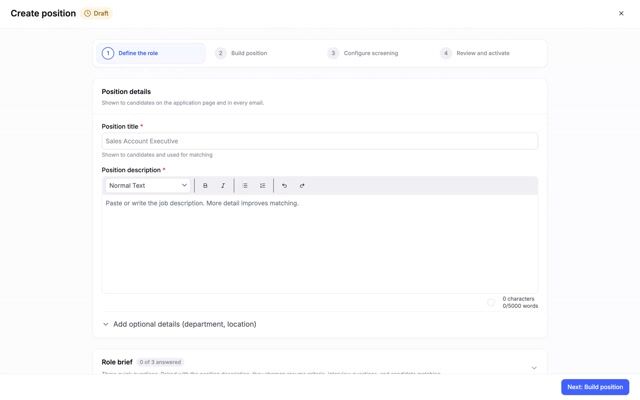
Truffle is an AI screening platform that combines one-way video interviews, talent assessments, and resume screening, so you can build a screening workflow around what actually matters for a role that draws lots of generic applications and has almost no built-in oversight once someone's hired.
Administrative assistant postings pull in volume because the title sounds broad and low-barrier, which means a lot of resumes that list the same software proficiencies without showing any judgment or follow-through behind them. Reading those applications one resume at a time isn't a plan, it's a bottleneck.
A workflow that fits a small business doing its own hiring:
- Resume screening first. Cut the obvious mismatches on relevant experience and tools before you spend time on anyone. This is where you deal with volume: a title this broad draws a wide range of applicants, which is manageable once you're not reading every resume yourself.
- A short one-way video interview, not a live panel round, for your first real look. Ask 2-3 of the scenario questions above, like the shared-inbox triage question or the confidential-information question, so you can hear how someone actually reasons through ambiguity and discretion, before you commit any live interview time.
- A short, practical skills check instead of a long take-home. Our free admin assistant assessment is built to be short and job-relevant: attention to detail, prioritization under competing deadlines, and confidentiality judgment, the kind of baseline skill this role needs on day one, without asking someone to burn an evening on a project.
- A real, live conversation only for the candidates who clear the first three steps. By the time you're on a call, you already know they can triage, communicate clearly, and clear a basic skills bar. The live conversation is for fit and working style, not for finding out for the first time whether they can do the job.
Our resume screening and one-way video interview tools handle the first two steps in one place, with AI that surfaces your strongest matches against the criteria you set. You review the evidence and decide. It doesn't pick for you.
3 sample questions to try for this role
A skills check only helps if it tests the judgment the job needs, not trivia about menu locations in Excel. These three come from our free admin assistant assessment question bank. Try them yourself before you decide what "job-ready" means for your opening.
1. You're scheduling a meeting requested by "Alicia Chen" for Thursday, April 18 at 2:30 PM ET. You draft a confirmation: "Hi Alisha, confirmed for Friday 4/18 at 2:30pm." What's wrong? Reveal answer
Best answer: the name is misspelled and the day of the week is wrong. "Alisha" instead of "Alicia," and "Friday" instead of "Thursday" for the 18th. Small mismatches like this create rework and quietly erode trust, especially with clients or partners on the other end. This is exactly the kind of error a busy candidate skims past.
2. It's 9:05 AM. Your manager needs a deck printed by 10:30. At 9:07, the CFO emails asking you to confirm today's 2 PM client call details. At 9:08, reception calls: a visitor has arrived early for a 9:30 interview. What's your first move? Reveal answer
Best answer: get the visitor seated and the interviewer notified, then confirm the print job's requirements. The visitor is the most time-sensitive, in-person problem, and a quick delegation (ask reception to seat them, confirm the interviewer is on the way) solves it without derailing everything else. Printing a deck due at 10:30 can wait a few minutes; a visitor standing awkwardly at reception can't.
3. The CEO's assistant asks you to "quickly" compile your director's travel dates for the next 60 days, but your director is in a client meeting and asked not to be interrupted unless urgent. What do you do? Reveal answer
Best answer: pull confirmed travel blocks from the calendar, label them clearly as calendar-confirmed, and offer to validate anything tentative after the meeting. This avoids interrupting the director over something that isn't urgent, while still being genuinely useful and honest about what's confirmed versus uncertain. Guessing, or interrupting a client meeting for a routine request, are both weaker moves.
The point isn't these three questions. It's that a short, job-relevant skills check like this tells you in twenty minutes what a resume and a friendly interview can hide: whether someone actually reaches for the right move under a little pressure. Inside Truffle, the same idea runs as a Situational Judgment assessment: you rank how you'd want each scenario handled, every applicant answers the same ones, and you see where each lands next to their resume and interview. You still make the call on who clears it.
Common hiring mistakes for this role
Screening for software proficiency instead of judgment. Almost every applicant will claim they're proficient in Microsoft Office or Google Workspace. That line tells you almost nothing about whether they'll follow through on a task without a reminder or handle a scheduling conflict with good judgment. Weight the scenario questions above it, not below it.
Not testing discretion with sensitive information. An administrative assistant sees HR, financial, and client details that most of the company never touches. Skipping a direct question about how they've handled confidential information leaves a real risk untested until it's already a problem.
Confusing this role with an executive assistant or a virtual assistant. These are genuinely different jobs with different skill emphases: an executive assistant manages one person's priorities closely, a virtual assistant is usually an outsourced contractor, and an administrative assistant supports a broader team on-site. Writing a job posting that blurs the three sets the wrong expectations for both you and the candidate.
Letting a generic-sounding title overwhelm you with volume. "Administrative assistant" reads as broad and low-barrier, which pulls in lots of applicants who list the same handful of software skills. Build a layered screen (resume, then a short one-way interview, then a skills check) so the list gets shorter before it reaches your calendar.
Not clarifying who this person reports to and what "urgent" means at your company. Early turnover in this role often traces back to a candidate discovering, after they start, that three different people expect to be their top priority with no agreed-upon order. Set that expectation in the interview, not after the first conflicting request lands.
What should your screening process look like?
Answer six quick questions about how you hire. We'll point you to the screening steps that fit, so you spend your time on the candidates worth a conversation.
What each result looks like
Start with resume screening
You're working through real volume, and the resume still carries signal. Score every resume against your criteria first, so a shortlist surfaces before you spend time on anyone.
- Resume screeningScore every resume against your criteria and surface your strongest matches first.
- One-way interviewsHear how candidates think on a recorded prompt, on their schedule and yours.
7-day free trial. No credit card required.
Lead with one-way interviews
Resumes look interchangeable and phone screens are eating your week. Let candidates answer a recorded prompt on their own time. You watch the moments that matter and decide who's worth a live round.
- One-way interviewsHear how candidates think on a recorded prompt, on their schedule and yours.
- Resume screeningScore every resume against your criteria and surface your strongest matches first.
7-day free trial. No credit card required.
Anchor on talent assessments
For these roles the work matters more than the paper. Put a role-calibrated assessment up front, so you see real, comparable evidence before you book a calendar slot.
- Talent assessmentsSee role-calibrated work before you spend a calendar slot on a live round.
- One-way interviewsHear how candidates think on a recorded prompt, on their schedule and yours.
7-day free trial. No credit card required.
Layer all three signals
Your hiring spans high volume and high stakes, so no single step covers it. Layer all three: score resumes first, hear candidates on a one-way interview, then confirm with an assessment. Each step narrows the field, and you make the call at every stage.
- Resume screeningScore every resume against your criteria and surface your strongest matches first.
- One-way interviewsHear how candidates think on a recorded prompt, on their schedule and yours.
- Talent assessmentsSee role-calibrated work before you spend a calendar slot on a live round.
7-day free trial. No credit card required.