Restaurant shift manager: job description, interview questions, and screening workflow
The obvious move is to promote your strongest server or line cook. Running a great station is not the same job, and the gap between them is exactly where this hire fails. Your best cook can still freeze the first time they have to discipline a friend, handle an irate table alone, or find coverage when someone no-shows at 5pm on a Friday. A resume, or even a great track record on your own floor, shows none of that. It shows they can execute. This role is about holding authority when the plan breaks and no one is coming to help. This guide is built to screen for decisiveness under live pressure, not for years on the line.
What a restaurant shift manager actually does at a small, independent restaurant
At a large chain, a shift manager works inside a system built by someone else: a training manual, a corporate scheduling tool, a district manager one phone call away. At an independent restaurant or a small local group, that system doesn't exist, or it's three pages the owner wrote themselves. The shift manager is often the only authority on the floor for four to eight hours at a time, with no one to escalate to but a phone call to an owner who's trying to stay out of the day-to-day.
The job is leadership under live conditions, not task execution. Taking an order, running food, and closing a register are things any trained team member can do. What the shift manager owns is everything that happens when the plan breaks: a cook calls out mid-rush, a table's meal comes out wrong twice, two servers are in a quiet argument by the pass. None of it is written down anywhere. It gets handled in the moment, by whoever's holding the keys.
The core responsibilities, in practice:
- Running the floor and the pass during the shift: staffing, pacing, and covering gaps in real time
- Handling customer complaints and escalations before they reach the owner
- Making the call when someone no-shows, calls out sick, or needs to leave early mid-shift
- Opening or closing procedures: cash handling, prep checks, and end-of-shift reporting
- Coaching and correcting team members in the moment, including friends and former peers
- Spotting and acting on food safety issues (temperature checks, cross-contamination, expired product) without waiting for someone else to catch it
At a single-location independent, this person is often also the de facto trainer for new hires and the one who decides whether a slow Tuesday is a good night to send someone home early. That's a different job than "supervise the shift," and it's worth naming clearly in the posting so candidates understand the level of judgment the role actually requires.
Job description you can post today
Copy this, then adjust the specifics (your hours, your team size, your service style) to match your restaurant.
Restaurant shift manager
[Restaurant name] is looking for a shift manager to run the floor when the owner isn't on-site. You'll be the person the team looks to when something goes wrong mid-service, so we need someone who stays level-headed and makes a call instead of waiting for permission.What you'll do
Run front and/or back of house during your shift, cover gaps when someone calls out, handle customer issues directly, coach the team in real time, and manage opening or closing procedures including cash and food safety checks. You'll report directly to the owner or general manager and flag anything that needs their attention.What we're looking for
Experience leading a small team under pressure, whether that's a restaurant, a retail floor, or another fast-paced customer-facing environment. Someone who can de-escalate an upset customer without pulling in the owner, and who'll make a staffing decision on the spot rather than let a shift run short-handed. Comfort with basic food safety practices; a food handler certification is a plus if you don't already have one, and we'll help you get it.Schedule
[Insert shift days and hours, e.g. Thursday-Sunday, 3pm-close, with occasional weekday coverage][Insert pay range and any tip credit or overtime structure that applies to this role, per your state's wage and salary transparency requirements]
10 interview questions, and what a good answer sounds like
1. Walk me through the last time you ran a full shift on your own. What made it hard?
You're checking whether they've actually held this level of responsibility before, not just worked a busy shift as a line cook or server. A strong answer names specific decisions they made: who they moved where, what they told the team, what they told a customer. A vague answer ("it's just busy, you handle it") suggests they've been present for pressure without owning the outcome.
2. It's 6:45 on a Friday and your line cook texts that they're not coming in. What do you do in the next ten minutes?
This is the no-show question, and it's the one that separates people who can lead from people who can only execute. A good answer moves fast: check who else can cover or come in, adjust the menu or pace if needed, and communicate the change to the team and to affected tables honestly. A weak answer either panics, tries to do the missing role themselves on top of their own, or waits for the owner to fix it.
3. A table sends a dish back twice and the guest is getting loud. What do you say and do?
Listen for de-escalation before problem-solving. A strong candidate goes to the table themselves, acknowledges the frustration without being defensive, and offers a concrete resolution (remake it, comp it, check in personally) before the guest has to ask. Someone who immediately blames the kitchen to the guest, or avoids the table altogether, is a flag.
4. Tell me about a time you had to correct or discipline someone you were also friendly with outside of work.
This tests whether they can actually hold the authority the role requires, which is often the hardest adjustment for someone stepping up from the team. A strong answer describes a direct, private, specific conversation. If they can't come up with a real example, or describe avoiding the conversation entirely, that's worth a follow-up question about how they'd handle it here.
5. What's something you'd rather delegate than do yourself, and what's something you'd never hand off?
You're testing for delegation instinct, which matters because a shift manager who tries to do every job themselves becomes the bottleneck the moment two things go wrong at once. A good answer names specific tasks and reasoning, not just "I'm good at delegating." Watch for candidates who can't imagine handing anything off. That usually means they'll burn out or bottleneck your busiest shifts.
6. What would you do if you noticed food sitting out of temp, or a prep item past its label date, five minutes before doors open?
This is your food safety and compliance check. The right answer is immediate and unambiguous: pull the item, log it, and adjust the prep plan, even if it slows things down. Someone who hesitates, or suggests they'd let it slide "just this once" to make service on time, is telling you how they'll actually behave under pressure later.
7. How would you handle two team members who are clearly not getting along during a shift?
You want to see whether they intervene early or let it fester. A strong answer separates the immediate fix (keep service moving, split them up if needed) from the follow-up (a private conversation with each, after the shift). Someone who says they'd "let them sort it out" or ignore it until it becomes a bigger problem is a risk on a small team where tension spreads fast.
8. Describe how you'd train a new hire on their first Friday night shift.
Listen for structure: do they have a plan (shadow first, small tasks, check in at set points) or do they throw someone in and hope it works out. This role often is the training program at a small restaurant, so someone with no instinct for how to onboard a new person under real volume will struggle to build a team that sticks.
9. What's your approach to closing out a register and reconciling the night's numbers?
You're checking for basic financial responsibility and honesty under a process that's easy to shortcut when you're tired at 1am. A good answer describes an actual routine: counting down, matching receipts, flagging discrepancies immediately rather than "fixing" them quietly. Vagueness here is worth probing further before you hand someone the keys and the drawer.
10. Why this role, and not a general manager role somewhere else?
This surfaces whether they understand the scope of what you're actually hiring for. Candidates who talk about wanting to "run the whole restaurant" may be picturing GM-level ownership over P&L and hiring, which isn't this job. Candidates who talk specifically about running a great shift, developing the people on it, and being the steady hand when things go sideways are picturing the right role.
A scorecard you can score candidates against
Ten questions only help if everyone interviewing is listening for the same thing. Score every candidate on the same six signals, so you are comparing evidence instead of gut feel. Copy this into a doc and fill in a row per candidate.
| What you're scoring | Strong signal | Weak signal |
|---|---|---|
| Real ownership of a shift | Names specific decisions they made running a shift: who they moved where, what they told the team and the guests | "It's just busy, you handle it." Present for pressure without owning the outcome |
| The no-show call | Moves fast: checks who can cover, adjusts pace or menu, tells the team and tables honestly | Panics, tries to work the missing role themselves, or waits for the owner to fix it |
| De-escalation | Goes to the loud table themselves, acknowledges the frustration, offers a concrete fix before being asked | Blames the kitchen to the guest, or avoids the table altogether |
| Holding authority | Can describe a direct, private conversation correcting someone they were friendly with | No example, or a pattern of avoiding the conversation entirely |
| Delegation instinct | Names specific tasks they would hand off and one they never would, with reasons | Cannot imagine handing anything off, the profile that bottlenecks a busy shift |
| Food safety judgment | Pulls the out-of-temp or expired item, logs it, adjusts the plan, even if it slows service | Hesitates, or would let it slide "just this once" to make service on time |
How to screen restaurant shift manager candidates without losing a week to it
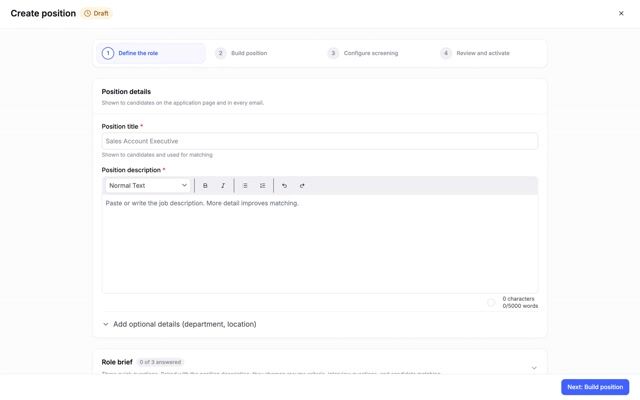
Truffle is an AI screening platform that combines resume screening, one-way video interviews, and talent assessments, so you can build a process around what this role actually rewards: judgment under pressure, not just restaurant vocabulary on a resume.
For a leadership role like this one, here's a workflow that fits a single-location or small-group operation:
- Resume screening as a light first pass. You're not filtering for restaurant experience specifically. You're filtering out candidates with no evidence of leading or supervising anyone, and flagging the ones with real team-lead experience, restaurant or otherwise, for a closer look.
- A one-way video interview built around the pressure-test questions. Ask 2-3 of the scenario questions above, especially the no-show question and the upset-customer question, on video before you spend an in-person slot on someone. You'll see how they actually think on their feet and how they communicate under a version of real pressure, which a resume can't show you at all.
- A leadership assessment for your shortlist. Have finalists work through our free leadership skills questionnaire before the final interview. It gives you a structured way to talk through delegation, decision-making, and how they handle conflict, so your last conversation is a discussion about specific competencies instead of a generic gut check.
If you're running a real applicant pool for this role, our resume screening and one-way video interview tools handle the first two steps in one place. AI surfaces your strongest matches against the criteria you set for the role. You review the evidence and make the call yourself.
What the leadership skills questionnaire surfaces for this role
Our free leadership skills questionnaire is a good fit for a shift manager, but it works differently from a right-or-wrong skills test. It rates observable leadership behaviors across competencies rather than scoring a single exam. Three of those competencies decide whether someone can actually run your floor.
Decision-making and judgment. A strong signal is someone who makes a timely call with the information they have and communicates it clearly, the instinct behind handling a 6:45 no-show without freezing. A weak signal is thrash and delay, or waiting for the owner before making any call at all.
Delegation and empowerment. A strong signal is distributing work with clear boundaries so the shift does not bottleneck on one person. A weak signal is trying to do every job personally, which is exactly how a shift manager becomes the bottleneck the moment two things break at once.
Conflict management and candor. A strong signal is surfacing tension early and having the direct, private conversation, including with a friend or former peer. A weak signal is avoiding the conversation and letting friction fester on a small team where it spreads fast.
The questionnaire gives you these tendencies as structured signal to weigh against the expectations you set for the role. You still make the call, and pairing it with the no-show and upset-customer questions above gives you more than one read on the same person.
Common hiring mistakes for this role
Treating this like any other hourly opening. A lot of independent restaurants post a shift manager role the same way they'd post a server or host opening, and screen it the same way too: first resume in, first interview, first offer. But you're hiring for someone to hold authority and make decisions alone, not just execute tasks, and a process built for high-volume hourly hiring won't catch whether someone can actually run a shift.
Underestimating turnover and flaky candidates in this labor pool. Restaurant hiring runs on ghosted interviews and no-shows on day one more than almost any other industry. That reality doesn't disappear because the role has "manager" in the title. Build in a short paid trial shift or a working interview where you can, and don't assume a confirmed start date is a guaranteed one.
Sourcing only where you'd look for a corporate hire. This workforce mostly isn't on LinkedIn. If your only posting is a generic job board, you're missing the walk-ins, Indeed applicants, and word-of-mouth referrals from your own staff, who are often your best source for someone who already knows what the job is really like.
Writing a posting that oversells the job. Hourly and shift-lead candidates in this industry have been burned before by postings that make the pay or the hours sound better than the reality once overtime, scheduling, and the actual pace of the floor sets in. Be specific and honest about the schedule, the pace, and what the role demands. A posting that undersells slightly and delivers accurately builds more trust, and less early turnover, than one that oversells and disappoints in week two.
Refilling the same seat without a repeatable process. If you're building a new job description and a new interview script every time this role opens, you're spending hours on something you'll do again in six months. A saved posting, a short set of scenario questions, and a screening workflow you reuse turns a burnout task into a ten-minute job the next time someone gives notice.
Filling the frontline roles this shift lead will supervise? See our restaurant server and line cook hiring guides for job descriptions, role-specific interview questions, and screening workflows sized for the same small restaurant. Hiring the role this shift manager reports to, the person who owns the full P&L and every shift, not just one block of hours? See our restaurant general manager hiring guide.
What should your screening process look like?
Answer six quick questions about how you hire. We'll point you to the screening steps that fit, so you spend your time on the candidates worth a conversation.
What each result looks like
Start with resume screening
You're working through real volume, and the resume still carries signal. Score every resume against your criteria first, so a shortlist surfaces before you spend time on anyone.
- Resume screeningScore every resume against your criteria and surface your strongest matches first.
- One-way interviewsHear how candidates think on a recorded prompt, on their schedule and yours.
7-day free trial. No credit card required.
Lead with one-way interviews
Resumes look interchangeable and phone screens are eating your week. Let candidates answer a recorded prompt on their own time. You watch the moments that matter and decide who's worth a live round.
- One-way interviewsHear how candidates think on a recorded prompt, on their schedule and yours.
- Resume screeningScore every resume against your criteria and surface your strongest matches first.
7-day free trial. No credit card required.
Anchor on talent assessments
For these roles the work matters more than the paper. Put a role-calibrated assessment up front, so you see real, comparable evidence before you book a calendar slot.
- Talent assessmentsSee role-calibrated work before you spend a calendar slot on a live round.
- One-way interviewsHear how candidates think on a recorded prompt, on their schedule and yours.
7-day free trial. No credit card required.
Layer all three signals
Your hiring spans high volume and high stakes, so no single step covers it. Layer all three: score resumes first, hear candidates on a one-way interview, then confirm with an assessment. Each step narrows the field, and you make the call at every stage.
- Resume screeningScore every resume against your criteria and surface your strongest matches first.
- One-way interviewsHear how candidates think on a recorded prompt, on their schedule and yours.
- Talent assessmentsSee role-calibrated work before you spend a calendar slot on a live round.
7-day free trial. No credit card required.