Customer success manager: job description, interview questions, and screening workflow
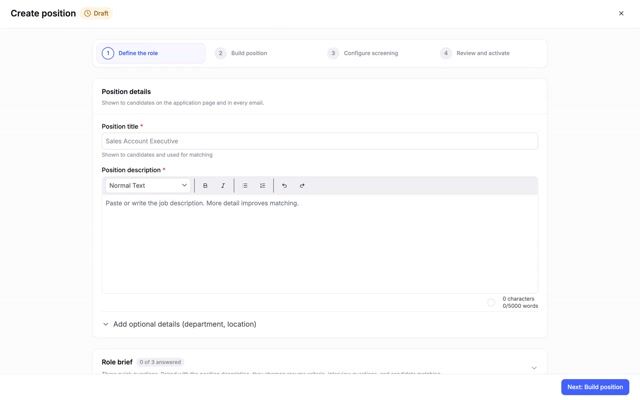
For a lot of small software and subscription businesses, the customer success manager is the first customer-facing hire beyond the founder, and a wrong hire here doesn't fail loudly. It fails quietly. Onboarding gets a little slower, check-ins get skipped, a champion goes quiet and nobody notices, and three months later a handful of renewals don't happen, with no single moment you can point to as the cause. A resume full of the right CS vocabulary can't tell you whether someone will actually catch that drift before it costs you the account. This guide is built to screen for that directly: the job description, the interview questions, a scorecard, and a screening workflow, in one structured place.
What a customer success manager actually does at a small business
At a company with a mature CS org, a CSM works inside a system: a health-scoring tool flags risk automatically, a renewals or sales team owns the commercial conversation, a support team fields tickets, and there's a playbook for onboarding, QBRs, and escalation. The CSM executes inside guardrails someone else built.
At a small, founder-led business, there's usually no system and no playbook, just the CSM. They're often the one answering support tickets and running onboarding and watching for churn risk and quietly passing product feedback back to the founder, all at once, with no health-scoring tool doing the noticing for them. If an account is drifting, they have to spot it themselves, from raw usage and gut feel, because nobody built a dashboard that will flag it for them.
The core responsibilities, in practice:
- Owning onboarding for new accounts, since there's usually no separate onboarding team to hand it off to
- Answering support requests directly, at least for the accounts on their book, alongside everything else
- Watching for early signs of churn risk (usage dropping, a champion going quiet, support tickets spiking) without a tool that surfaces it automatically
- Running renewal conversations and owning whether an account actually renews, not just staying friendly with the customer
- Building the first version of a health check, a QBR cadence, or an onboarding checklist, since none of it exists yet
- Passing product feedback back to the founder in a way that's specific and useful, not just a list of complaints
- Deciding, without a manager next to them, when something is worth escalating and when it's theirs to handle
This is a distinct role from a customer service representative, even though the two overlap at a small company. A CSR is reactive: a customer has a problem, they resolve it, on to the next ticket. A CSM owns the relationship and the renewal proactively, which means going looking for problems before the customer reports one. If the role you're actually hiring is closer to answering inbound tickets with no renewal ownership attached, our customer service representative hiring guide is the better fit.
Job description you can post today
Copy this, then adjust the specifics (your product, your account count, your pay) to match your business.
Customer success manager
[Company name] is looking for a customer success manager to own our customer relationships from onboarding through renewal. You'll be the main point of contact for a book of accounts, and you'll be building a lot of our CS process from scratch, not stepping into a fully built playbook.What you'll do
Own onboarding for new customers, getting them to real value quickly. Manage a book of accounts, watching usage and engagement for early signs of risk instead of waiting for a customer to complain. Handle support requests for your accounts directly. Run renewal conversations and own the outcome, not just the relationship. Build the first versions of our onboarding checklist, health check, and check-in cadence. Bring product feedback back to the team in a way that's specific and actionable, not just a list of complaints.What we're looking for
Real comfort working without a playbook or a dedicated CS team to lean on. A track record of proactively catching a problem before a customer had to raise it. Direct experience owning a renewal outcome, not just a support relationship. Clear, calm written and verbal communication, including when the message isn't what the customer wants to hear. Comfort juggling reactive support work and proactive account management in the same day.Schedule
[Insert hours, e.g. standard business hours with occasional flexibility for customer time zones][Insert pay, per your company's policy and any applicable state salary transparency requirements]
10 interview questions, and what a good answer sounds like
1. Walk me through the last time you had a customer on the phone or on a call who was genuinely angry and at risk of leaving. What did you actually say?
You want a specific, sequenced memory, not a general philosophy about staying calm. A strong answer names what the customer was actually upset about, how they responded in the moment, and what happened after the call ended. "I just stay calm and listen" without any real detail is the answer of someone describing an instinct they haven't actually tested under pressure.
2. Tell me about an account where you noticed something was wrong before the customer said anything. What tipped you off, and what did you do?
This is the core proactive-instinct question for this role. A strong answer names a specific, concrete signal, usage dropping, a champion going quiet, a key contact leaving, and describes a real action they took, not just a note they made to themselves. A candidate who can't produce a real example, or who describes waiting for the customer to eventually say something, is telling you they're reactive, no matter how they describe their general approach to the job.
3. You've got a support ticket queue building up and it's also the day you're supposed to run three proactive check-in calls. How do you actually decide what happens first?
Listen for a real triage method, not just "I try to do both." A strong answer weighs actual urgency and account risk, not just whichever task feels most urgent in the moment, and is honest about what gets pushed when something has to give. A weak answer either claims they'd never fall behind or has no real method for choosing between two legitimate demands on their time.
4. Explain a real technical limitation of a product you've supported to someone who isn't technical, the way you'd actually explain it to a customer.
This tests whether they can translate, not just whether they know the product. A strong answer is plain, specific, and doesn't hide behind jargon or a vague "it's a known issue." A candidate who gets defensive, over-explains the engineering reason, or talks past a non-technical listener is showing you exactly how that conversation will go with your customers.
5. Tell me about a time you had to say no to a customer request. How did you say it, and how did the relationship hold up afterward?
You're checking whether they can hold a line without torching the relationship. A strong answer explains the no plainly, offers whatever real alternative existed, and describes the relationship surviving it, sometimes stronger for the honesty. A candidate who says they'd probably find a way to say yes to keep the customer happy is telling you they'll cave on the next hard ask too.
6. Describe a job where you had no CS team, no playbook, and no health-scoring tool. How did you keep your accounts on track anyway?
This is the small-business reality check. A strong answer describes building something themselves, a simple spreadsheet, a manual check-in cadence, a habit of skimming usage data weekly, rather than assuming a tool or a teammate will always be there to catch what they miss. A candidate who's only ever worked inside a mature CS org might still be a good hire, but they should be honest about that gap rather than assume the transition will be easy.
7. Tell me about a time you brought product feedback back to a founder or a product team. What did you say, and how was it received?
A CSM who only relays complaints verbatim isn't doing the full job. A strong answer describes translating what several customers were actually asking for into something specific and actionable, not just forwarding a frustrated email. Listen for whether they prioritized the feedback or just dumped everything they heard. A candidate who can't name a real example may be used to being a pass-through rather than a filter.
8. Tell me about an account you saved, and one you lost. What did you learn from each?
Every CSM who's actually done the job has both stories. A strong answer is specific about what they noticed, what they tried, and, for the account they lost, what they'd do differently now. A candidate who only has a save story, or who blames the lost account entirely on the product or the price, isn't being fully honest with you, and neither answer is a great sign for a role built on judgment under real stakes.
9. You've got 20 accounts and 2 hours today to spend on them. Walk me through how you'd actually spend that time.
This tests real prioritization, not a general work ethic. A strong answer describes a method: which accounts are near renewal, which show risk signals, which are quiet and probably fine for now, and moves through that list with reasoning attached. A weak answer either has no system, or would try to touch all 20 accounts equally regardless of actual risk.
10. Why do you want an early, scrappy CS role instead of joining a company with a mature customer success team already in place?
This checks whether they actually understand what they're signing up for. A strong answer names something real: they want to build the process instead of executing someone else's, they like the ownership, they're energized by ambiguity rather than anxious about it. A candidate who can't give a genuine reason, or who seems to be picturing the support and tooling of a bigger team, may be underprepared for how different this job actually is.
A scorecard you can score candidates against
Ten questions only help if everyone interviewing scores the same signals. Use this instead of comparing gut feelings about who seemed most relationship-oriented.
| What you're scoring | Strong signal | Weak signal |
|---|---|---|
| Composure with an at-risk customer | Specific, sequenced story of de-escalating a genuinely angry customer, with a real outcome named | General claim of "staying calm" with no concrete detail |
| Proactive risk detection | Names a specific signal they noticed before the customer complained, and a real action taken | Can't produce a real example, or describes waiting for the customer to raise it first |
| Prioritization under competing demands | Describes a real method for weighing account risk and urgency, honest about tradeoffs made | Claims they'd never fall behind, or has no real method for choosing |
| Holding a line | Explains a real no, offers an alternative, describes the relationship surviving it | Says they'd probably find a way to say yes to avoid the friction |
| Comfort without a playbook | Describes building their own system from scratch in a past role, without assuming a tool will catch what they miss | Only describes working inside a mature CS org with existing tooling and process |
| Useful product feedback | Describes translating customer input into something specific and prioritized | Describes only forwarding complaints verbatim, with no filtering or synthesis |
How to screen customer success manager candidates without losing a week to it
Truffle is an AI screening platform that combines resume screening, one-way video interviews, and talent assessments, which matters here because a CSM posting at a small software company pulls a mix of genuinely proactive operators and candidates whose resumes are full of CS vocabulary but whose actual experience is closer to reactive support.
A workflow sized for that reality, without burning your week:
- Resume screening first, looking past the job title. Look for specific account counts, whether they owned renewal outcomes or just the relationship, and whether they've worked somewhere without a mature CS org backing them up. Hiring software built for founder-led startups is designed around exactly this kind of scope, so you're not reading every application by hand.
- A one-way video interview before you schedule anyone live. Ask 2-3 of the scenario questions above, especially the at-risk account and the account-you-lost questions. A one-way interview shows you how someone explains a real judgment call, on their own time, before you spend an hour on a live conversation.
- A customer service assessment to check the guest-facing side. A resume can list account counts. It can't show you how someone actually handles a tense customer interaction. Our customer service assessment gives every candidate the same scenario-based test, scored the same way.
- A live conversation focused on the prioritization and playbook-free questions. By the time you're on a call, you already know they can handle a tense customer and describe a real save. The live conversation is where you dig into how they'd actually build your process from scratch.
- A reference check that asks specifically about renewal outcomes. Ask a past manager whether this person's accounts actually renewed, not just whether customers liked them.
AI surfaces the resume matches, video responses, and assessment scores side by side, so you're not piecing together who's worth a live conversation from memory. It doesn't decide who gets the job. You review the evidence and make the call. For the fuller argument, see our guide on how to hire a customer success manager who actually retains customers.
3 questions from the skills check we'd actually run for this role
A skills check for this role only means something if it tests real judgment under renewal-level stakes, not just a single friendly interaction. These three are adapted from Truffle's customer service assessment, scaled to the kind of situations a CSM actually runs into when an account is on the line. Try them yourself before you decide what "qualified" looks like for your opening.
1. An account's logins have dropped by half over the last month, renewal is in six weeks, and the customer hasn't said a word. What do you do first? Reveal answer
Best answer: reach out proactively, before renewal pressure forces the conversation. A strong response reaches out with a specific, low-pressure check-in rather than a generic "just checking in," names something concrete they've noticed (without sounding like surveillance), and tries to surface whether something changed internally, like a champion leaving or a shift in priorities. Waiting until renewal week to raise it, or waiting for the customer to bring it up first, is exactly the reactive instinct this scenario is built to catch.
2. A long-time customer, one of your biggest accounts, asks for a custom feature that's not on your roadmap and won't be for a long time. They're framing it as a condition of renewing. What do you say? Reveal answer
Best answer: be honest about the roadmap, and look for a real path forward that doesn't involve a false promise. A strong response explains plainly that the feature isn't planned, digs into the underlying problem the customer is actually trying to solve, and looks for a workaround or partial solution instead of either promising something that won't happen or dismissing the request outright. Promising a timeline the team hasn't committed to, just to save the renewal in the moment, is the failure this scenario is designed to surface.
3. You manage 25 accounts alone, with no health-scoring tool. How would you actually keep track of which ones need attention this week? Reveal answer
Best answer: describe a real, concrete system, even a simple one. A strong response names something specific: a spreadsheet with renewal dates and a manual risk flag, a weekly habit of skimming usage data, a rule for how long is too long since the last contact. The point isn't sophistication. It's whether the candidate has actually thought about this problem and built something, versus assuming a tool will eventually exist to solve it for them.
The point isn't these three scenarios specifically. It's that a structured skills check like this surfaces real proactive judgment under renewal-level stakes, which is a far harder thing to fake in an interview than a resume line full of CS vocabulary. Truffle's AI scores and surfaces the results against the bar you set for the role. You still make the call on who clears it.
Common hiring mistakes for this role
Hiring for support-ticket competence and assuming renewal ownership comes with the title. Answering tickets patiently is a real skill, but it's not the same skill as noticing an account drifting toward churn and doing something about it before the renewal conversation. Test both directly instead of assuming a good ticket answerer will also be a good account owner.
No real test of how they handle an at-risk account. A friendly interview conversation tells you almost nothing about whether someone will actually catch a quiet account before it's gone. If you skip the scenario questions and the skills check, you're hiring on charm and hoping the renewal instincts show up later.
Assuming enterprise CS experience transfers directly to a scrappy small-team environment. Someone who's only ever worked with a mature playbook, a health-scoring tool, and a dedicated renewals team may struggle the first time they have to build all of that themselves for 20 accounts with no support. That doesn't disqualify them, but it's worth testing directly, not assuming.
Not checking whether they can surface product feedback usefully. A CSM who only relays customer complaints verbatim isn't giving you anything you couldn't have gotten from a support inbox. The candidates worth hiring can translate scattered feedback into something specific and prioritized, and that's worth a direct question, not an assumption based on their title.
What should your screening process look like?
Answer six quick questions about how you hire. We'll point you to the screening steps that fit, so you spend your time on the candidates worth a conversation.
What each result looks like
Start with resume screening
You're working through real volume, and the resume still carries signal. Score every resume against your criteria first, so a shortlist surfaces before you spend time on anyone.
- Resume screeningScore every resume against your criteria and surface your strongest matches first.
- One-way interviewsHear how candidates think on a recorded prompt, on their schedule and yours.
7-day free trial. No credit card required.
Lead with one-way interviews
Resumes look interchangeable and phone screens are eating your week. Let candidates answer a recorded prompt on their own time. You watch the moments that matter and decide who's worth a live round.
- One-way interviewsHear how candidates think on a recorded prompt, on their schedule and yours.
- Resume screeningScore every resume against your criteria and surface your strongest matches first.
7-day free trial. No credit card required.
Anchor on talent assessments
For these roles the work matters more than the paper. Put a role-calibrated assessment up front, so you see real, comparable evidence before you book a calendar slot.
- Talent assessmentsSee role-calibrated work before you spend a calendar slot on a live round.
- One-way interviewsHear how candidates think on a recorded prompt, on their schedule and yours.
7-day free trial. No credit card required.
Layer all three signals
Your hiring spans high volume and high stakes, so no single step covers it. Layer all three: score resumes first, hear candidates on a one-way interview, then confirm with an assessment. Each step narrows the field, and you make the call at every stage.
- Resume screeningScore every resume against your criteria and surface your strongest matches first.
- One-way interviewsHear how candidates think on a recorded prompt, on their schedule and yours.
- Talent assessmentsSee role-calibrated work before you spend a calendar slot on a live round.
7-day free trial. No credit card required.