Retail sales associate: job description, interview questions, and screening workflow
The usual advice is to hire for retail experience. At a small store, that's the least useful line on the resume. Product knowledge and the register take a week to teach on your own floor. What you can't teach, and can't see on paper, is whether someone stays warm with a customer who's being difficult, reads what a browser actually came in for, and shows up for the Saturday shift they promised. Those three things decide whether this hire works out, and none of them survive contact with a resume. This guide screens for them instead of for a work history.
What a retail sales associate actually does at a small retail store
At a big-box or national chain, a sales associate is one of dozens of employees spread across departments, following a script written by corporate, backed by a loss prevention team, a regional manager, and a training program that runs the same way in every location. At a small independent store, the associate on the floor is often the only person a customer talks to during their entire visit. There's no department to hand a hard question to, no regional manager to call, and no script. Whatever the associate says and does is what the customer walks away thinking about your store.
That's a different job than the one national retailers hire for. Your associate isn't just working a shift. They're representing the shop, in a way that directly shapes whether a customer buys something, comes back, or tells a friend. Product knowledge isn't a nice-to-have, it's the difference between a browser and a sale, since you don't have the volume or the margin to treat every visit as a wash. And because your staff is small, one unreliable person doesn't just create a gap, it can leave the floor uncovered on a Saturday.
A sales associate is also a broader role than a cashier. A cashier's job centers on the register: accurate transactions and a fast, friendly checkout. A sales associate does that too, often, but the core of the job is everything around it: approaching customers, understanding what they're looking for, knowing the product well enough to make a real recommendation, and representing the brand on the floor. If the role you're hiring for is register-only, treat it as a narrower hire and see cashier interview questions for that specific screen.
The day-to-day responsibilities, in practice:
- Greeting customers and reading what they actually need, rather than reciting a fixed pitch
- Knowing the product well enough to answer real questions and recommend the right item, not just the one closest to the register
- Upselling and cross-selling where it genuinely fits the customer, without turning every interaction into a pitch
- Operating the register accurately, handling cash, card, and returns without discrepancies
- Restocking shelves, straightening displays, and keeping the floor looking like a store people want to shop in
- Handling a busy stretch alone, when it's just them on the floor and a line forming
- Representing your store's tone and standards, since for many customers this person is the only interaction they have with your business
- Flagging shrink, damaged stock, or pricing issues to you before they become a bigger problem
You're not hiring someone to stand near the merchandise. You're hiring the person who determines whether a walk-in becomes a sale and a repeat customer. Hire through that lens.
Job description you can post today
Copy this, then fill in the specifics (your hours, your product category, your pay) to match your store.
Retail sales associate
[Store name] is looking for a retail sales associate to join our team. We're an independent [type of store, e.g. boutique, hardware store, gift shop], not a chain, and we're looking for someone who genuinely enjoys helping customers find the right thing.What you'll do
Greet and help customers on the floor, learn our product well enough to make real recommendations, operate the register, restock and merchandise the floor, and help cover busy periods including weekends.What we're looking for
Someone friendly and reliable who shows up on time and follows through on their shifts. Comfortable talking to strangers and handling a busy stretch without losing their composure. Prior retail experience is a plus, but not required. We'll train you on the product.Schedule
[Insert days and hours, e.g. Thursday-Monday, including weekend and holiday shifts]Pay
[Insert pay, per your company's policy and any applicable state salary transparency requirements]
10 interview questions, and what a good answer sounds like
1. Tell me about a time you dealt with a difficult or upset customer. What did you do?
This is the scenario question that matters most for a customer-facing floor role. A strong answer stays calm in the retelling, describes listening to the actual complaint before responding, and lands on a concrete resolution, not just "I apologized." A weak answer gets defensive even in the retelling, blames the customer, or can't come up with a real example at all, which is itself a signal for someone claiming retail experience.
2. How do you recommend an additional item to a customer without it feeling like a pitch?
You're checking whether they understand the difference between upselling that serves the customer and upselling that annoys them. A strong answer ties the recommendation to something the customer actually needs, "they were buying the jacket, so I mentioned the matching gloves since it's been cold." A weak answer describes pushing whatever's on promotion regardless of fit, or says they don't really do that, which leaves real revenue on the table.
3. This role includes weekend and holiday shifts. Walk me through your actual availability.
Ask this early and get specifics, not a general "yes I'm flexible." A strong answer names real constraints upfront, like a class on Tuesday nights or a standing commitment every other Sunday, so you know exactly what you're working with. A vague "I'm pretty open" that turns into a string of declined shifts once they start is one of the most common ways this hire goes wrong, since retail schedules run on weekends and holidays, not around them.
4. It's a busy Saturday and you're the only one on the floor. Walk me through how you handle it.
Small shops don't always have backup on the floor, so this tests real judgment under pressure. A strong answer describes prioritizing: acknowledging every customer even briefly so no one feels ignored, handling the register queue without letting the floor go empty, and knowing when to ask a customer to wait a moment versus rushing them. A weak answer has no real plan, or assumes there's always someone else around to help.
5. Tell me about a time you noticed a discrepancy at the register, cash short, an item scanned wrong, anything like that. What did you do?
Cash handling is a trust question, and how someone talks about a mistake tells you more than whether a mistake happened at all. A strong answer owns the discrepancy honestly, describes flagging it right away rather than hoping it goes unnoticed, and shows they understand why accuracy matters at a small store where there's no separate loss prevention team. A weak answer minimizes it, or gets uncomfortable and evasive when you ask a natural follow-up.
6. How do you go about learning a new product line quickly?
At a small store, you don't have a multi-week corporate training program, so you need someone who picks things up fast on the floor. A strong answer names a real method: asking questions, handling the product themselves, watching how a coworker talks about it, testing what they've learned on real customers. A weak answer is passive, assuming knowledge will just arrive with time on the job.
7. Describe a time you had to lean on a coworker to get through a shift, or cover for one.
Small staffs run on a handful of people who need to trust each other, not a large team that absorbs one weak link. A strong answer shows they pitch in without being asked and communicate clearly when they need help themselves. A weak answer treats teamwork as someone else's job, or can't describe a specific moment where they actually did it.
8. Tell me about a return or exchange you handled that the customer wasn't happy about.
Returns are one of the most common friction points in retail, and how someone handles them affects whether an unhappy customer stays a customer. A strong answer follows a clear process, explains the policy calmly, and looks for a fair resolution within it. A weak answer either caves on every policy to avoid conflict, or gets rigid and adversarial with a paying customer.
9. What would you do if you were mid-conversation with one customer and another one clearly needed help?
This tests real floor instincts, since a small shop rarely has enough staff to give every customer undivided attention. A strong answer acknowledges the second customer briefly, "I'll be right with you," rather than ignoring them or abruptly dropping the first conversation. A weak answer picks one extreme, fully ignore one customer or awkwardly abandon the other, with no sense of how to balance both.
10. Why retail, and why this kind of store specifically?
Turnover is the defining challenge of this role, so it's worth spending a question on genuine interest rather than assuming everyone applying wants to be here. A strong answer names something specific, an interest in the product category, enjoying the pace, wanting steady hours, that suggests they'll actually stick around. A generic "I need a job" answer isn't disqualifying on its own, but paired with vague availability or a thin work history, it's worth weighing carefully.
A scorecard you can score candidates against
Ten questions only help if everyone talking to candidates is listening for the same thing. Score every candidate on the same six signals, so you're weighing evidence instead of six different gut feelings. Copy this into a doc and fill in a row per candidate.
| What you're scoring | Strong signal | Weak signal |
|---|---|---|
| Staying calm with a difficult customer | Retells a hard interaction without getting defensive, listens to the complaint before responding, lands on a concrete fix | Blames the customer even in the retelling, or can't produce a real example |
| Needs-based selling | Ties a recommendation to what the customer actually needs, like gloves with the winter jacket | Pushes whatever's on promotion regardless of fit, or says they don't really sell |
| Availability honesty | Names real constraints upfront: specific days, a standing commitment, a class night | Vague "I'm pretty open" that turns into a string of declined weekend shifts |
| Solo floor judgment | Prioritizes under pressure: acknowledges every customer, keeps the register moving, knows when to ask someone to wait a moment | Has no real plan, or assumes there's always someone else on the floor to help |
| Cash-handling honesty | Owns a register discrepancy, flags it right away, understands why accuracy matters with no separate loss-prevention team | Minimizes it, or gets evasive when you ask a natural follow-up |
| Reason to stay | Names something specific: the product category, the pace, steady hours they actually want | "I just need a job," paired with vague availability and a thin work history |
How to screen retail sales associate candidates without losing a week to it
Retail sales associate roles pull one of the highest volumes of applicants of any small-business hire, and the quality is uneven. A weekend post can bring in a stack of applications by Monday morning, most from people who apply to a dozen jobs a day and won't answer when you call. Whoever is doing that screening, usually you, burns hours reading resumes for a role that resumes barely predict.
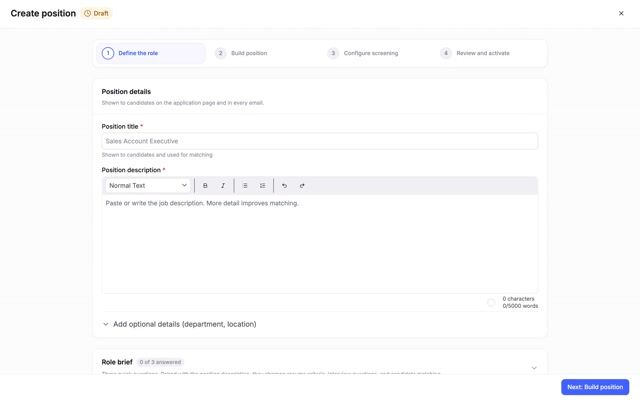
Truffle is an AI screening platform that combines resume screening, one-way video interviews, and talent assessments, built for exactly this kind of high-volume, no-recruiter hiring.
A workflow that fits a small independent store:
- Ask availability first, before anything else. Since this role runs on weekend and holiday coverage, a quick qualification question on availability filters out a large share of mismatches before you spend any more time on an application.
- A short one-way video interview for everyone who clears availability. This is a customer-facing role, so seeing and hearing how someone actually communicates matters more than it does for a back-office hire. Truffle's one-way video interview software lets candidates record answers to 2-3 of the questions above on their own time, so you see real communication style without booking a call for every applicant.
- A customer service assessment for anyone who clears the video step. Truffle's customer service assessment gives you a structured read on how a candidate handles a difficult customer or a judgment call, before you find out live on your floor.
- Let resume screening handle the first cut on volume. If a posting brings in a large stack of applicants, resume screening narrows the pile against the basics (location, availability, relevant experience) before a human reads anything.
- Then a short in-person conversation or floor trial for finalists only. Save your in-person time for candidates who've already cleared availability, communicated well on video, and shown reasonable judgment on the assessment.
AI surfaces the evidence. You review it and make the call. None of these steps decide who you hire, they just make sure the person you're deciding on is real, available, and worth the conversation. If you want more general interview prep across retail roles beyond this one, see retail interview questions, or check retail hiring software for how this fits into hiring across your whole store.
3 questions from the skills check we'd actually run for this role
A skills check only helps if it tests the judgment the floor needs, not trivia. These three are pulled straight from Truffle's customer service assessment, the one we'd point you to for this role. They're the kind of scenario that separates someone who talks well in an interview from someone who handles a real customer well. Try them yourself before you decide what "floor-ready" means for your store.
1. A customer says their order was supposed to arrive yesterday, they're furious, and they say they'll never buy from you again. It turns out to be a carrier delay, and it's now due tomorrow. What do you do first? Reveal answer
Best answer: acknowledge the frustration, confirm the order details, share the updated timing, and offer a reasonable option within your policy. Jumping straight to a full refund trains costly behavior, and "it's the carrier's fault, not ours" just escalates an already-angry person. On a small store's floor, this same instinct is what keeps an upset customer from becoming a one-star review.
2. A customer wants a refund 10 days past your return window. They say they never used the item, but you can see that they did. How do you handle it? Reveal answer
Best answer: explain the policy, reference what you can see neutrally, offer a fair alternative like store credit, and escalate only if there's a real exception path. Caving on every return bleeds margin a small store can't spare. Flatly accusing the customer of lying loses them for good. Returns are the highest-friction moment in retail, and this is exactly the judgment you're hiring for.
3. A customer is swearing at you repeatedly. What's the right move? Reveal answer
Best answer: set a respectful boundary, refocus on resolving the problem, and warn that you'll end the interaction per policy if it continues. Matching their intensity or dropping the interaction with no explanation both make it worse. At a small store, this associate is often the only person in the room, so holding a boundary without escalating is most of the job.
The point isn't these three questions. It's that a short, job-relevant skills check tells you in a few minutes what a friendly interview can hide: whether someone reaches for the right move when a customer is upset. Truffle's AI scores and surfaces the results against the bar you set. You still make the call on who clears it.
Common hiring mistakes for this role
Being vague about weekend and holiday availability until after the offer. This role runs on the shifts other jobs try to avoid. If you're not explicit about weekend and holiday expectations in the posting and the first conversation, you'll find out about the mismatch after training someone, not before.
Sourcing only where you'd look for a salaried hire. This workforce mostly isn't building a LinkedIn presence. Retail candidates apply through Indeed, walk in with a resume in hand, or hear about the opening from someone who already works for you. A posting strategy built for professional hiring misses most of your actual applicant pool.
Reading every resume yourself and burning out on volume. A single posting for this role can bring in far more applicants than a specialized hire, and most of them are a poor fit on paper. Doing that reading manually, every time you post, is one of the fastest ways to dread hiring for this role at all.
Treating the interview like a cashier screen. A sales associate does more than run a register. If your questions only cover cash handling and none of them touch product knowledge, upselling, or floor judgment, you're not actually testing for the job you're filling.
Scheduling an in-person interview before confirming the person is serious. Ghosting and no-shows, both for interviews and for confirmed start dates, are the norm in high-turnover retail hiring, not the exception. A candidate who won't complete a short video step or answer a basic availability question is unlikely to show up for an in-person slot either, and every no-show costs you a chunk of a day you didn't have to spare.
Dragging the process out while a good candidate takes another offer. Retail candidates are often interviewing at more than one store at once, and the ones worth hiring don't stay unclaimed for long. A slow, multi-step process doesn't read as careful to them, it reads as disorganized, and they'll take whichever offer moves first.
What should your screening process look like?
Answer six quick questions about how you hire. We'll point you to the screening steps that fit, so you spend your time on the candidates worth a conversation.
What each result looks like
Start with resume screening
You're working through real volume, and the resume still carries signal. Score every resume against your criteria first, so a shortlist surfaces before you spend time on anyone.
- Resume screeningScore every resume against your criteria and surface your strongest matches first.
- One-way interviewsHear how candidates think on a recorded prompt, on their schedule and yours.
7-day free trial. No credit card required.
Lead with one-way interviews
Resumes look interchangeable and phone screens are eating your week. Let candidates answer a recorded prompt on their own time. You watch the moments that matter and decide who's worth a live round.
- One-way interviewsHear how candidates think on a recorded prompt, on their schedule and yours.
- Resume screeningScore every resume against your criteria and surface your strongest matches first.
7-day free trial. No credit card required.
Anchor on talent assessments
For these roles the work matters more than the paper. Put a role-calibrated assessment up front, so you see real, comparable evidence before you book a calendar slot.
- Talent assessmentsSee role-calibrated work before you spend a calendar slot on a live round.
- One-way interviewsHear how candidates think on a recorded prompt, on their schedule and yours.
7-day free trial. No credit card required.
Layer all three signals
Your hiring spans high volume and high stakes, so no single step covers it. Layer all three: score resumes first, hear candidates on a one-way interview, then confirm with an assessment. Each step narrows the field, and you make the call at every stage.
- Resume screeningScore every resume against your criteria and surface your strongest matches first.
- One-way interviewsHear how candidates think on a recorded prompt, on their schedule and yours.
- Talent assessmentsSee role-calibrated work before you spend a calendar slot on a live round.
7-day free trial. No credit card required.