Electrician: job description, interview questions, and screening workflow
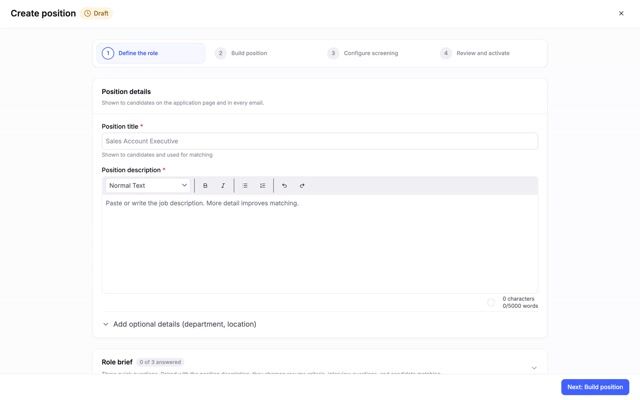
The license tells you someone is allowed to work unsupervised. It tells you nothing about what they actually do once they are. At a small shop you are rarely on the job site, so the hire lives or dies on the habits a resume can't show: whether they run lockout/tagout every time and not just when someone's watching, whether they diagnose a fault instead of swapping parts until something sticks, and whether they tell a customer the truth about a code-required repair that costs more. Those are the calls that come back to your company's name, not theirs. This guide screens for judgment and discipline under no supervision, not for a certificate.
What an electrician actually does at a small electrical contracting business
At a large national contractor, an electrician works off a project schedule set by a superintendent, backed by an estimating team, a safety officer, and a warehouse that stocks whatever the job needs. At a small electrical contracting business with a handful of trucks, the electrician is often the entire job. They diagnose the problem, decide what's actually required to fix it safely and to code, explain the cost to the homeowner or general contractor standing in the driveway, and drive to the next call without anyone coordinating it for them.
That difference changes what the role actually requires. An electrician at a small shop needs technical skill plus the judgment to make calls a foreman or a project manager would normally make at a bigger company: what to quote on the spot, when to call the owner before opening a panel that's more complicated than expected, how to push back on a GC who wants a shortcut. There's less backup if something goes sideways on a job, and the stakes are higher than a lot of trades. A misjudged diagnosis costs money. A missed safety step can hurt someone.
The core responsibilities, in practice:
- Installing, maintaining, and repairing electrical systems in residential and light commercial buildings
- Reading blueprints and wiring diagrams, and running wire, conduit, and panels to match them
- Diagnosing electrical problems methodically, often solo and without a second opinion available on-site
- Following code requirements and pulling the necessary permits, even when a customer or GC would rather skip the paperwork
- Practicing lockout/tagout and safe work procedures around live circuits on every job, not just the ones someone's watching
- Explaining the problem, the fix, and the cost to the customer or GC in plain language, before starting work
- Managing their own truck stock of wire, breakers, fixtures, and common parts
- Representing your company directly. For a lot of customers, the electrician at their door is the only interaction they'll ever have with your business
If you're a small electrical contractor, your electricians are your reputation and your liability at the same time. A homeowner or GC remembers whether the work was done to code, whether the electrician was upfront about cost, and whether the job site was left safe. That's worth naming when you post the role, because it's a different pitch than "electrician wanted."
Job description you can post today
Copy this, then adjust the specifics (your hours, your pay, your service area) to match your company.
Electrician
[Company name] is looking for an electrician to join our team of [X] trucks. You'll work independently on residential and light commercial jobs, diagnose and repair electrical systems, and represent our company directly to the customers and contractors you work with.What you'll do
Install, diagnose, and repair electrical systems, including panels, wiring, and fixtures. Read blueprints and wiring diagrams and work to code on every job. Follow lockout/tagout and safe work procedures around live circuits, every time. Explain the problem and the cost to the customer or GC clearly, before you start work. Keep your truck stocked and your paperwork current, including permits where required.What we're looking for
A current journeyman or master electrician license, active and in good standing with your state licensing board. A valid driver's license with a clean record. Comfort working independently, without a foreman walking you through every call. Strong communication with customers and GCs, especially when the news isn't good.Schedule
[Insert hours, e.g. Monday-Friday, 7am-4pm, with occasional emergency or on-call work][Insert pay, per your company's policy and any applicable state salary transparency requirements]
10 interview questions, and what a good answer sounds like
1. Walk me through how you'd troubleshoot a circuit that keeps tripping the breaker, on a system you've never worked on before.
You're checking for an actual troubleshooting sequence, not a guess. A strong answer moves in order: identify what's on the circuit, check for obvious overload or a shorted device, test with a meter before opening anything up, and isolate the fault systematically rather than swapping parts to see what sticks. A candidate who jumps straight to "probably a bad breaker" without a process is telling you they replace parts instead of diagnosing, which costs you money and, on this trade, can also be a safety issue.
2. What's your process for lockout/tagout, and when do you use it?
This should come out specific and automatic, not vague. A strong answer names the actual steps: de-energize the circuit, lock it out, tag it, and verify with a meter that it's actually dead before touching anything, every time they work on a panel or circuit that could be live. A candidate who says they "usually just flip the breaker and check visually" or treats the question as obvious and not worth explaining is telling you they cut corners when no one's watching. On a small crew where you're not standing over every job, that's the answer that should worry you most.
3. Tell me about a time you found something unsafe or out of code on a job that wasn't why you were called out. What did you do?
Every experienced electrician has run into this: aluminum wiring, an overloaded panel, unpermitted work from a previous job. Listen for whether they flagged it and explained the risk to the customer, even though it meant more work and a harder conversation, versus whether they ignored it or just quietly worked around it. A candidate who can't produce a real example, or whose instinct was to avoid the conversation, is a flag for a small shop where you're the one liable if something goes wrong later.
4. You're the only one on-site and the job turns out bigger than expected. How do you decide what to handle yourself versus call the office first?
Small shops don't have a foreman backing up every call, so this tests whether an electrician actually knows their own limits. A strong answer names a clear line: routine scope changes they'll just handle and quote, anything unusual, high-cost, or outside code they're confident on, they'll pause and call before proceeding. A candidate who says they'd just push through regardless, or who says they'd call for absolutely everything, is either overconfident or not ready to work independently yet.
5. Tell me about a time you had to explain an expensive or code-required repair to a customer who wasn't expecting it.
Listen for a real, specific story: what the issue was, how they explained it, whether they gave the customer options instead of just a number. A strong answer shows they walked the customer through why the code requirement exists, not just that it exists, and let them decide without pressure. A candidate who can't produce an example, or whose story is really about talking someone into the pricier option, is a flag for a small shop where word of mouth is your whole marketing budget.
6. How do you handle a general contractor who wants you to cut a corner to hit a deadline or budget?
This comes up constantly for electricians working on GC jobs, and it's a direct test of whether code discipline survives pressure. A strong answer holds the line: explains why the shortcut doesn't pass inspection or isn't safe, and offers whatever legitimate option exists to help the schedule instead. A candidate who says they'd "make it work" to keep the GC happy is telling you they'll sign off on something that comes back to your company's name, not theirs, when it fails an inspection or causes a problem down the line.
7. What license do you currently hold, and how long have you held it?
You want a direct, specific answer: journeyman or master, how long they've held it, and whether they can produce the number. A candidate who's vague, says they "think" it's still active, or can't answer quickly is worth verifying carefully with your state licensing board before you move forward. This is a case where you confirm it yourself rather than taking the answer at face value, the same way you'd verify a license for any regulated trade.
8. How do you keep your truck stocked so you're not making extra runs to the supply house?
Good electricians treat their truck like their own small business. A strong answer describes an actual system: checking stock on a schedule, knowing which wire gauges, breakers, and fixtures they use most, restocking after each job rather than waiting until they're empty on-site. A candidate who says they "just grab what's there" or has no system is telling you to expect wasted trips and delayed jobs.
9. Tell me about a time a customer or GC was frustrated with you or your work. What happened?
Every experienced electrician has this story. Listen for whether they stayed professional and focused on resolving the actual issue, or got defensive and let it escalate. A strong answer includes what they did to fix it and how the relationship ended up. A weak answer blames the other party entirely or brushes past the question, which usually means they haven't reflected on how their own reaction affects the outcome.
10. What's your attendance and reliability record like? Has anything ever come up that made you late or unavailable, and how did you handle it?
Ask this directly. A strong answer is honest about it happening occasionally, and specific about how they handled it: called ahead, gave real notice, coordinated coverage if needed. A candidate who claims a perfect record with no specifics, or gets defensive at the question, is harder to read. For a small shop with a handful of trucks, one no-show electrician can blow up a full day's schedule and a customer relationship along with it, so this is worth spending real time on.
A scorecard you can score candidates against
Ten questions only help if everyone interviewing is listening for the same thing, so score every candidate on the same six signals instead of comparing gut feelings from six different conversations.
| What you're scoring | Strong signal | Weak signal |
|---|---|---|
| Diagnostic method | Orders the steps, tests with a meter before opening anything, isolates the fault systematically | Jumps to "probably a bad breaker" and swaps parts to see what sticks |
| Lockout/tagout discipline | Names the steps automatically: de-energize, lock, tag, verify dead with a meter, every time | "Flip the breaker and check visually," or treats the question as too obvious to answer |
| Code discipline under pressure | Holds the line with a GC, explains why the shortcut fails inspection, offers a legitimate option | Says they'd "make it work" to keep the GC happy |
| Flagging unsafe work | Real story of flagging out-of-code work and having the harder conversation with the customer | No example, or their instinct was to work around it quietly |
| Knowing their limits solo | Clear line: routine scope they handle and quote, anything unusual or high-cost they pause and call | Pushes through everything regardless, or would call the office for absolutely everything |
| Customer communication | Walks the customer through why the repair is needed, gives options, no pressure | Can't produce an example, or the story is about talking someone into the pricier option |
How to screen electrician candidates without losing a week to it
Truffle is an AI screening platform that combines resume screening, one-way video interviews, and talent assessments, so you can build a workflow around what actually matters for a licensed trade role like this one.
For an electrician, license verification has to come first, not somewhere in the middle of the process. And because this trade gets sourced through Indeed listings, walk-ins, and word of mouth more than polished resumes, the workflow needs to fit how these candidates actually apply. This is the same dynamic you'll see if you also hire HVAC technicians, plumbers, or automotive technicians: verify the credential first, keep the resume optional, and lean on structured screening instead. If you hire across multiple trades, it's worth running the same workflow for each. Here's one that fits a small electrical contracting business:
- Verify their journeyman or master electrician license is active with your state licensing board before you schedule anything. A quick check of the license number and status filters out applicants who aren't actually eligible to work unsupervised. Licensing rules vary by state, so confirm against your own state's board rather than assuming, and treat this the same way you'd verify a credential for any regulated role.
- Make the resume optional, not required. A lot of your strongest candidates learned this trade through an apprenticeship and don't have a polished resume to show for it. Where you do use resume screening, weight license status and work history over formatting or presentation.
- A short one-way video interview before you commit an in-person slot. Ask 2-3 of the scenario questions above, like the lockout/tagout question or the GC pressure question, so you can see how someone actually thinks and communicates before you use up a working interview on them. A one-way video interview surfaces judgment and communication style, which are hard to read from a resume and much easier to hear on video.
- A mechanical ability assessment to check diagnostic reasoning before you're on-site together. A structured mechanical ability assessment on circuits, tools, and basic troubleshooting logic surfaces how someone reasons through a system, which is a harder signal to fake than a resume line about years of experience.
- A working interview. Once someone's cleared license verification, video, and assessment, bring them out on an actual job or two. This is where you confirm what the earlier steps only hinted at, including whether their safety habits hold up when you're not standing right next to them.
AI surfaces the evidence. You review it and make the call. It doesn't pick for you, and it never should for a hire where the wrong call carries safety and liability risk, not just a scheduling headache.
3 questions from the skills check we'd actually run for this role
A skills check only helps if it tests the reasoning the job needs, not trivia. These three are pulled straight from Truffle's mechanical ability assessment, the one we'd point you to for a trade where diagnosis and safe sequence matter more than raw years. Try them yourself before you decide what "job-ready" means for your shop.
1. A lamp on a single-pole switch is off. What's the best first troubleshooting step: replace the lamp, check for supply voltage at the switch input, replace the switch, or use heavier wire? Reveal answer
Best answer: check for supply voltage at the switch input. You start at the source and confirm power before you swap any component. This is the exact instinct that separates an electrician who diagnoses from one who throws parts at a problem on your dime, and on this trade guessing can also be a safety issue.
2. Two identical bulbs are wired in series to a battery. One bulb burns out and opens. What happens to the other bulb? Reveal answer
Best answer: the other bulb turns off. An open anywhere in a series circuit breaks the only current path. Reading how a fault propagates through a circuit is baseline for anyone who will be tracing why a run went dead on a real job.
3. A technician uses a 30 cm wrench to loosen a bolt that needs 60 N·m of torque. Roughly how much force, applied perpendicular at the end of the wrench, does that take? Reveal answer
Best answer: about 200 N, since torque equals force times distance, so 60 divided by 0.30 m. The point isn't the arithmetic. It's whether someone reasons about force, leverage, and the right tool instead of muscling a fastener until something strips.
The point isn't these three questions. It's that a structured skills check like this surfaces how someone reasons through a system, which is a harder signal to fake than a resume line about years of experience. Truffle's AI scores and surfaces the results against the bar you set. You still make the call on who clears it.
Common hiring mistakes for this role
Requiring a resume when your best electricians don't have one. A lot of strong candidates in this trade learned it through an apprenticeship, don't use LinkedIn, and source jobs through Indeed, a walk-in, or a call from a friend already on your crew. If you require a formatted resume to even apply, you filter out people who can do the work and keep the ones who are good at writing resumes instead.
Blaming "nobody wants to work" when the real issue is pay. If your pay is below what other shops in your area are offering, no amount of better screening fixes the turnover. Electricians who take the job anyway tend to leave the moment something better comes along, and a revolving door gets chalked up to a labor shortage when the actual cause is the number on the offer.
Skipping or rushing license verification and background checks to fill the seat faster. It's tempting to move fast when you're short-staffed, but skipping the license check or rushing a background check is exactly what causes problems months later, on a job where the stakes are code compliance and customer safety, not just performance. Build the verification step into the process instead of treating it as optional paperwork.
Writing a posting that blurs electrician with general handyman or maintenance work. A vague "maintenance tech, electrical a plus" posting undersells the license requirement and the judgment this role requires, and pulls in applicants who aren't actually qualified to work on electrical systems. Be specific about the license requirement and the safety responsibilities from the first line of the post.
Running a slow process and losing candidates to whoever calls back first. This is a tight labor market for licensed trades, and a strong electrician who doesn't hear from you within a day or two will take the next offer that comes in. Verify the license fast, screen fast, and don't let a good candidate sit in your inbox while you get around to it.
What should your screening process look like?
Answer six quick questions about how you hire. We'll point you to the screening steps that fit, so you spend your time on the candidates worth a conversation.
What each result looks like
Start with resume screening
You're working through real volume, and the resume still carries signal. Score every resume against your criteria first, so a shortlist surfaces before you spend time on anyone.
- Resume screeningScore every resume against your criteria and surface your strongest matches first.
- One-way interviewsHear how candidates think on a recorded prompt, on their schedule and yours.
7-day free trial. No credit card required.
Lead with one-way interviews
Resumes look interchangeable and phone screens are eating your week. Let candidates answer a recorded prompt on their own time. You watch the moments that matter and decide who's worth a live round.
- One-way interviewsHear how candidates think on a recorded prompt, on their schedule and yours.
- Resume screeningScore every resume against your criteria and surface your strongest matches first.
7-day free trial. No credit card required.
Anchor on talent assessments
For these roles the work matters more than the paper. Put a role-calibrated assessment up front, so you see real, comparable evidence before you book a calendar slot.
- Talent assessmentsSee role-calibrated work before you spend a calendar slot on a live round.
- One-way interviewsHear how candidates think on a recorded prompt, on their schedule and yours.
7-day free trial. No credit card required.
Layer all three signals
Your hiring spans high volume and high stakes, so no single step covers it. Layer all three: score resumes first, hear candidates on a one-way interview, then confirm with an assessment. Each step narrows the field, and you make the call at every stage.
- Resume screeningScore every resume against your criteria and surface your strongest matches first.
- One-way interviewsHear how candidates think on a recorded prompt, on their schedule and yours.
- Talent assessmentsSee role-calibrated work before you spend a calendar slot on a live round.
7-day free trial. No credit card required.