A practical guide to pre-employment testing
What pre-employment tests actually measure, which types to use and when, what makes a test useful versus risky, and how to fit testing into a screening process without tanking completion rates.

AI summary
- Pre-employment testing adds structured, consistent signal to a hiring process, but the type of test matters. Skills tests and work samples tend to hold up well legally and practically. Cognitive, personality, and integrity tests require more care around job-relatedness and potential adverse impact.
- A useful test is job-related, consistent across every candidate, and hard to game because there's no universal correct answer. A risky test is generic, long, or placed so early in the funnel that it drives away qualified candidates before they know anything about the role.
- Testing works best as one layer in a broader screening workflow, not as a standalone filter. Pair it with something that shows how candidates actually communicate, and you get a much fuller picture before scheduling a single live conversation.
You’ve got 140 applications for a customer success role. Thirty of them look reasonable on paper. You could phone-screen all 30. That’s 7.5 hours of your week, plus scheduling, plus no-shows, plus the candidates who were polished on the call but couldn’t have actually done the job.
Or you add a test.
Pre-employment testing looks straightforward on the surface and gets complicated fast. The basic idea is simple: give candidates something to do beyond submitting a resume, and you’ll learn more about them before you spend live time on anyone. The complications show up in which tests you pick, when you use them, and what you’re actually allowed to conclude from the results.
This guide covers the main types of tests, what makes a test useful versus risky, the legal considerations that actually matter, and how to fit testing into a screening process without wrecking your completion rates.
What pre-employment testing is (and isn’t)
A pre-employment test is any structured assessment used before or during the hiring process to gather information about candidates that a resume doesn’t show.
That’s a broad definition on purpose. It covers:
- A 10-question skills test sent after someone applies
- A personality questionnaire that takes 15 minutes
- A work-sample exercise given after a first-round interview
- A situational judgment test built around real scenarios from the role
What it doesn’t cover: unstructured conversation, gut feel, or asking candidates to “just send over some samples.” Those might produce useful information, but they’re not structured, they’re not consistent, and you can’t compare them across candidates in any meaningful way.
The point of a test is consistency. Every candidate gets the same questions, in the same order, under the same conditions. That’s what lets you compare results. It’s also what gives you a defensible record if your process is ever questioned.
The main types of pre-employment tests
Skills and work-sample tests
These measure whether candidates can actually do specific things the job requires. A writing test for a content role. A spreadsheet task for an analyst. A customer email response for a support position.
Work samples are generally considered the most face-valid type of assessment, meaning they’re the easiest to defend as job-related, because the connection to the actual work is obvious. According to the EEOC’s guidance on employment tests and selection procedures, content validity is one of the recognized ways to establish that a test is job-related, and a well-designed work sample is often the clearest path to that.
The limitation: they take more time to design, they take more time for candidates to complete, and they have to actually reflect the job. A writing test for a role that involves almost no writing is not a useful screening tool. A related case: generic English literacy tests used to screen communication ability often fail this test, because they measure language proficiency in the abstract rather than the specific communication tasks the role actually requires.
Cognitive ability tests
These assess reasoning, problem-solving, memory, and the ability to learn new information. They tend to have meaningful predictive validity for job performance, particularly for roles with a high cognitive load.
The tradeoff is adverse impact. Cognitive ability tests show statistically significant group differences on scores across race and ethnicity, which means employers relying on them need to understand that risk and have job-relatedness evidence to back up their use. The Uniform Guidelines on Employee Selection Procedures require employers to demonstrate validity if a selection procedure produces adverse impact, regardless of intent.
Cognitive tests work best when the reasoning demands are central to the role and when the test is designed for that context.
Personality assessments
These measure relatively stable traits, like how someone tends to approach new situations, how they manage competing demands, or how they engage with other people.
The most credible personality frameworks in hiring are built on the Big Five model (also called the Five-Factor Model): Openness, Conscientiousness, Extraversion, Agreeableness, and Neuroticism. The research on the Big Five is extensive, and Conscientiousness in particular has consistent associations with job performance across a wide range of roles, as documented in decades of published research in industrial-organizational psychology. For a look at how hiring assessments fit into a broader evidence-based process, that post covers the case for combining multiple signals rather than relying on any one measure.
A few things to get right here:
Personality assessments tell you about tendencies, not types. Putting candidates into categories (“you’re a Type A” or “they’re an INTJ”) misrepresents how trait-based psychology actually works. Traits exist on continuums, and context shapes how they show up at work.
No personality test predicts performance. They surface information about how someone tends to approach situations. A high score on conscientiousness doesn’t guarantee a person will be a top performer in your environment. It’s one input, not a verdict.
And “cultural fit” as an assessment output is a phrase worth avoiding. It tends to mean different things to different evaluators, and evaluator-defined “fit” has a way of encoding existing team demographics rather than actual job requirements. The blind hiring post goes into this pattern in more depth, specifically why anonymization doesn’t solve the problem if the evaluation criteria are still poorly defined. Better to name the specific traits you’re looking for and evaluate against those.
Situational judgment tests
SJTs present candidates with realistic workplace scenarios and ask them to choose or rank responses based on what they’d do. Instead of asking “tell me how you’d handle a difficult customer,” you show them three specific situations and see how they’d navigate each one.
The advantage of an SJT is that it surfaces how candidates approach real situations, not just how they describe their past behavior. Good scenarios are specific, relevant to the role, and constructed around decisions people actually face.
The limitation: SJTs are most useful when the employer has defined what the preferred approach looks like. A scenario about handling a client complaint has no universal “right answer.” The right answer is whatever approach fits how your team operates. That means the assessment is measuring alignment with your preferences, not some objective standard of good judgment.
Integrity tests
Integrity assessments are designed to evaluate reliability, honesty, and attitudes toward counterproductive work behaviors. Some are overt (asking directly about attitudes toward theft or dishonesty). Others are personality-adjacent and more indirect.
They’re common in industries with high risk of loss, fraud, or safety-sensitive work. The research on integrity tests is generally supportive of their ability to reduce counterproductive behavior, but they come with their own set of concerns: candidates can often identify what the test is looking for and respond accordingly, and some questions touch on protected characteristics or attitudes in ways that require legal review.
If you’re using an integrity test, it’s worth reviewing whether the specific instrument has been validated for your role type and geography.
What makes a test useful versus risky
Not all tests are worth using. Here’s a practical breakdown of what separates useful pre-employment testing from the kind that creates more problems than it solves.
| Factor | Useful | Risky |
|---|---|---|
| Job-relatedness | Directly measures skills or traits the role requires | Generic, off-the-shelf, no obvious connection to the work |
| Consistency | Same test, same conditions, every candidate | Ad hoc, some candidates get harder versions |
| Adverse impact | Designed with awareness of group differences | No review of differential outcomes |
| Gamability | Hard to game because there’s no universal right answer | Transparently fakeable with basic preparation |
| Length | Proportionate to what the stage warrants | Long early in the process, before trust is established |
| Position in funnel | After candidates know something about the role | First thing they see, before basic information is shared |
The hardest one to get right is gamability. Skills tests can be gamed with AI assistance for certain task types. Personality tests can be gamed by candidates who know the Big Five dimensions and can figure out what a “good” profile looks like for the role. SJTs built around obvious scenarios can be gamed by anyone who’s done light research on the company.
The assessments that are most resistant to gaming are the ones where the employer’s preferences are genuinely unknown to the candidate, where there are no universally “correct” responses. That’s why well-designed situational judgment tests and personality assessments tied to employer-specific criteria hold up better than skills tests alone in a world where AI can help write code or draft copy on demand.
Legal and validity considerations
In the U.S., the legal framework for pre-employment testing centers on the EEOC’s Uniform Guidelines on Employee Selection Procedures. The key requirements are:
Job-relatedness. Tests must measure something actually relevant to the role. This is established through validity evidence. The Uniform Guidelines recognize three forms of validation: criterion-related validity (demonstrating a statistical relationship between test scores and job performance), content validity (demonstrating that the test’s content represents the job’s actual requirements), and construct validity.
Adverse impact. If a test produces significantly different pass rates across protected groups (defined as less than four-fifths of the highest group’s rate, under the Uniform Guidelines’ “four-fifths rule”), employers should have validity evidence to support continued use. The standard doesn’t prohibit using tests with adverse impact, but it requires a business necessity defense.
Consistency. Tests must be applied consistently. Giving different tests to different candidates for the same role, or applying tests selectively based on factors like a candidate’s resume quality, creates legal exposure.
A few things worth being clear about: these guidelines apply to all employers covered by Title VII, not just large companies. And the requirement to demonstrate validity is triggered by adverse impact, so many employers never conduct formal validity studies because they haven’t identified differential impact in their outcomes. That’s a reasonable operating approach, but it’s worth understanding the framework if you’re adding testing to a high-volume process.
The EEOC’s employment tests fact sheet is a readable starting point. For anything beyond standard off-the-shelf tools, a review by an employment attorney or an I-O psychologist who specializes in selection is worthwhile.
Candidate completion rates: what actually drives drop-off
A test that no one finishes isn’t helping you hire. Completion rates on pre-employment assessments vary widely, and the factors that drive drop-off are mostly predictable.
Timing matters more than most people expect. An assessment sent before a candidate knows anything about the role, the team, or why the company might be worth their time will complete at a lower rate than the same assessment sent after a brief introduction. Candidates are making a calculation about whether the investment is worth it. Give them a reason to invest.
Length has diminishing returns. The signal quality of a 45-minute assessment is not proportionally better than a 20-minute assessment. And a 45-minute assessment early in the funnel will lose candidates who are simultaneously interviewing elsewhere and have options. The drop-off tends to fall disproportionately on candidates with the most options, which is not the selection pressure you want.
Transparency helps. Candidates who understand why they’re being asked to complete an assessment, what it measures, and how the results will be used complete at higher rates. “We use this to understand how you approach X situations” is a better framing than sending a link with no context.
Framing as “no right answers” reduces gaming and anxiety. For personality and situational judgment assessments, telling candidates there are no right or wrong answers, and that their honest responses are what the assessment is designed for, produces more useful results than letting them infer what you’re looking for.
How to fit testing into your screening process
The most common mistake with pre-employment testing isn’t using the wrong test. It’s treating testing as a standalone step rather than one layer in a broader process. If you’re building a screening workflow from scratch, start with the signal layers first, then decide where testing fits.
A resume tells you what someone has done. A test tells you something about how they work. A video response tells you how they communicate. You need all three to get a useful picture, and none of them alone is sufficient.
A practical sequencing approach:
-
Qualification questions at the application stage. Yes/no and numeric questions that surface must-haves (authorization, specific certifications, location) before you ask anyone to do anything else.
-
A one-way video interview at the early screening stage. Candidates record their responses to your questions on their own time. You see how they communicate, how they think on their feet, and whether they match what the resume claims. This is the step that replaces a lot of phone screens.
-
Assessment layered in at the right moment. Personality or situational judgment assessment for roles where those signals genuinely matter. Work samples for roles where specific skills need to be demonstrated. Not both at once, and not before the candidate has enough context to care.
The sequence matters because completion rates compound. An application with three long steps will see lower completion on each subsequent step. Keep early stages short. Save depth for candidates who’ve already demonstrated interest.
Truffle’s assessments and where they fit
Truffle is an AI screening platform that combines talent assessments with resume screening and one-way video interviews. If you’re building a testing layer into your screening process, here’s how the three assessment types work.
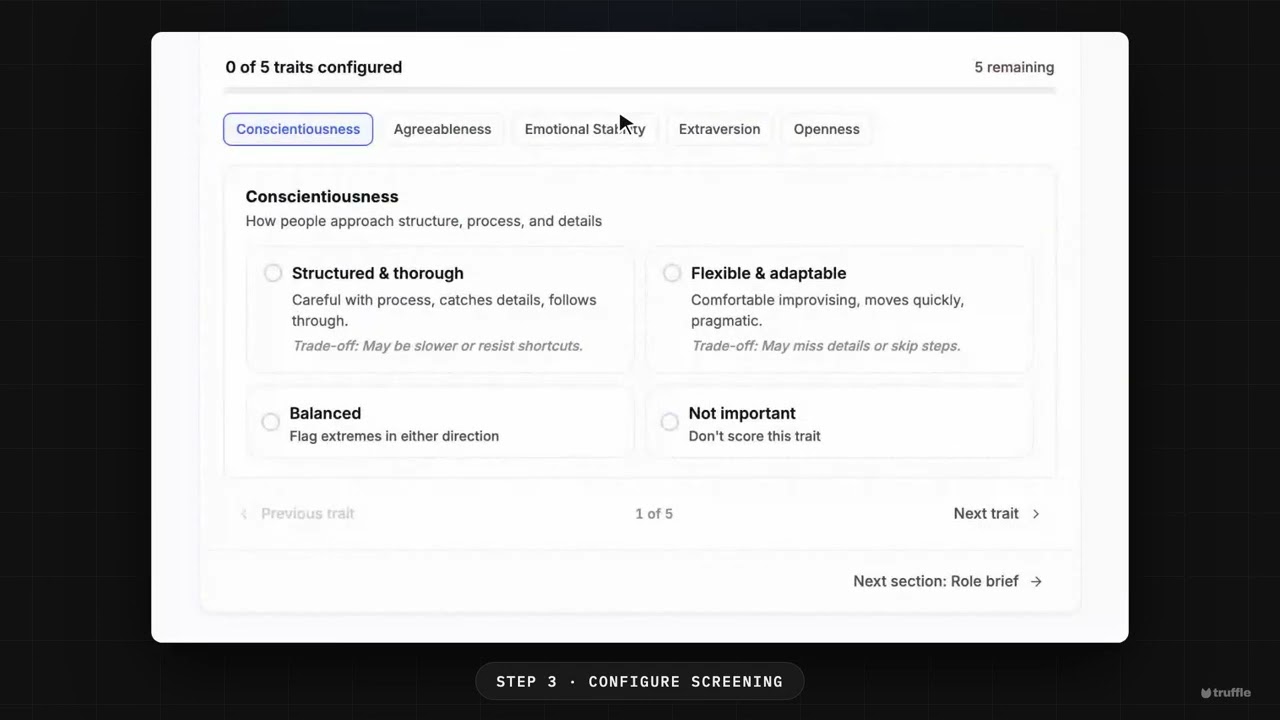
Personality assessment. Built on the IPIP (International Personality Item Pool), a validated, public-domain Big Five instrument with published reliability data. Measures the five major personality dimensions. You can say “validated” here because the IPIP has an established research base. Results surface how candidates tend to approach situations.
Situational Judgment Test. Shows how candidates would handle scenarios relevant to the role, measured against the approach your team prefers. Because you define what “good” looks like, the assessment measures alignment between candidate approach and your preferences, not some universal standard. There are no right answers from the candidate’s perspective, which makes it meaningfully harder to game than skills tests. The situational interview questions guide covers how to design those scenarios well if you’re building them from scratch.
Environment Fit assessment. Based on realistic job preview principles. Surfaces whether a candidate’s preferences about how work gets done align with how work actually gets done at your company. When expectations are set clearly before someone starts, early turnover driven by mismatched expectations tends to drop. This assessment measures preference alignment.
All three types sit alongside resume data, video interview responses, and AI match scores in one candidate view on Truffle’s talent assessment platform. You don’t have to use all three. Most roles call for one or two, applied at the right stage. Truffle’s self-serve plans start from $49/month, credit-based, with a 7-day free trial and no credit card required.
For a look at how specific tools compare, the recruitment assessment tools guide covers 16 platforms with honest tradeoffs for each.
A few things worth knowing before you add testing
Testing adds signal. It doesn’t add certainty. A strong assessment result is one piece of information, not a decision.
The best use of assessment results is as a starting point for better interview conversations. A candidate whose SJT responses diverge from your preferred approach isn’t automatically a bad hire. They’re a candidate worth asking about how they’d handle that situation in your environment. Gaps are conversation starters, not disqualifiers.
Consistency is non-negotiable. If you use a test for one candidate and not another in the same pool, you’ve created a problem that’s hard to undo. Test everyone or test no one. Apply the same assessment at the same stage.
And resist the pull toward adding more tests. The goal is to get to a confident hiring decision, not to generate more data. One well-chosen assessment at the right stage in the process is almost always more useful than three mediocre ones stacked together.
If you’re still building out your candidate screening process more broadly and want to think about how testing fits within a full workflow, start there before layering in assessment tools.
Frequently asked questions about pre-employment testing
What is pre-employment testing?
Pre-employment testing is the use of structured assessments before or during the hiring process to gather information about candidates beyond what a resume shows. Tests can measure skills, cognitive ability, personality traits, situational judgment, or work style preferences. The goal is to give hiring teams more consistent, comparable signal across candidates before they invest time in live interviews.
Is pre-employment testing legal?
In the United States, pre-employment testing is legal when tests are job-related and applied consistently to all candidates. The EEOC’s Uniform Guidelines on Employee Selection Procedures set the framework: if a test produces adverse impact on a protected group, employers must be able to demonstrate its job-relatedness through validity evidence. The core requirement is that tests measure something actually relevant to the role, not just general attributes.
What types of pre-employment tests are most commonly used?
The most common types are skills and work-sample tests, cognitive ability tests, personality assessments, situational judgment tests, and integrity tests. Skills tests measure specific job-relevant abilities. Cognitive tests assess reasoning and problem-solving. Personality assessments explore traits like conscientiousness and openness. Situational judgment tests show how candidates would approach real workplace scenarios. Integrity tests assess values and reliability.
How long should a pre-employment test be?
Shorter is almost always better, especially earlier in the funnel. Assessments that take more than 20 to 30 minutes early in the process tend to reduce completion rates, and the drop-off is not always coming from the candidates you’d least want. A practical approach: use a shorter, focused assessment at the screening stage, and reserve any longer or more in-depth testing for candidates who have already expressed serious interest in the role.