Active sourcing gets candidates. Your screening process loses them.
Active sourcing finds candidates. Slow screening loses them. Here's how to fix the conversion gap most teams ignore.


AI summary
- Active sourcing finds candidates. The bottleneck is what happens next: converting interest into evaluated pipeline.
- Most active sourcing efforts waste outreach by not having a fast screening step ready for respondents.
- Send a one-way interview link with your outreach message and you screen candidates the same day they engage.
You spent three hours crafting the perfect LinkedIn message. You researched the candidate’s background, referenced a project they led, and wrote something that actually felt human. Two days later, they responded: “Sure, I’d be open to a conversation.”
Then your screening process kicked in. A phone screen got scheduled for next week. The hiring manager rescheduled. The candidate waited. By the time you circled back, they’d accepted another offer.
The sourcing worked. The conversion didn’t.
This is the pattern that quietly kills active sourcing strategies. Teams invest heavily in finding and engaging passive candidates, then funnel them into the same slow screening process they use for inbound candidates. It’s like running a targeted ad campaign that drives traffic to a broken checkout page.
Active sourcing is the practice of proactively identifying, reaching out to, and engaging candidates who aren’t actively looking for a new position. It’s the opposite of posting a listing and waiting. And when it works, it delivers candidates you’d never find through job boards alone. But “finding” is only half the problem.
For a broader look at how sourcing fits into the full recruiting cycle, see our guide to candidate recruitment.
active sourcing
What active sourcing actually means
Most hiring teams operate in reactive mode. You post a position on Indeed or LinkedIn, applications flow in, and you screen what arrives. That’s passive recruiting. It works when the market is flooded with candidates. It breaks when you need someone specific.
Active sourcing flips the model. Instead of waiting for candidates to come to you, you go find them. You search LinkedIn profiles, attend industry events, mine your existing database, and reach out directly to people who match what you’re looking for. This proactive recruiting mindset is the core shift: from waiting to pursuing.
The distinction matters because the two approaches attract fundamentally different candidates. Inbound candidates are actively looking. They’re applying to multiple positions. They’re motivated but not necessarily the best fit. Actively sourced candidates are often employed, selective, and harder to engage. They’re also more likely to be a strong fit, because you chose them for a reason.
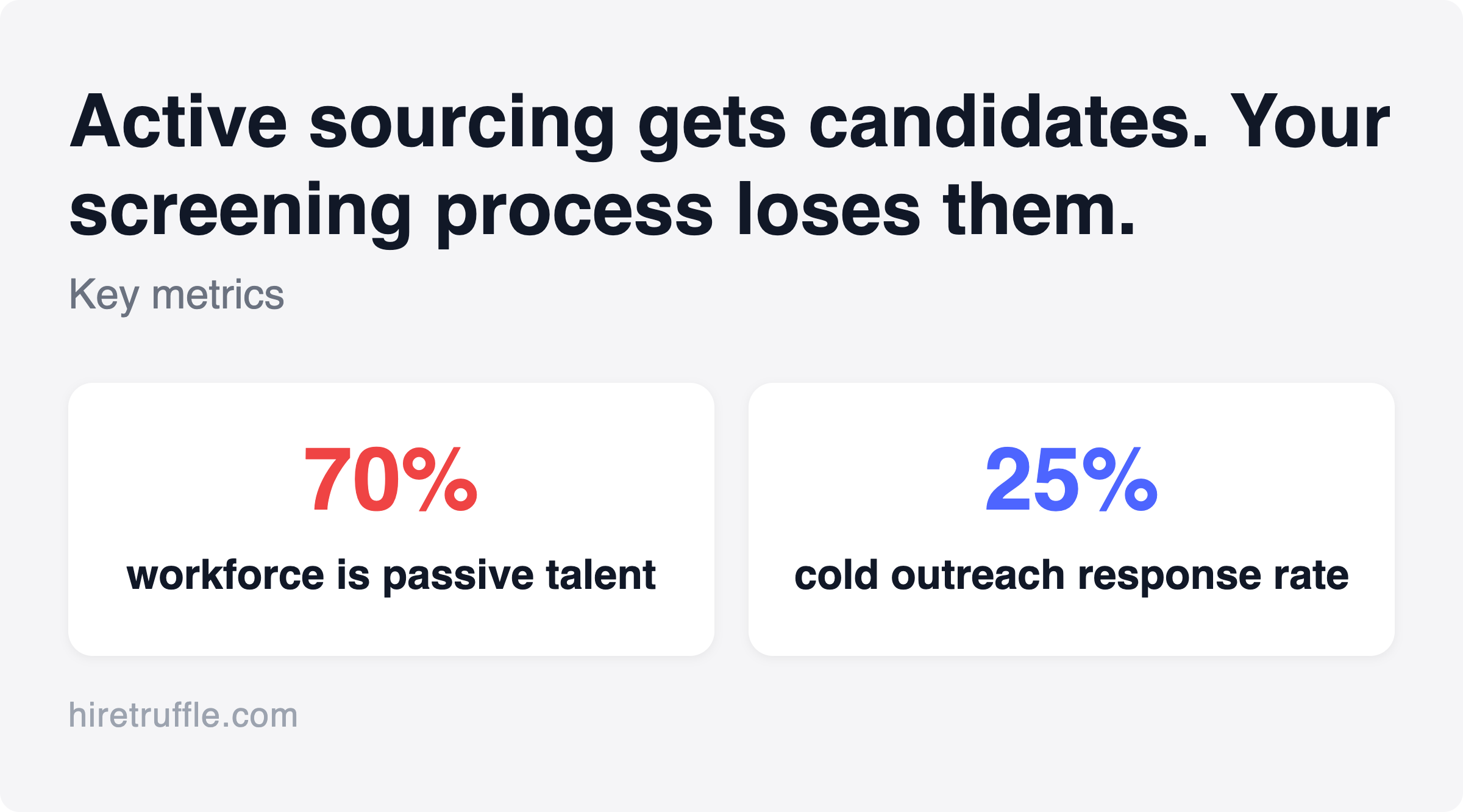
Think of it this way. Passive recruiting casts a wide net. Active sourcing uses a spear. Both have a place. But if you’re only casting nets, you’re missing the fish that don’t swim near the surface. And according to LinkedIn, roughly 70% of the global workforce qualifies as passive talent. People not actively looking but open to the right conversation. That’s the pool active sourcing gives you access to.
Why active sourcing matters more than it used to
Two things have changed the math on inbound recruiting.
First, application volume has exploded. AI tools now help candidates apply to dozens of positions in minutes. One recruiter described their inbox as “drowning in applications.” Volume is up, but the signal-to-noise ratio has cratered. Sorting through 200 applications to find 10 worth talking to takes hours you don’t have. If your team is already feeling the squeeze of an ongoing talent shortage, that pile of low-signal applications makes it worse, not better.
Second, the candidates you actually want are rarely in that pile. The experienced operations manager who’d be perfect for your team isn’t browsing Indeed on a Tuesday afternoon. She’s busy running her current team. If you want to reach her, you need to go to her.
Active sourcing solves the quality problem that job boards can’t. But it introduces a different challenge: once you’ve engaged a passive candidate, you can’t afford to waste their time.
Six active sourcing strategies that actually work
Not all sourcing channels deliver the same results. The talent sourcing strategies that hold up over time share a common trait: they put you in front of people who weren’t looking, in a way that makes them glad you reached out. Here’s what works, why, and where most teams get it wrong.
1. LinkedIn outreach (done right)
LinkedIn is still the dominant sourcing channel for candidate outreach. But there’s a difference between good outreach and what most recruiters do.
Good outreach is specific. You mention the candidate’s actual work. You explain why this particular position might be relevant to their career. You keep it under 150 words. You don’t lead with your company’s awards or culture deck.
Bad outreach is a template with a name swapped in. Candidates can spot these instantly. One recruiter on Reddit described receiving “dozens of randos on LinkedIn” with generic messages. Don’t be that message.
Imagine you’re hiring a senior customer success manager. Instead of “I came across your profile and thought you’d be a great fit,” try something like: “Saw your case study on reducing churn at [Company]. We’re building a CS team focused on the same problem. Would a 10-minute call make sense?” Specific. Brief. Respectful of their time.
If you’re investing in a LinkedIn Recruiter seat, this kind of personalization is what makes that spend worth it.
2. Boolean search and advanced filters
Boolean search recruiting lets you go beyond LinkedIn’s basic filters. Combine keywords with AND, OR, and NOT operators to find candidates across LinkedIn, GitHub, Stack Overflow, or even Google itself.
For example, searching "customer success" AND "SaaS" AND "manager" NOT "director" narrows results to the exact seniority level you need. Add site-specific modifiers like site:linkedin.com/in to search LinkedIn profiles from Google, which sometimes surfaces results LinkedIn’s own search misses.
The skill gap here is real. Many HR teams don’t know Boolean search recruiting exists. If you learn it, you have an edge over every team that’s still using basic keyword filters.
3. Employee referrals
Referrals are the oldest sourcing strategy and still one of the most effective. Referred candidates tend to get hired faster and stay longer. Your employees already know who’s good at what they do.
The mistake most teams make is treating referrals as passive. You send an all-hands email asking “know anyone?” and hope for the best. That’s not active sourcing. Active referral sourcing means sitting down with your team, reviewing specific positions, and asking targeted questions: “Who’s the best project manager you’ve worked with in the last five years?”
For a deeper look at what makes referral programs actually work, see our guide to employee referral programs.
4. Talent communities and events
Industry events, meetups, conferences, and online communities (Slack groups, Discord servers, niche forums) put you in front of candidates who are engaged in their field. These aren’t people browsing job boards. They’re people investing in their craft.
The key is showing up consistently, not just when you have an open position. Build relationships before you need them. When a position opens, you already have a warm network to tap.
This doesn’t scale like LinkedIn outreach. But the quality of candidates you meet tends to be higher, and the conversion rate from “interested” to “hired” tends to be higher.
5. Your own candidate database
This is the most overlooked sourcing channel. Every candidate who’s ever applied to your company, completed a screening, or had a conversation with your team is sitting in your ATS or spreadsheet. Many of them were strong but the timing wasn’t right.
Before you spend hours sourcing externally, search internally. Someone who applied for a similar position six months ago and made it to the final round might be perfect for your new opening. They already know your company. The conversation starts warm. Passive candidate recruitment from your own backlog often yields faster hires than starting cold.
For tips on building and maintaining this resource, see our guide on growing your candidate pool.
6. Industry-specific channels
Not every role gets filled through LinkedIn. Developers hang out on GitHub and Stack Overflow. Designers post on Dribbble and Behance. Healthcare professionals network through specialty associations. Tradespeople use local job boards and union halls.
Know where your candidates spend their time online (and offline) and meet them there. A targeted post in a niche Slack community will often outperform a LinkedIn InMail blast.
The conversion bottleneck most sourcing teams ignore
Here’s where active sourcing breaks down. Not in the sourcing itself, but in what comes next.
Imagine you’ve done everything right. You identified 50 candidates through LinkedIn and Boolean search. You wrote personalized messages. Fifteen responded with some version of “I’d be interested in learning more.”
Now what?
The typical next step is a phone screen. You email each candidate to find a time. Calendars go back and forth. Some candidates respond quickly. Others take days. By the time you’ve scheduled all 15 calls, a week has passed. The phone screens themselves take 20-30 minutes each. That’s 5-8 hours of your time, spread over another week or two.
For passive candidates, this pace is fatal. They weren’t actively looking. Their interest had a shelf life. Every day between “I’m interested” and “let’s talk” is a day they’re cooling off, fielding other messages, or just getting busy with their current position.
The problem isn’t the sourcing strategy. It’s the screening bottleneck that follows.
This is where faster screening methods make or break your sourcing investment. If you can get from “candidate responded” to “screening complete” in 48 hours instead of two weeks, your conversion rate changes dramatically.
One-way video interviews solve this specific problem. Instead of scheduling a phone screen, you send the candidate a link. They record their answers on their own time, whether that’s 10pm on a Tuesday or during a lunch break. No scheduling. No calendar ping-pong.
Truffle is an AI screening platform that combines one-way video interviews, talent assessments, and resume screening. For active sourcing, the video interview is the key unlock. That link is a Position Link you can share in your outreach message or follow-up email. The candidate clicks, answers a few questions on video, and you get a completed screening without a single call. For passive candidates who are busy and skeptical of drawn-out processes, this is the difference between a response and a ghost.
What happens after screening
Sourcing gets the conversation started. Screening determines whether it continues. But even after screening, you need speed.
Truffle’s AI analyzes each response against the criteria you defined when you set up the position. Match scores show you which candidates align most closely with what you’re looking for. AI summaries give you the key takeaways in seconds. And Candidate Shorts surface the most revealing moments from each interview in a 30-second highlight reel. If you want more signal, you can also layer in resume screening and talent assessments so video responses sit next to qualification data and assessment results in one candidate view.
This means you’re not watching hours of video. You’re scanning a ranked list, reading summaries, and watching 30-second clips. For the 15 passive candidates who responded to your outreach, you can review all of them in the time it would take to do three phone screens.
The result: you get back to your strongest matches faster. And in passive candidate recruiting, speed is the whole game.
Metrics that tell you if your active sourcing is working
Sourcing without measurement is guessing. Track these metrics to understand where your pipeline is strong and where it leaks.
Response rate. What percentage of candidates you reach out to actually respond? Industry benchmarks for cold LinkedIn outreach hover around 15-25%. If you’re below 10%, your messaging needs work. For context on how this fits into broader sourcing candidates benchmarks, response rate is the first number worth fixing.
Source-to-screen conversion. Of the candidates who respond, how many complete a screening step? If this number is low, your screening process is the bottleneck, not your outreach.
Time from first contact to completed screen. This is the metric most teams don’t track but should. Anything over one week is too long for passive candidates. Aim for 48-72 hours.
Drop-off rate by stage. Where are candidates falling out? Between response and screen? Between screen and hiring manager review? Between review and offer? Each stage has its own leak, and fixing the biggest one moves the needle most.
Quality of hire by source channel. Not all channels produce equal results. Track which sourcing channels (LinkedIn, referrals, events, database) lead to hires that stick. This tells you where to invest next quarter.
Five active sourcing mistakes that waste your time
1. Generic outreach at scale
Sending 200 identical InMails feels productive. It isn’t. Candidates ignore templated messages. If your response rate is below 5%, the volume isn’t the problem. The message is.
2. No follow-up cadence
Most recruiters send one message and move on. Passive candidates are busy. They might have seen your message and meant to respond. A second touch three to five days later, with a different angle or a question, converts at a surprisingly high rate.
3. Sourcing without a fast screening path
This is the most common and most expensive mistake. You invest time and money finding great candidates, then lose them in a two-week scheduling loop. Before you start sourcing, make sure your screening step can happen within 48 hours of a candidate’s response.
4. Ignoring your existing database
Your ATS is full of candidates who were strong but didn’t get the offer last time. Re-engaging them costs a fraction of sourcing new candidates from scratch. And the conversation starts warm because they already know your company.
5. Treating passive candidates like inbound candidates
Passive candidates didn’t apply. They responded to your outreach. They’re doing you a favor by engaging. If your process feels like a standard application funnel (submit resume, wait, phone screen, wait, panel interview, wait), you’ll lose them. Shorten the steps. Reduce the friction. Respect their time.
For more on reducing time-to-hire across your entire process, check out our guide to hiring faster.
The bigger picture
Active sourcing is one of the most effective ways to find candidates who’d never apply on their own. But the real differentiator isn’t who you find. It’s how fast and how well you convert interest into a hiring decision.
The teams that win with active sourcing aren’t necessarily the ones with the cleverest LinkedIn messages or the biggest sourcing budgets. They’re the ones who’ve removed friction from every step after the candidate says “I’m interested.”
Sourcing is the beginning of a relationship, not the end of a workflow. The question isn’t “how do I find more candidates?” It’s “when a great candidate shows interest, what happens in the next 48 hours?” If you can answer that with confidence, your sourcing investment will pay off. If you can’t, no amount of Boolean search or InMail credits will fix it.
Frequently asked questions about active sourcing
What is the difference between active sourcing and passive recruiting?
Active sourcing means you proactively identify and contact candidates who aren’t looking for a new position. Passive recruiting (sometimes called “post and pray”) means you post a position and wait for applications to come in. The distinction matters because each approach reaches a fundamentally different candidate pool. According to LinkedIn, roughly 70% of the global workforce qualifies as passive talent. Employed, not actively looking, but open to the right opportunity. Active sourcing is how you reach them.
What are the most effective active sourcing strategies?
The strategies that consistently deliver are: personalized LinkedIn outreach (not template blasts), Boolean search recruiting to surface candidates that keyword filters miss, employee referrals done actively rather than passively, re-engaging candidates from your existing database, and showing up in niche communities where your target candidates spend time. The common thread is specificity. Generic candidate outreach at volume rarely converts. Targeted outreach to a smaller, better-fit list almost always outperforms it.
How do you convert passive candidates after they respond?
Speed is the biggest variable. Passive candidates weren’t looking. Their interest has a shelf life. If your next step is a phone screen scheduled for next week, you’ll lose a significant portion of the people who said yes. The goal is to complete a meaningful screening step within 48 hours of a candidate’s response. One-way video interviews work well here because candidates record on their own schedule rather than waiting for a call slot that works for both sides.
What metrics should I track for active sourcing?
The five metrics worth tracking are: response rate (what percentage of your outreach gets a reply), source-to-screen conversion (how many who respond complete a screening step), time from first contact to completed screen (anything over a week is too long for passive candidates), drop-off rate by stage (where exactly are candidates going silent?), and quality of hire by source channel (which channels produce people who actually stick around). Most teams track the first metric. Few track all five. The ones who do can diagnose and fix their funnel instead of guessing.