Candidate recruitment is broken. The fix isn't more sourcing.
Most candidate recruitment strategies obsess over sourcing. The real bottleneck is screening, and it's costing you the best matches.


AI summary
- Most candidate recruitment strategies over-invest in sourcing when the real bottleneck is screening.
- If you have 80+ candidates and no shortlist, you don't need more applicants. You need a faster way to review them.
- Structured screening with consistent criteria produces better shortlists than reading more resumes faster.
You posted a position on Indeed three days ago. You’ve got 87 candidates in your inbox. And you’re staring at your calendar trying to figure out where to fit 15 more phone screens this week.
Recruiting candidates has never been easier. Processing them is another story.
This is the reality of candidate recruitment for most HR teams at mid-size companies. Not a shortage of candidates. A shortage of hours.
The standard advice says you should fix this by sourcing better. Write tighter job descriptions. Try new job boards. Build a “talent pipeline.”
But here’s the argument this post makes: for most companies hiring at volume, the sourcing side of candidate recruitment is working fine. The screening side is where everything falls apart.
You don’t need more candidates. You need a faster way to figure out which ones deserve your time.
Candidate recruitment statistics
The candidate recruitment problem nobody talks about
Open any recruiting blog or HR conference deck and you’ll find the same playbook. Better employer branding. More diverse sourcing channels. Passive candidate outreach.
It’s all top-of-funnel advice.
There’s a reason for that. Sourcing feels proactive. It’s the part of recruiting that looks like strategy.
Screening, on the other hand, feels like grunt work. It’s the part that eats your afternoons.
The average time to hire has grown to approximately 44 days, according to recent industry benchmarks. Employers now receive around 180 candidates per hire from job boards. Managing high application volume ranks as a top challenge for roughly one in four employers. But look at where the hours actually go. If you’re an in-house recruiter handling five open positions, you might spend two hours a week on sourcing activities. You’ll spend 10 or more on phone screens.
One recruiter on Reddit put it bluntly: they dread having four or five phone screens back to back because saying the same thing over and over gets old. That feeling is universal.
Ask any HR person who’s done this work, and they’ll describe the same thing. Mornings blocked with calls. Afternoons spent trying to catch up on everything else.
The math makes it worse. A typical phone screen takes 15 to 20 minutes. For a position that attracts 80 candidates, even if you only screen the top 25%, that’s 20 calls.
Five hours of your week, for one position. Multiply that across your open roles.
The bottleneck isn’t finding people. It’s processing the people who already found you.
Why phone screens are the weakest link in your candidate recruitment process
Phone screens became the default first filter because they were the only option. Before recorded video was practical, a quick call was the fastest way to check if someone could string a sentence together and seemed interested.
But “fast” is relative. A phone screen is fast compared to an in-person interview. It’s painfully slow compared to what’s possible now.
Here’s what actually happens during a phone screen. You spend the first three minutes on small talk. You spend five minutes explaining the role (the same spiel you gave the last candidate, and the one before that).
You ask a few questions. You take notes that you’ll barely remember when you review them later. And if the candidate isn’t a fit, you’ve lost 20 minutes you’ll never get back.
The consistency problem is just as bad. Your energy level at 9 AM is different from your energy at 4 PM. The candidate who calls right after a great conversation gets a warmer reception than the one who calls after a no-show.
You’re human. Your screening quality varies, even when you’re trying to be fair.
Imagine you’re hiring a customer service manager. You phone-screen 15 people over three days. By candidate 12, you’re skimming resumes during the call. By candidate 15, you’re rushing through questions to make your next meeting.
The candidate who happened to land in slot three on Tuesday got a better version of you than the one in slot 15 on Thursday.
This isn’t a discipline problem. It’s a structural one. Phone screens don’t scale because human attention doesn’t scale.
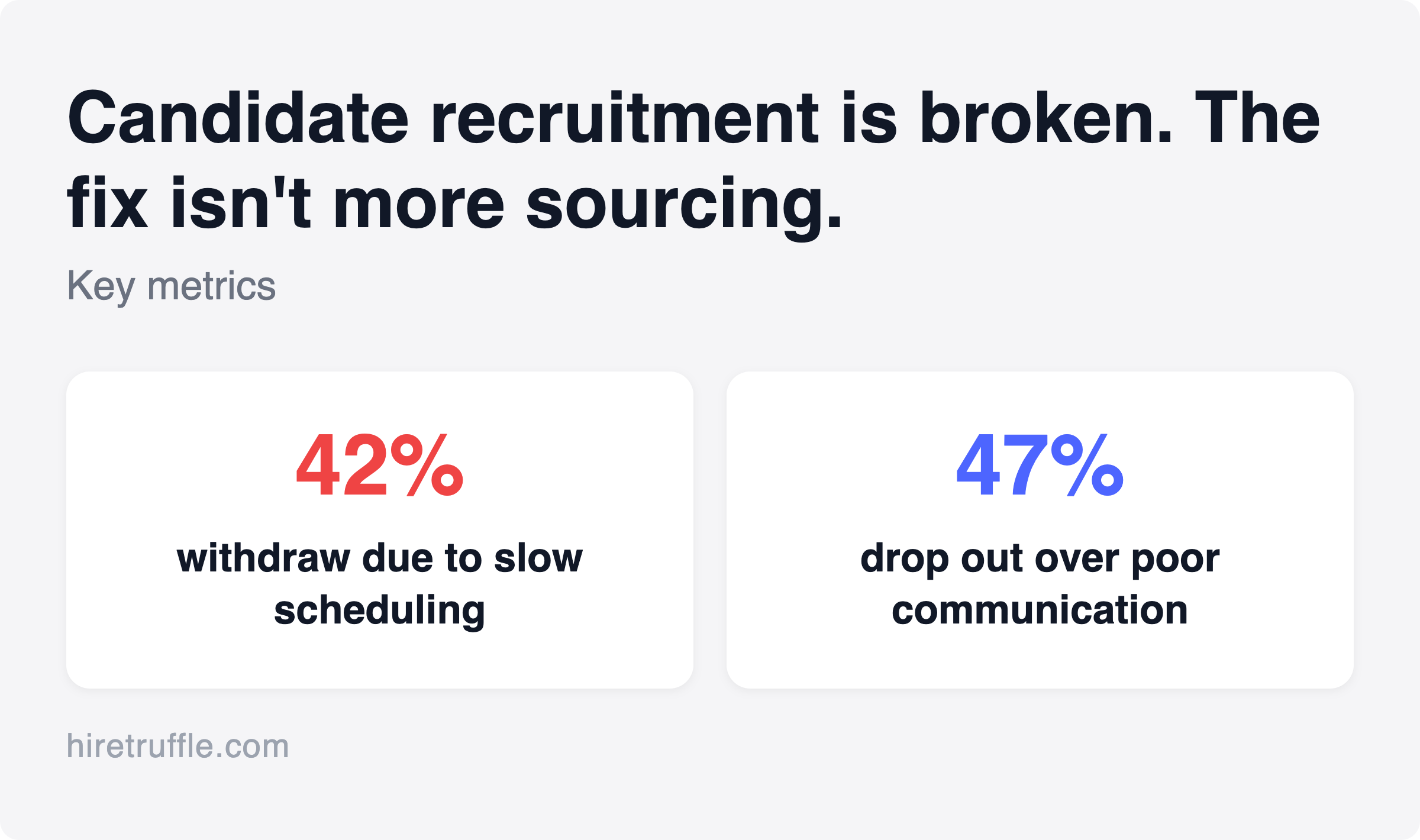
Candidates notice when your process is slow. Research consistently shows that 42% of candidates withdraw because scheduling takes too long, and 47% cite poor communication as a reason for dropping out. If it takes two weeks to get from “applied” to “first conversation,” you’ve already lost your strongest candidates to companies that moved faster.
Speed isn’t just an operational metric. It’s a candidate experience metric.
What a modern screening process looks like
The fix isn’t hiring more recruiters. It’s changing what screening looks like.
A structured screening process starts before you see a single candidate. You define what you’re looking for. Not vague qualities like “culture fit” or “strong communicator.” Specific criteria: three years of experience managing a team of five or more, familiarity with a specific tool, ability to explain complex topics simply.
Then you give every candidate the same questions and the same amount of time to answer them. Not in a phone call. In a format where they can record responses on their own schedule and you can review them when it works for you.
This is where one-way interviews change the math. Instead of scheduling 20 phone calls, you send a link. Candidates answer structured questions on video or audio. You review the responses at 2x speed during a focused block, not scattered across a week of calendar chaos.
The difference is dramatic. A phone screen takes 15 to 20 minutes of synchronous time per candidate. A recorded response review takes two to three minutes. That means you can screen 50 candidates in the time it used to take you to phone-screen five.
But speed alone isn’t the point. Structure is.
When every candidate answers the same questions, you’re comparing apples to apples. When you review them in a single sitting instead of spread across a week, your judgment is more consistent. When the criteria are defined upfront, you’re measuring against a standard instead of going on gut feel.
This is where tools like Truffle fit in. Truffle is an AI screening platform that combines resume screening, one-way video interviews, and talent assessments. It analyzes each candidate’s responses against the criteria you defined during intake, generates a match score and AI summary, and surfaces Candidate Shorts (30-second highlight reels of each candidate’s most relevant moments).
You’re not watching hours of video. You’re reviewing ranked candidates with context, then deciding who moves forward.
The AI doesn’t make the call. You do. It handles the time-consuming parts (transcription, scoring against your requirements, surfacing patterns) so you can focus on the parts that require human judgment.
How to build a candidate recruitment process that actually scales
If you’re ready to shift from a sourcing-heavy approach to a screening-smart one, here’s what it looks like in practice.
Step 1: Define your criteria before you post the position
This sounds obvious, but most recruiters skip it. They write a job description, post it, and figure out what they’re looking for as they go. That’s how you end up phone-screening 30 people with no clear standard for what “good” looks like.
Instead, spend 15 minutes with the recruiting leader answering two questions. What does success look like in this role in the first six months? What traits help people thrive on this team, and what traits don’t?
Those answers become your screening rubric. Every candidate gets measured against them.
Step 2: Replace phone screens with structured one-way interviews
You don’t need to record every candidate interaction. But that first screening call? The one where you repeat the same spiel 20 times? Replace it.
Set up five to seven structured questions that map to your criteria. Give candidates a link and a deadline. Let them record on their own time. You’ll get more thoughtful responses than you’d ever get in a rushed phone call, because candidates have time to think before they answer.
Step 3: Review in batches, not one by one
Scattered reviews kill consistency. Block 60 to 90 minutes, pull up your candidate screening dashboard, and review everyone in one sitting.
When you review in batches, you naturally compare candidates against each other. You notice patterns. You make faster, more confident decisions. And you free up the rest of your week for the work that actually needs real-time interaction: stakeholder meetings, offer negotiations, onboarding.
Step 4: Respond fast to your top matches
Once you’ve identified your top matches, move immediately. Don’t wait until Friday to send interview invitations. The data is clear: faster response times correlate with better candidate experience and lower dropout rates.
With a structured screening process, you can go from “position posted” to “shortlist identified” in 48 hours instead of two weeks. That speed advantage compounds across your hiring pipeline. Candidates who get a response within days are far more likely to stay engaged than those who wait weeks.
Frequently asked questions about candidate recruitment
Still have questions? Check out this FAQ.
How many candidates should you screen per position?
There’s no universal number. It depends on the role, the channel, and your criteria. But most positions attract 50-200+ candidates from job boards. The goal isn’t to screen fewer people. It’s to screen them faster. Structured one-way interviews let you review 50 candidates in the time it takes to phone-screen five.
What’s the difference between candidate sourcing and candidate screening?
Sourcing is finding candidates: job boards, LinkedIn outreach, referrals, career fairs. Screening is evaluating them: reviewing their qualifications, assessing fit, and deciding who moves forward. Most recruiting teams over-invest in sourcing and under-invest in screening.
How do you speed up the candidate screening process?
Replace phone screens with structured one-way interviews. Define your criteria before you post the position. Review candidates in batches instead of one by one. Use AI-assisted tools to score responses against your requirements. These changes can compress your screening timeline from weeks to days.
Do candidates prefer one-way interviews over phone screens?
Candidates prefer processes that respect their time. One-way interviews let them record on their own schedule instead of rearranging their day for a 20-minute call. The key is clear instructions, a reasonable number of questions (3-5), and a fast response from your team after they submit.
How do you build a strong hiring pipeline?
A strong hiring pipeline isn’t built by sourcing more candidates. It’s built by processing candidates faster and more consistently. Define your criteria before you post. Replace phone screens with structured one-way interviews. Review in batches. Respond to top matches within 48 hours. That cycle, done consistently, produces a candidate pool that renews itself because candidates talk about companies that treat them well.
The bigger shift: from sourcing-first to screening-first recruiting
For years, the recruiting industry has operated on a sourcing-first mental model. More job boards. More outreach. More employer branding.
The assumption is that if you put better candidates in the top of the funnel, better hires come out the bottom.
That assumption made sense when screening capacity was fixed. When the only way to evaluate a candidate was a phone call, you needed to be selective about who got that call. So you invested heavily in filters at the top: resume keywords, cover letter requirements, referral bonuses.
But screening capacity isn’t fixed anymore. When you can review 50 candidates in an hour instead of five, the calculus changes. You don’t need to over-filter at the top. You can let more people through, evaluate them consistently, and find matches you would have missed with a resume-only filter.
This is a real shift in how candidate recruitment works. The companies that respond fastest and screen most consistently will win the candidates that everyone else is still phone-screening two weeks later.
The irony is that fixing your screening process also fixes your sourcing problem. When you can process more candidates faster, your existing channels produce more results. You don’t need a fancier job board. You need a faster way to find the signal in the noise you’ve already got.
The recruiter who dreads back-to-back phone screens doesn’t need more motivation. They need a different process. One that respects their time, treats candidates consistently, and gets to a shortlist without burning through the week.
That’s not a sourcing problem. It’s a screening problem. And it’s fixable.