


You've got 200 candidates in your inbox and a hiring manager asking for a shortlist by Friday. You know AI candidate screening tools exist. You've seen the pitches. "Let AI find your best hires." "Eliminate bias with machine learning." "Automate your entire screening process."
And you're skeptical. Good.
The recruiters who are most effective with AI screening aren't the ones who hand over the reins. They're the ones who use AI to gather better evidence, faster, so they can make sharper human decisions. That's the thesis of this post: AI candidate screening works when it surfaces information for your decisions. It fails when it tries to make decisions for you.

What AI candidate screening actually does
Before you can use AI screening well, you need to understand what it's doing under the hood. Not the marketing version. The real version.
Parsing and matching resumes
AI resume screening tools read resumes and compare them against your role requirements. They use natural language processing to understand context, not just keywords. A candidate who writes "managed a team of 12" gets matched to a leadership requirement even if they never used the word "leadership."
This is useful. It's also limited. Resumes are self-reported documents. Candidates embellish. Candidates use ChatGPT to tailor their resumes to your exact position description.
A resume match score tells you what someone claims. It doesn't tell you what they can actually do.
Analyzing interview responses
Some AI screening tools go beyond resumes. They transcribe and analyze one-way interview responses, scoring each answer against criteria you define during intake. The AI identifies patterns in what candidates say, how they structure their answers, and how closely their responses align with what you asked for.
This is where AI adds the most value. Not by judging people, but by organizing information you'd otherwise spend hours gathering manually.
Ranking and surfacing patterns
After analysis, AI produces ranked lists. Candidates scored against the same criteria, in the same order, every time. No Monday-morning fatigue. No recency bias from the last phone screen.
The output isn't "hire this person." It's "based on the criteria you set, here's who aligns most closely, and here's why." That distinction matters more than most vendors will admit.
Why most AI screening tools get it wrong
If AI screening is so useful, why do so many recruiters distrust it? Because most tools are built on the wrong premise.
The black-box problem
Many automated candidate screening tools hide their reasoning. They ingest resumes or responses, run them through proprietary models, and produce scores. You can't see why a candidate scored 85 instead of 72.
You can't adjust the criteria mid-process. You can't explain the scoring to a hiring manager who asks.
Recruiters in online forums describe this frustration constantly. One put it bluntly: "No one I know feels comfortable letting AI make a decision on anything." That's not a trust problem with AI itself. It's a trust problem with tools that hide their reasoning.
When you can't see why a tool made a recommendation, you can't catch its mistakes. And AI in talent acquisition makes mistakes. It reflects whatever patterns exist in your training data. If those patterns include historical bias, the AI will reproduce it at scale, consistently and invisibly.
The "eliminates bias" overclaim
The second failure mode is the opposite: tools that promise AI screening will remove bias from hiring. According to a 2025 Pew Research survey, 66% of U.S. adults say they wouldn't apply for a position that uses AI in hiring decisions. That number reflects real concern.
No AI system eliminates bias. What good AI can do is apply your criteria consistently to every candidate. Same questions, same scoring rubric, same evaluation framework. That's consistency, not objectivity.
The difference matters, both legally and practically.
The promise should be "every candidate gets the same bar" rather than "our AI is unbiased." If a vendor tells you their AI removes bias from hiring, ask them to explain exactly how. The answer will tell you everything you need to know about whether to trust them.
What to look for in AI screening tools
Not all AI screening tools are built the same. The best ones share a few characteristics that separate them from the hype.
Transparency in scoring
You should be able to see exactly why each candidate received their score. What criteria did the AI measure against? How did this candidate's responses align? What specific moments in their interview drove the score up or down?
Transparent scoring isn't just nice to have. It's the foundation of trust. If you can't explain a score to a hiring manager, the tool is working against you, not for you.
Human control over criteria
The AI shouldn't have opinions about what makes a good candidate for your role. You should define the must-haves, nice-to-haves, and red flags during intake. The AI measures against your criteria. You own the standard.
This is where talent acquisition automation gets it right. Automate the measurement. Keep the judgment human.
Multiple screening signals
Resumes tell you one thing. Interviews tell you another. Assessments tell you something else entirely. The best AI-powered candidate screening combines multiple signals rather than relying on a single data source.
A candidate might look perfect on paper but struggle to articulate their experience in an interview. Another might have a thin resume but demonstrate exactly the problem-solving approach you need. You only catch these differences when you're screening across multiple dimensions, using resume screening tools, one-way interviews, and pre-employment assessments together.
Consistency without rigidity
Good AI screening applies the same bar to every candidate. But it should also let you adjust. If you realize mid-process that a particular criterion matters more than you expected, you should be able to update your requirements and re-evaluate.
Machine learning hiring tools that lock you into a single scoring model miss the reality of how hiring works. Requirements evolve as you see candidates. Your tools should keep up.
How AI-powered candidate screening works in practice
Theory is fine. Here's what effective AI screening actually looks like in a real workflow.
Setting up structured intake
Imagine you're hiring a customer success manager. You define your criteria upfront: 2+ years in customer-facing roles, ability to explain technical concepts clearly, comfort with ambiguity, and a collaborative working style.
These criteria become the measuring stick. Every candidate gets scored against the same list, whether they're candidate number 3 or candidate number 130.
Screening at scale without losing signal
Candidates complete a one-way interview on their own time. The AI transcribes every response, analyzes each answer against your criteria, and produces a match score with a summary explaining the reasoning.
You're not watching 130 full interviews. You're reviewing ranked summaries that show you who aligns most closely with what you defined, and why. According to hiring data, AI-assisted screening can reduce time in early-stage review by roughly 75%. That's the difference between a week of phone screens and an afternoon of focused review.
Reviewing with context, not just scores
The score is a starting point. It tells you where to focus. But you still watch the highlight moments, read the summaries, and make the call about who moves forward.
A candidate might score lower because they took a nontraditional approach to a question. That could be a red flag, or it could be exactly the creative thinking you need. The AI surfaces the pattern. You interpret it.
This is how teams doing high-volume hiring avoid the trap of either drowning in applications or letting a machine pick for them. They use AI to compress the information-gathering phase. Then they apply human judgment to a smaller, better-organized set of candidates.
The Truffle approach
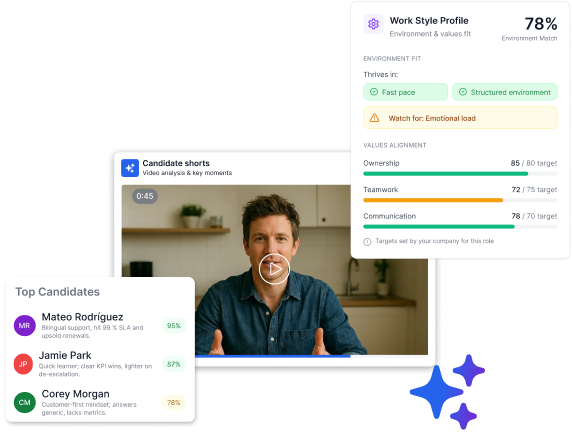
Truffle is a candidate screening platform that combines one-way video interviews, talent assessments, and resume screening. Use any on its own or combine all three. It was built around one principle: AI surfaces evidence. Humans decide.
Here's what that looks like in practice. You create a position with your criteria. Candidates submit their resume or complete a one-way interview or complete an assessment. AI analyzes every response and produces three things:
- AI Match scores each candidate against the requirements you defined during intake. You see the percentage and the reasoning behind it. Nothing is hidden.
- AI Summaries give you a concise overview of each candidate's responses with key takeaways. You orient immediately.
- Candidate Shorts surface the most revealing 30 seconds from each interview so you can see who someone is without watching every answer.
- AI Check flags when responses show patterns suggesting AI assistance, giving you context to ask better follow-up questions. Not a verdict. A signal.
All of this is included at $149/month ($99/month with annual billing). No enterprise pricing gates. No sales calls required.
The recruiters who use AI well share one belief
The split in the market isn't between recruiters who use AI and those who don't. It's between recruiters who treat AI as a decision-maker and those who treat it as evidence.
One recruiter in an online forum captured the tension: "AI is only this year starting to pop up a bit more, but no one I know feels comfortable letting AI make a decision on anything." That discomfort isn't a problem to solve. It's a signal to follow.
The recruiters who get results with AI screening are the ones who stay in the loop. They define the criteria. They review the evidence. They make the call.
AI handles the transcription, the pattern recognition, the scoring against their requirements. Humans handle the judgment.
This isn't just a philosophical preference. According to a 2025 report from Insight Global, 93% of hiring managers say human involvement in hiring decisions is still essential, even as AI adoption grows.
The recruitment funnel isn't getting replaced by AI. It's getting compressed. The same stages exist. They just happen faster because AI handles the parts that don't require human nuance.
The future of hiring isn't a choice between AI and humans. It's AI that makes every human screener faster, more consistent, and better informed. The recruiters who win the next five years won't be the ones who automated the most. They'll be the ones who used AI to see more clearly, then made better calls with what they saw.
FAQ on AI candidate screening
Still have questions? Check out this FAQ on candidate screening using AI.
Does AI candidate screening replace recruiters?
No. AI handles transcription, scoring against your criteria, and ranking. It surfaces information and patterns. Recruiters review the evidence, interpret context, and make every hiring decision. The best AI screening tools make recruiters faster, not unnecessary.
Can AI screening tools eliminate bias in hiring?
No AI system eliminates bias. What effective AI screening does is apply the same criteria consistently to every candidate. Same questions, same rubric, same evaluation framework. That's consistency, not objectivity. Look for tools with transparent scoring you can audit, not tools that claim to be bias-free.
What's the difference between AI resume screening and AI candidate screening?
AI resume screening focuses on one signal: the resume. It parses text, matches keywords, and scores qualifications. AI candidate screening is broader. It can include resume analysis, one-way video interview analysis, and assessment scoring.
More signals give you a more complete picture. A candidate who looks average on paper might stand out in an interview, and vice versa.
How much does AI candidate screening software cost?
Pricing varies widely. Enterprise tools like HireVue require custom quotes. Many AI screening tools start at $200-400/month. Truffle includes AI Match, Candidate Shorts, and AI Summaries at $149/month ($99/month with annual billing), with a 7-day free trial and no credit card required.
The TL;DR

You've got 200 candidates in your inbox and a hiring manager asking for a shortlist by Friday. You know AI candidate screening tools exist. You've seen the pitches. "Let AI find your best hires." "Eliminate bias with machine learning." "Automate your entire screening process."
And you're skeptical. Good.
The recruiters who are most effective with AI screening aren't the ones who hand over the reins. They're the ones who use AI to gather better evidence, faster, so they can make sharper human decisions. That's the thesis of this post: AI candidate screening works when it surfaces information for your decisions. It fails when it tries to make decisions for you.
What AI candidate screening actually does
Before you can use AI screening well, you need to understand what it's doing under the hood. Not the marketing version. The real version.
Parsing and matching resumes
AI resume screening tools read resumes and compare them against your role requirements. They use natural language processing to understand context, not just keywords. A candidate who writes "managed a team of 12" gets matched to a leadership requirement even if they never used the word "leadership."
This is useful. It's also limited. Resumes are self-reported documents. Candidates embellish. Candidates use ChatGPT to tailor their resumes to your exact position description.
A resume match score tells you what someone claims. It doesn't tell you what they can actually do.
Analyzing interview responses
Some AI screening tools go beyond resumes. They transcribe and analyze one-way interview responses, scoring each answer against criteria you define during intake. The AI identifies patterns in what candidates say, how they structure their answers, and how closely their responses align with what you asked for.
This is where AI adds the most value. Not by judging people, but by organizing information you'd otherwise spend hours gathering manually.
Ranking and surfacing patterns
After analysis, AI produces ranked lists. Candidates scored against the same criteria, in the same order, every time. No Monday-morning fatigue. No recency bias from the last phone screen.
The output isn't "hire this person." It's "based on the criteria you set, here's who aligns most closely, and here's why." That distinction matters more than most vendors will admit.
Why most AI screening tools get it wrong
If AI screening is so useful, why do so many recruiters distrust it? Because most tools are built on the wrong premise.
The black-box problem
Many automated candidate screening tools hide their reasoning. They ingest resumes or responses, run them through proprietary models, and produce scores. You can't see why a candidate scored 85 instead of 72.
You can't adjust the criteria mid-process. You can't explain the scoring to a hiring manager who asks.
Recruiters in online forums describe this frustration constantly. One put it bluntly: "No one I know feels comfortable letting AI make a decision on anything." That's not a trust problem with AI itself. It's a trust problem with tools that hide their reasoning.
When you can't see why a tool made a recommendation, you can't catch its mistakes. And AI in talent acquisition makes mistakes. It reflects whatever patterns exist in your training data. If those patterns include historical bias, the AI will reproduce it at scale, consistently and invisibly.
The "eliminates bias" overclaim
The second failure mode is the opposite: tools that promise AI screening will remove bias from hiring. According to a 2025 Pew Research survey, 66% of U.S. adults say they wouldn't apply for a position that uses AI in hiring decisions. That number reflects real concern.
No AI system eliminates bias. What good AI can do is apply your criteria consistently to every candidate. Same questions, same scoring rubric, same evaluation framework. That's consistency, not objectivity.
The difference matters, both legally and practically.
The promise should be "every candidate gets the same bar" rather than "our AI is unbiased." If a vendor tells you their AI removes bias from hiring, ask them to explain exactly how. The answer will tell you everything you need to know about whether to trust them.
What to look for in AI screening tools
Not all AI screening tools are built the same. The best ones share a few characteristics that separate them from the hype.
Transparency in scoring
You should be able to see exactly why each candidate received their score. What criteria did the AI measure against? How did this candidate's responses align? What specific moments in their interview drove the score up or down?
Transparent scoring isn't just nice to have. It's the foundation of trust. If you can't explain a score to a hiring manager, the tool is working against you, not for you.
Human control over criteria
The AI shouldn't have opinions about what makes a good candidate for your role. You should define the must-haves, nice-to-haves, and red flags during intake. The AI measures against your criteria. You own the standard.
This is where talent acquisition automation gets it right. Automate the measurement. Keep the judgment human.
Multiple screening signals
Resumes tell you one thing. Interviews tell you another. Assessments tell you something else entirely. The best AI-powered candidate screening combines multiple signals rather than relying on a single data source.
A candidate might look perfect on paper but struggle to articulate their experience in an interview. Another might have a thin resume but demonstrate exactly the problem-solving approach you need. You only catch these differences when you're screening across multiple dimensions, using resume screening tools, one-way interviews, and pre-employment assessments together.
Consistency without rigidity
Good AI screening applies the same bar to every candidate. But it should also let you adjust. If you realize mid-process that a particular criterion matters more than you expected, you should be able to update your requirements and re-evaluate.
Machine learning hiring tools that lock you into a single scoring model miss the reality of how hiring works. Requirements evolve as you see candidates. Your tools should keep up.
How AI-powered candidate screening works in practice
Theory is fine. Here's what effective AI screening actually looks like in a real workflow.
Setting up structured intake
Imagine you're hiring a customer success manager. You define your criteria upfront: 2+ years in customer-facing roles, ability to explain technical concepts clearly, comfort with ambiguity, and a collaborative working style.
These criteria become the measuring stick. Every candidate gets scored against the same list, whether they're candidate number 3 or candidate number 130.
Screening at scale without losing signal
Candidates complete a one-way interview on their own time. The AI transcribes every response, analyzes each answer against your criteria, and produces a match score with a summary explaining the reasoning.
You're not watching 130 full interviews. You're reviewing ranked summaries that show you who aligns most closely with what you defined, and why. According to hiring data, AI-assisted screening can reduce time in early-stage review by roughly 75%. That's the difference between a week of phone screens and an afternoon of focused review.
Reviewing with context, not just scores
The score is a starting point. It tells you where to focus. But you still watch the highlight moments, read the summaries, and make the call about who moves forward.
A candidate might score lower because they took a nontraditional approach to a question. That could be a red flag, or it could be exactly the creative thinking you need. The AI surfaces the pattern. You interpret it.
This is how teams doing high-volume hiring avoid the trap of either drowning in applications or letting a machine pick for them. They use AI to compress the information-gathering phase. Then they apply human judgment to a smaller, better-organized set of candidates.
The Truffle approach
Truffle is a candidate screening platform that combines one-way video interviews, talent assessments, and resume screening. Use any on its own or combine all three. It was built around one principle: AI surfaces evidence. Humans decide.
Here's what that looks like in practice. You create a position with your criteria. Candidates submit their resume or complete a one-way interview or complete an assessment. AI analyzes every response and produces three things:
- AI Match scores each candidate against the requirements you defined during intake. You see the percentage and the reasoning behind it. Nothing is hidden.
- AI Summaries give you a concise overview of each candidate's responses with key takeaways. You orient immediately.
- Candidate Shorts surface the most revealing 30 seconds from each interview so you can see who someone is without watching every answer.
- AI Check flags when responses show patterns suggesting AI assistance, giving you context to ask better follow-up questions. Not a verdict. A signal.
All of this is included at $149/month ($99/month with annual billing). No enterprise pricing gates. No sales calls required.
The recruiters who use AI well share one belief
The split in the market isn't between recruiters who use AI and those who don't. It's between recruiters who treat AI as a decision-maker and those who treat it as evidence.
One recruiter in an online forum captured the tension: "AI is only this year starting to pop up a bit more, but no one I know feels comfortable letting AI make a decision on anything." That discomfort isn't a problem to solve. It's a signal to follow.
The recruiters who get results with AI screening are the ones who stay in the loop. They define the criteria. They review the evidence. They make the call.
AI handles the transcription, the pattern recognition, the scoring against their requirements. Humans handle the judgment.
This isn't just a philosophical preference. According to a 2025 report from Insight Global, 93% of hiring managers say human involvement in hiring decisions is still essential, even as AI adoption grows.
The recruitment funnel isn't getting replaced by AI. It's getting compressed. The same stages exist. They just happen faster because AI handles the parts that don't require human nuance.
The future of hiring isn't a choice between AI and humans. It's AI that makes every human screener faster, more consistent, and better informed. The recruiters who win the next five years won't be the ones who automated the most. They'll be the ones who used AI to see more clearly, then made better calls with what they saw.
FAQ on AI candidate screening
Still have questions? Check out this FAQ on candidate screening using AI.
Does AI candidate screening replace recruiters?
No. AI handles transcription, scoring against your criteria, and ranking. It surfaces information and patterns. Recruiters review the evidence, interpret context, and make every hiring decision. The best AI screening tools make recruiters faster, not unnecessary.
Can AI screening tools eliminate bias in hiring?
No AI system eliminates bias. What effective AI screening does is apply the same criteria consistently to every candidate. Same questions, same rubric, same evaluation framework. That's consistency, not objectivity. Look for tools with transparent scoring you can audit, not tools that claim to be bias-free.
What's the difference between AI resume screening and AI candidate screening?
AI resume screening focuses on one signal: the resume. It parses text, matches keywords, and scores qualifications. AI candidate screening is broader. It can include resume analysis, one-way video interview analysis, and assessment scoring.
More signals give you a more complete picture. A candidate who looks average on paper might stand out in an interview, and vice versa.
How much does AI candidate screening software cost?
Pricing varies widely. Enterprise tools like HireVue require custom quotes. Many AI screening tools start at $200-400/month. Truffle includes AI Match, Candidate Shorts, and AI Summaries at $149/month ($99/month with annual billing), with a 7-day free trial and no credit card required.



Try Truffle instead.