



You placed 30 candidates last quarter. You also screened 600 to get there. That ratio, roughly 20 candidates reviewed for every placement, is the math that defines staffing work. And it's the math that's breaking your calendar.
Most of the time you spend isn't on the part that makes placements stick. It's on the first pass. Reading resumes. Scheduling intro calls. Asking the same qualifying questions for the fourth time before lunch. The conversations that matter, the ones where you gauge personality, assess culture alignment with a client, or coach a candidate through negotiation, those happen after you've already spent hours sorting through the pile.
AI staffing tools promise to fix this. Some of them actually do. But the conversation around AI in the staffing industry has gotten noisy enough that it's hard to tell which tools solve real problems and which ones just add another dashboard to your workflow.
Here's the honest breakdown.

The volume problem staffing agencies can't outrun
Staffing is a volume business. That's not a complaint. It's the model. You fill positions faster than internal teams can, and you do it by keeping a wider pipeline of candidates moving at all times.
And staffing automation hasn't kept pace. Most agencies are still running their first-pass screens the way they were a decade ago.
The problem isn't volume itself. It's that every screening step is still manual for most agencies.
Imagine you're running a staffing desk with 12 open positions across 4 clients. Each position gets 40 to 80 candidates per week from job board postings and your existing database. That's somewhere between 480 and 960 candidates hitting your desk every week. Even if you spend just 3 minutes per candidate on an initial screen, you're looking at 24 to 48 hours of first-pass review per week.
Nobody has that kind of time. So what happens? You skim. You sort by keyword. You make gut calls based on the first 10 seconds of a resume. Candidates who might be great matches slip through because you physically can't review them all.
This is the problem AI is built to solve. Not the judgment calls. Not the client relationships. The sheer volume of first-pass screening that bottlenecks everything else.
What AI staffing actually looks like today
The term "AI staffing" covers a wide range of tools, from resume parsing to full candidate matching platforms. Here's what the real landscape looks like, stripped of vendor hype.
As of 2025, 61% of staffing firms already use AI, up from 48% the year before. The adoption is real. The results vary widely depending on how firms actually deploy these tools.
Resume parsing and matching
These tools extract structured data from resumes (skills, experience, certifications) and compare it against position requirements. They've been around for years, and the newer versions are meaningfully better than the keyword-matching systems you might have tried in 2019. They rank candidates by how closely their profile aligns with the criteria you set.
Automated screening interviews
Instead of scheduling a 15-minute phone call with every candidate, you send a link. Candidates record video or audio responses to your screening questions on their own time. AI transcribes and analyzes each response against the criteria you've defined. You get a ranked shortlist with summaries instead of a voicemail box full of callbacks. One-way video interview software has made this the most practical entry point for agencies that want to cut screening time without overhauling their entire process.
Candidate scoring and ranking
AI compares each candidate's qualifications and responses against the specific requirements of the position. You set the criteria (must-have certifications, years of experience, specific skills). AI scores how closely each candidate matches. You still review. You still decide. But you start with a sorted list instead of a random pile.
Outreach automation
Some tools automate candidate communication, scheduling, and follow-up. These sit closer to CRM than AI, but they're often bundled under the "AI staffing" umbrella. This is where the staffing automation category gets murky. Not everything labeled "AI" involves machine learning. A lot of it is rules-based workflow automation wearing a newer label.
What none of these tools do is replace the staffing professional. They don't build client relationships. They don't coach candidates on how to present themselves. They don't call a hiring manager to understand why the last three placements didn't work out. They don't catch the soft signals that tell you whether a candidate will actually thrive in a specific environment.
AI handles the mechanical screening. You handle everything that requires human context.
Where AI fits in the staffing workflow (and where it doesn't)
Think of your workflow as two distinct phases.
- Phase 1: Sort and surface. This is where AI shines. Taking a large pool of candidates and organizing it into a ranked, scored shortlist based on the criteria that matter for each position. Transcribing screening responses so you can read instead of listen. Flagging which candidates meet basic qualifications so you don't spend time on candidates who don't have the required certifications.
- Phase 2: Assess and place. This is where you earn your fee. Reading a candidate's energy during a conversation. Knowing that Client A cares about communication style more than technical skills. Understanding that the hiring manager at Company B has rejected the last three candidates who seemed "overqualified" on paper. Coaching a candidate to negotiate salary without overplaying their hand.
AI is excellent at Phase 1. It can process 200 candidates faster than you can process 20. It applies the same criteria to every candidate without getting tired at 4pm on a Friday. It doesn't skip candidates because their resume format is annoying.
AI is not equipped for Phase 2. The nuanced, relational, context-dependent work that makes staffing agencies valuable is exactly the kind of work that AI can't do. No algorithm understands why your best client prefers candidates who ask a lot of questions in interviews. No scoring model captures the gut feeling you get when a candidate's enthusiasm doesn't match their resume.
The agencies getting AI right don't treat it as a replacement. They treat it as a layer that clears the bottleneck so their recruiters spend more time on Phase 2.
Here's a simple scenario. A staffing coordinator at a mid-size agency manages 8 active positions. Before AI, she spends Monday through Wednesday just doing initial screens. Calls, resume reviews, qualification checks. She doesn't start her real matchmaking work until Thursday. With applicant screening software handling the first pass, she gets scored shortlists by Monday afternoon. She spends the rest of the week on client conversations, candidate prep, and the relationship work that drives placements.
Same number of placements. Half the screening time. More time on the work that actually differentiates her from the next agency.

The staffing agency advantage with AI
Here's something that doesn't get talked about enough. Staffing agencies, and specifically AI staffing agencies that have deployed screening tools well, have a structural advantage over in-house teams for AI-assisted screening.
In-house recruiters might hire for 5 to 10 positions per quarter. A staffing agency fills that many in a week. The volume of candidates flowing through a staffing firm means AI's impact compounds faster. Every hour saved on screening multiplies across dozens of concurrent positions.
Consider the math for a 20-person staffing agency. If each recruiter screens 50 candidates per day manually and AI cuts that first-pass time by 60-70%, the firm recovers hundreds of recruiter-hours per month. Those hours don't disappear. They move to higher-value activities: client development, candidate relationship building, and the follow-up work that improves retention after placement. Research backs this up: recruiters who use automation fill 64% more vacancies than those who don't.
For RPO (recruitment process outsourcing) firms, the case is even clearer. RPOs are often measured on time-to-fill and cost-per-hire. AI-assisted screening compresses the front end of the pipeline without cutting corners. You present qualified shortlists to clients faster. Your candidates are better aligned because every one of them was scored against the actual criteria, not just keyword-matched from a database search. If you want to understand how AI for staffing agencies differs from how internal teams use the same tools, this is the key distinction: staffing firms have both the volume to justify the investment and a direct financial incentive to move fast.
Temp agencies see a different advantage. When you're filling 50 warehouse positions by Friday, you don't have time to individually assess each candidate. AI can rank candidates by qualification match, flag missing certifications, and surface the strongest fits instantly. You still make the placement call. But you're working from a prioritized list instead of a random candidate queue. For a deeper look at how volume screening plays out at scale, see how teams approach high-volume hiring differently once AI is handling the first pass.
How to pick the right AI staffing tools without getting burned
The AI staffing market is crowded. Not every tool is worth your time or your budget. AI staffing solutions range from narrow resume parsers to full screening platforms, and the pitch decks tend to blur the distinctions. Here's what to look for, based on how staffing agencies actually work.
- Does it show its reasoning? If a tool scores a candidate at 85% match, you should be able to see why. What criteria drove that score? What did the candidate say or demonstrate that aligned with the position requirements? Staffing recruiters need to explain their shortlists to clients. "The AI said so" isn't an explanation. "She scored 92% on your must-have criteria because she has the certification, 6 years of relevant experience, and demonstrated clear alignment with your team priorities" is.
- Does it work with your ATS? A tool that lives in a silo creates more work, not less. Check for integrations with your existing systems. You shouldn't have to copy-paste candidate data between platforms. This is one of the most common complaints with AI recruiting tools: great screening capability, no connection to the rest of your workflow. See what to look for in AI recruiting software before you commit.
Does it handle your actual workflow?
Staffing agencies work differently from internal HR teams. You manage multiple clients, each with different criteria. You need a tool that lets you configure screening per position, not one that applies the same generic filter across everything.
Is it a layer or a takeover?
The best AI tools augment your process. They sit between the candidate pool and your review. The worst ones try to replace your process entirely, forcing you into their workflow instead of fitting into yours.
What happens to the candidates?
AI should surface information. It shouldn't reject anyone on your behalf. A strong AI staffing tool ranks and organizes. It doesn't silently discard candidates who might be a fit for a different client or a future position.
What AI-assisted screening looks like in practice
Here's where the concepts become concrete.
With one-way video interviews, you send candidates a link instead of scheduling a call. They record their responses on their own time. No calendar coordination. No phone tag. No 15-minute calls that turn into 3-minute disqualifications.
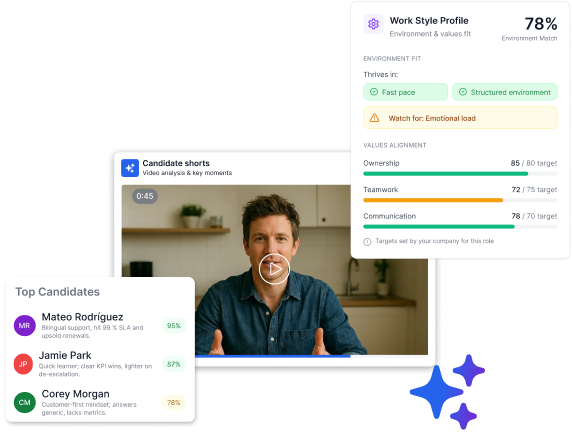
Truffle takes this further. Once candidates complete their interviews, AI transcribes and analyzes every response against the criteria you've defined for that position. You get three things that change how you review:
- AI Match scores. Each candidate receives a match percentage based on how closely their responses align with the position requirements you set. Not a generic "quality" score. A transparent alignment score based on your criteria, for this specific position. You can see exactly what drove the number. Sort by score, filter by threshold (80%+, 90%+), and focus your attention on the candidates who most closely fit what you need.
- Candidate Shorts. AI surfaces the most revealing moments from each interview and compiles them into a 30-second highlight reel. Instead of watching 15 minutes of video per candidate, you see the clips that matter most. For staffing agencies, this is a game-changer when presenting candidates to clients. Share a 30-second clip instead of asking a hiring manager to watch a full recording.
- AI Summaries. A concise overview of each candidate's responses, highlighting key strengths and alignment with the position criteria. Think of it as the brief you'd normally write after a phone screen, generated for every candidate automatically.
The workflow looks like this: You create a position with your client's specific requirements. You send the Position Link to candidates or post it on job boards. Candidates complete the screening on their own time. You open your dashboard and see every candidate ranked by match score, with summaries and highlight clips ready for review.
Instead of spending 3 hours on first-pass phone screens, you spend 30 minutes reviewing AI-surfaced insights. You spend the other 2.5 hours on client calls, candidate prep, and placements.
The bigger shift AI is driving in staffing
The staffing industry is at an interesting inflection point. For decades, the competitive advantage in staffing has been speed and relationships. The agency that could fill a position fastest with a reliable candidate won the business. Recruiting automation is changing what "fastest" means. Not by cutting corners, but by removing the manual bottlenecks that slow the front end of every search.
AI doesn't change that equation. It amplifies it. The agencies that adopt AI-assisted screening will be faster. Not because they cut corners, but because they spend less time on the parts of the process that don't require human expertise.
The more interesting shift is what happens to the recruiter's role. When first-pass screening is handled, recruiters become more like talent consultants. They spend more time understanding client needs, coaching candidates, and building the kind of deep relationships that lead to repeat business and referrals. If you're thinking about the broader implications for your team, the discussions around talent acquisition AI and AI recruiting assistants are worth reading alongside this one.
That's not a threat to staffing professionals. It's a return to what the role was supposed to be before the sheer volume of candidates turned every recruiter into a resume-reading machine.
The agencies that figure this out first won't just be faster at filling positions. They'll be better at it. Because their recruiters will have the time to do the work that actually matters.
Frequently asked questions about AI staffing
Still have questions? Get them answered here.
What does an AI staffing agency actually do differently?
An AI staffing agency uses AI tools to handle first-pass screening: ranking candidates against position criteria, transcribing screening interviews, and surfacing a scored shortlist before a human recruiter reviews anyone. The agency itself still manages client relationships, candidate coaching, and final placement decisions. The difference is speed and capacity: an AI-assisted recruiter can cover more positions without sacrificing quality on the candidates they do engage.
How is AI in the staffing industry different from AI in internal HR teams?
The core difference is volume and financial pressure. Internal HR teams might hire for a handful of roles per quarter. A staffing firm might fill that many in a week across multiple clients. AI's impact compounds at higher volumes, which means AI in the staffing industry tends to show clearer ROI faster than the same tools deployed in-house. Staffing firms also have a direct billing incentive to move quickly. Slower time-to-submit means lost client business, not just a delayed start date.
Will AI replace staffing agency recruiters?
No. AI handles the parts of staffing that don't require human judgment: sorting large candidate pools, scoring responses against criteria, flagging qualification gaps, and reducing administrative work. It doesn't replace the relationship layer: understanding client culture, coaching candidates on negotiation, reading the soft signals that determine whether a placement will stick. The staffing professionals most at risk are those who resist adopting AI tools, not those who use them. Agencies that integrate AI screening can take on more positions with the same headcount, which actually increases the value of their recruiters.
What should I look for in AI staffing solutions?
Three things matter most. First, transparency: the tool should show you why a candidate scored the way they did, not just give you a number. You need to explain your shortlists to clients. Second, workflow fit: AI staffing solutions should add a layer to your process, not force you to abandon your ATS or existing candidate database. Third, per-position configurability: staffing work means different criteria for every client and every role. A tool that applies the same generic filter to everything will rank the wrong candidates.
Want to see how Truffle handles AI-assisted screening for staffing agencies? Start a free trial. No credit card required.
The TL;DR

You placed 30 candidates last quarter. You also screened 600 to get there. That ratio, roughly 20 candidates reviewed for every placement, is the math that defines staffing work. And it's the math that's breaking your calendar.
Most of the time you spend isn't on the part that makes placements stick. It's on the first pass. Reading resumes. Scheduling intro calls. Asking the same qualifying questions for the fourth time before lunch. The conversations that matter, the ones where you gauge personality, assess culture alignment with a client, or coach a candidate through negotiation, those happen after you've already spent hours sorting through the pile.
AI staffing tools promise to fix this. Some of them actually do. But the conversation around AI in the staffing industry has gotten noisy enough that it's hard to tell which tools solve real problems and which ones just add another dashboard to your workflow.
Here's the honest breakdown.
The volume problem staffing agencies can't outrun
Staffing is a volume business. That's not a complaint. It's the model. You fill positions faster than internal teams can, and you do it by keeping a wider pipeline of candidates moving at all times.
And staffing automation hasn't kept pace. Most agencies are still running their first-pass screens the way they were a decade ago.
The problem isn't volume itself. It's that every screening step is still manual for most agencies.
Imagine you're running a staffing desk with 12 open positions across 4 clients. Each position gets 40 to 80 candidates per week from job board postings and your existing database. That's somewhere between 480 and 960 candidates hitting your desk every week. Even if you spend just 3 minutes per candidate on an initial screen, you're looking at 24 to 48 hours of first-pass review per week.
Nobody has that kind of time. So what happens? You skim. You sort by keyword. You make gut calls based on the first 10 seconds of a resume. Candidates who might be great matches slip through because you physically can't review them all.
This is the problem AI is built to solve. Not the judgment calls. Not the client relationships. The sheer volume of first-pass screening that bottlenecks everything else.
What AI staffing actually looks like today
The term "AI staffing" covers a wide range of tools, from resume parsing to full candidate matching platforms. Here's what the real landscape looks like, stripped of vendor hype.
As of 2025, 61% of staffing firms already use AI, up from 48% the year before. The adoption is real. The results vary widely depending on how firms actually deploy these tools.
Resume parsing and matching
These tools extract structured data from resumes (skills, experience, certifications) and compare it against position requirements. They've been around for years, and the newer versions are meaningfully better than the keyword-matching systems you might have tried in 2019. They rank candidates by how closely their profile aligns with the criteria you set.
Automated screening interviews
Instead of scheduling a 15-minute phone call with every candidate, you send a link. Candidates record video or audio responses to your screening questions on their own time. AI transcribes and analyzes each response against the criteria you've defined. You get a ranked shortlist with summaries instead of a voicemail box full of callbacks. One-way video interview software has made this the most practical entry point for agencies that want to cut screening time without overhauling their entire process.
Candidate scoring and ranking
AI compares each candidate's qualifications and responses against the specific requirements of the position. You set the criteria (must-have certifications, years of experience, specific skills). AI scores how closely each candidate matches. You still review. You still decide. But you start with a sorted list instead of a random pile.
Outreach automation
Some tools automate candidate communication, scheduling, and follow-up. These sit closer to CRM than AI, but they're often bundled under the "AI staffing" umbrella. This is where the staffing automation category gets murky. Not everything labeled "AI" involves machine learning. A lot of it is rules-based workflow automation wearing a newer label.
What none of these tools do is replace the staffing professional. They don't build client relationships. They don't coach candidates on how to present themselves. They don't call a hiring manager to understand why the last three placements didn't work out. They don't catch the soft signals that tell you whether a candidate will actually thrive in a specific environment.
AI handles the mechanical screening. You handle everything that requires human context.
Where AI fits in the staffing workflow (and where it doesn't)
Think of your workflow as two distinct phases.
- Phase 1: Sort and surface. This is where AI shines. Taking a large pool of candidates and organizing it into a ranked, scored shortlist based on the criteria that matter for each position. Transcribing screening responses so you can read instead of listen. Flagging which candidates meet basic qualifications so you don't spend time on candidates who don't have the required certifications.
- Phase 2: Assess and place. This is where you earn your fee. Reading a candidate's energy during a conversation. Knowing that Client A cares about communication style more than technical skills. Understanding that the hiring manager at Company B has rejected the last three candidates who seemed "overqualified" on paper. Coaching a candidate to negotiate salary without overplaying their hand.
AI is excellent at Phase 1. It can process 200 candidates faster than you can process 20. It applies the same criteria to every candidate without getting tired at 4pm on a Friday. It doesn't skip candidates because their resume format is annoying.
AI is not equipped for Phase 2. The nuanced, relational, context-dependent work that makes staffing agencies valuable is exactly the kind of work that AI can't do. No algorithm understands why your best client prefers candidates who ask a lot of questions in interviews. No scoring model captures the gut feeling you get when a candidate's enthusiasm doesn't match their resume.
The agencies getting AI right don't treat it as a replacement. They treat it as a layer that clears the bottleneck so their recruiters spend more time on Phase 2.
Here's a simple scenario. A staffing coordinator at a mid-size agency manages 8 active positions. Before AI, she spends Monday through Wednesday just doing initial screens. Calls, resume reviews, qualification checks. She doesn't start her real matchmaking work until Thursday. With applicant screening software handling the first pass, she gets scored shortlists by Monday afternoon. She spends the rest of the week on client conversations, candidate prep, and the relationship work that drives placements.
Same number of placements. Half the screening time. More time on the work that actually differentiates her from the next agency.
The staffing agency advantage with AI
Here's something that doesn't get talked about enough. Staffing agencies, and specifically AI staffing agencies that have deployed screening tools well, have a structural advantage over in-house teams for AI-assisted screening.
In-house recruiters might hire for 5 to 10 positions per quarter. A staffing agency fills that many in a week. The volume of candidates flowing through a staffing firm means AI's impact compounds faster. Every hour saved on screening multiplies across dozens of concurrent positions.
Consider the math for a 20-person staffing agency. If each recruiter screens 50 candidates per day manually and AI cuts that first-pass time by 60-70%, the firm recovers hundreds of recruiter-hours per month. Those hours don't disappear. They move to higher-value activities: client development, candidate relationship building, and the follow-up work that improves retention after placement. Research backs this up: recruiters who use automation fill 64% more vacancies than those who don't.
For RPO (recruitment process outsourcing) firms, the case is even clearer. RPOs are often measured on time-to-fill and cost-per-hire. AI-assisted screening compresses the front end of the pipeline without cutting corners. You present qualified shortlists to clients faster. Your candidates are better aligned because every one of them was scored against the actual criteria, not just keyword-matched from a database search. If you want to understand how AI for staffing agencies differs from how internal teams use the same tools, this is the key distinction: staffing firms have both the volume to justify the investment and a direct financial incentive to move fast.
Temp agencies see a different advantage. When you're filling 50 warehouse positions by Friday, you don't have time to individually assess each candidate. AI can rank candidates by qualification match, flag missing certifications, and surface the strongest fits instantly. You still make the placement call. But you're working from a prioritized list instead of a random candidate queue. For a deeper look at how volume screening plays out at scale, see how teams approach high-volume hiring differently once AI is handling the first pass.
How to pick the right AI staffing tools without getting burned
The AI staffing market is crowded. Not every tool is worth your time or your budget. AI staffing solutions range from narrow resume parsers to full screening platforms, and the pitch decks tend to blur the distinctions. Here's what to look for, based on how staffing agencies actually work.
- Does it show its reasoning? If a tool scores a candidate at 85% match, you should be able to see why. What criteria drove that score? What did the candidate say or demonstrate that aligned with the position requirements? Staffing recruiters need to explain their shortlists to clients. "The AI said so" isn't an explanation. "She scored 92% on your must-have criteria because she has the certification, 6 years of relevant experience, and demonstrated clear alignment with your team priorities" is.
- Does it work with your ATS? A tool that lives in a silo creates more work, not less. Check for integrations with your existing systems. You shouldn't have to copy-paste candidate data between platforms. This is one of the most common complaints with AI recruiting tools: great screening capability, no connection to the rest of your workflow. See what to look for in AI recruiting software before you commit.
Does it handle your actual workflow?
Staffing agencies work differently from internal HR teams. You manage multiple clients, each with different criteria. You need a tool that lets you configure screening per position, not one that applies the same generic filter across everything.
Is it a layer or a takeover?
The best AI tools augment your process. They sit between the candidate pool and your review. The worst ones try to replace your process entirely, forcing you into their workflow instead of fitting into yours.
What happens to the candidates?
AI should surface information. It shouldn't reject anyone on your behalf. A strong AI staffing tool ranks and organizes. It doesn't silently discard candidates who might be a fit for a different client or a future position.
What AI-assisted screening looks like in practice
Here's where the concepts become concrete.
With one-way video interviews, you send candidates a link instead of scheduling a call. They record their responses on their own time. No calendar coordination. No phone tag. No 15-minute calls that turn into 3-minute disqualifications.
Truffle takes this further. Once candidates complete their interviews, AI transcribes and analyzes every response against the criteria you've defined for that position. You get three things that change how you review:
- AI Match scores. Each candidate receives a match percentage based on how closely their responses align with the position requirements you set. Not a generic "quality" score. A transparent alignment score based on your criteria, for this specific position. You can see exactly what drove the number. Sort by score, filter by threshold (80%+, 90%+), and focus your attention on the candidates who most closely fit what you need.
- Candidate Shorts. AI surfaces the most revealing moments from each interview and compiles them into a 30-second highlight reel. Instead of watching 15 minutes of video per candidate, you see the clips that matter most. For staffing agencies, this is a game-changer when presenting candidates to clients. Share a 30-second clip instead of asking a hiring manager to watch a full recording.
- AI Summaries. A concise overview of each candidate's responses, highlighting key strengths and alignment with the position criteria. Think of it as the brief you'd normally write after a phone screen, generated for every candidate automatically.
The workflow looks like this: You create a position with your client's specific requirements. You send the Position Link to candidates or post it on job boards. Candidates complete the screening on their own time. You open your dashboard and see every candidate ranked by match score, with summaries and highlight clips ready for review.
Instead of spending 3 hours on first-pass phone screens, you spend 30 minutes reviewing AI-surfaced insights. You spend the other 2.5 hours on client calls, candidate prep, and placements.
The bigger shift AI is driving in staffing
The staffing industry is at an interesting inflection point. For decades, the competitive advantage in staffing has been speed and relationships. The agency that could fill a position fastest with a reliable candidate won the business. Recruiting automation is changing what "fastest" means. Not by cutting corners, but by removing the manual bottlenecks that slow the front end of every search.
AI doesn't change that equation. It amplifies it. The agencies that adopt AI-assisted screening will be faster. Not because they cut corners, but because they spend less time on the parts of the process that don't require human expertise.
The more interesting shift is what happens to the recruiter's role. When first-pass screening is handled, recruiters become more like talent consultants. They spend more time understanding client needs, coaching candidates, and building the kind of deep relationships that lead to repeat business and referrals. If you're thinking about the broader implications for your team, the discussions around talent acquisition AI and AI recruiting assistants are worth reading alongside this one.
That's not a threat to staffing professionals. It's a return to what the role was supposed to be before the sheer volume of candidates turned every recruiter into a resume-reading machine.
The agencies that figure this out first won't just be faster at filling positions. They'll be better at it. Because their recruiters will have the time to do the work that actually matters.
Frequently asked questions about AI staffing
Still have questions? Get them answered here.
What does an AI staffing agency actually do differently?
An AI staffing agency uses AI tools to handle first-pass screening: ranking candidates against position criteria, transcribing screening interviews, and surfacing a scored shortlist before a human recruiter reviews anyone. The agency itself still manages client relationships, candidate coaching, and final placement decisions. The difference is speed and capacity: an AI-assisted recruiter can cover more positions without sacrificing quality on the candidates they do engage.
How is AI in the staffing industry different from AI in internal HR teams?
The core difference is volume and financial pressure. Internal HR teams might hire for a handful of roles per quarter. A staffing firm might fill that many in a week across multiple clients. AI's impact compounds at higher volumes, which means AI in the staffing industry tends to show clearer ROI faster than the same tools deployed in-house. Staffing firms also have a direct billing incentive to move quickly. Slower time-to-submit means lost client business, not just a delayed start date.
Will AI replace staffing agency recruiters?
No. AI handles the parts of staffing that don't require human judgment: sorting large candidate pools, scoring responses against criteria, flagging qualification gaps, and reducing administrative work. It doesn't replace the relationship layer: understanding client culture, coaching candidates on negotiation, reading the soft signals that determine whether a placement will stick. The staffing professionals most at risk are those who resist adopting AI tools, not those who use them. Agencies that integrate AI screening can take on more positions with the same headcount, which actually increases the value of their recruiters.
What should I look for in AI staffing solutions?
Three things matter most. First, transparency: the tool should show you why a candidate scored the way they did, not just give you a number. You need to explain your shortlists to clients. Second, workflow fit: AI staffing solutions should add a layer to your process, not force you to abandon your ATS or existing candidate database. Third, per-position configurability: staffing work means different criteria for every client and every role. A tool that applies the same generic filter to everything will rank the wrong candidates.
Want to see how Truffle handles AI-assisted screening for staffing agencies? Start a free trial. No credit card required.



Try Truffle instead.