What is a video interview? Types, how they work, and why companies use them
A video interview is a screening format where candidates respond to interview questions on video. There are two types: live (both people present) and one-way (candidates record answers on their own schedule). This post explains how each works, when companies use them, and what to expect as a candidate.


AI summary
- A video interview is either a live call (like Zoom) or a one-way recording where candidates answer preset questions on their own time. They solve different problems.
- One-way interviews replace the phone screen. Same questions for every candidate, no scheduling, and review time drops from 40 hours to under 3 for a typical hiring round.
- The format feels unfamiliar to candidates, but it gives everyone an equal shot at being seen regardless of schedule, time zone, or who happened to book the first call slot.
You get an email from a recruiter: “We’d like to invite you to a video interview.” You click the link expecting a Zoom calendar invite. Instead, you’re looking at a page with a record button and a countdown timer. No recruiter. No live call. Just you, a camera, and a set of questions.
If that experience caught you off guard, you’re not alone. And if you’re on the employer side wondering why candidates keep asking “is this a real interview?”, the confusion runs both ways.
A video interview isn’t one thing. It’s two very different formats that share a name, and the difference between them changes everything about how the process works for both sides. Understanding that distinction is the whole point of this post.
What a video interview actually is
A video interview is a screening format where candidates respond to interview questions via video. That’s the broad definition, and it covers two distinct formats.
The first is a live video interview: both the interviewer and candidate are present at the same time, typically on Zoom, Google Meet, or Teams. It looks and feels like a regular interview, just through a screen.
The second is a one-way video interview (sometimes called an on-demand interview or video screening): candidates record answers to preset questions on their own schedule. No interviewer is present. The employer reviews responses later, on their own time.
These two formats are often lumped together under “video interview,” which causes the confusion. They serve different purposes, suit different stages of hiring, and create different experiences for everyone involved.
Live video interviews vs. one-way video interviews
The easiest way to understand the difference is to think about what each format is optimized for.
- A live video interview is optimized for conversation. You can ask follow-up questions. You can read reactions in real time. You can go off-script when something interesting comes up. For final-round conversations, panel discussions, or any moment where dialogue matters, live is the right call.
- A one-way video interview is optimized for scale. The employer sets the questions once, every candidate answers the same set, and review happens in batches. There’s no scheduling required. They send a link. Candidates respond when it works for them. The team reviews when it works for them.
Neither format is better in the abstract. They solve different problems.
Live works best for: final interviews, senior roles where conversation quality matters, situations where the company needs to sell itself to competitive candidates.
One-way works best for: first-round screening, high-volume positions, roles where you need to evaluate a lot of candidates efficiently before investing time in live conversations.
Most teams that use one-way interviews aren’t replacing live interviews. They’re replacing the phone screen. The 20-minute call that happens before anyone decides whether a live interview is worth scheduling.
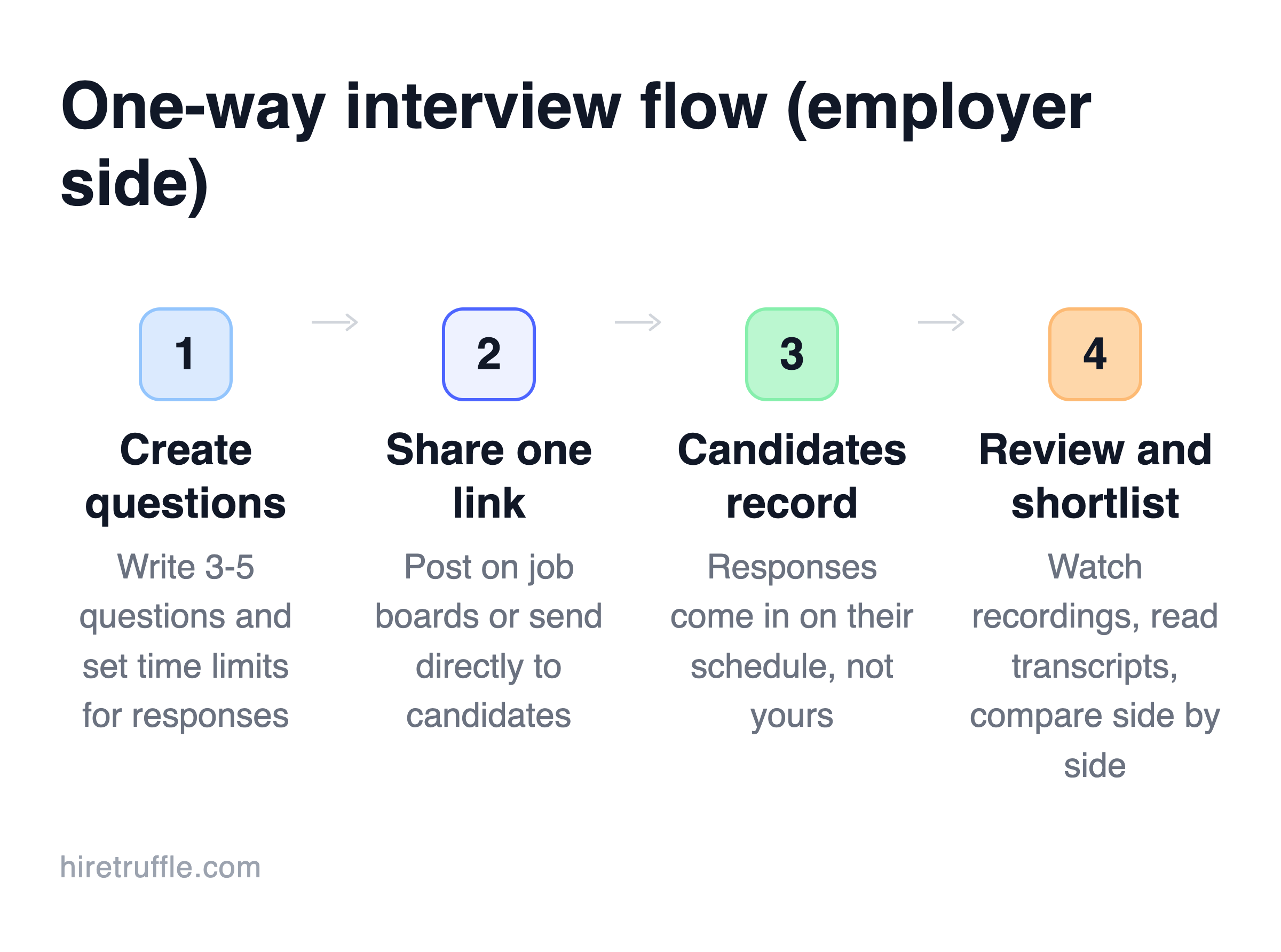
How one-way interviews work (employer side)
How a one-way video interview works (from both sides)
Here’s how both types of video interviews work.
The employer side
You start by creating an interview. You write 3 to 5 questions, set time limits for responses (usually 1 to 3 minutes per question), and decide how much thinking time candidates get before the recording starts. Most platforms let you configure the number of retakes too.
Once the interview is live, you get a link. You put that link on your job posting, send it to candidates directly, or both. Anyone who clicks the link can complete the interview without you scheduling anything.
When a candidate finishes, you get notified. You log in and review responses at whatever time works for you. You can watch full recordings, read transcripts, and compare candidates side by side. Modern platforms add AI-assisted analysis on top of this: automatic transcription, summaries of each candidate’s responses, and scoring against the criteria you defined when setting up the interview.
Here’s what that looks like in practice. Say you’re hiring a customer success manager at a 70-person software company. You post the role on Monday and get 90 applications by Wednesday. Instead of scheduling 90 phone screens, you send a one-way interview link. By Friday, 60 candidates have completed it. You spend two hours reviewing responses, and you have a shortlist of 12 people worth a live conversation. You’ve done what used to take three weeks of scheduling in a single afternoon.
The candidate side
You get a link, usually in an email from the company’s hiring platform. You click it and land on a page with the company’s branding, a welcome message, and instructions.
You complete a quick mic and camera check. Then the questions start.
Each question appears on screen with a countdown. You get a moment to think before recording begins. You record your response, and depending on the settings, you may have the option to retake it once or twice. After you’ve answered all the questions, you submit.
The whole thing typically takes 10 to 20 minutes. You do it on your schedule. Early morning, lunch break, Sunday evening. There’s no coordination required with the hiring team.
Candidates sometimes find this format strange at first, especially if they’ve never done it before. Talking to a camera without anyone on the other end doesn’t feel like a “real” conversation. That’s a fair reaction. The format is designed for a different purpose than conversation. It gives you a fair shot to put your best answer on record, on your own time, without the added pressure of someone watching and reacting in real time.
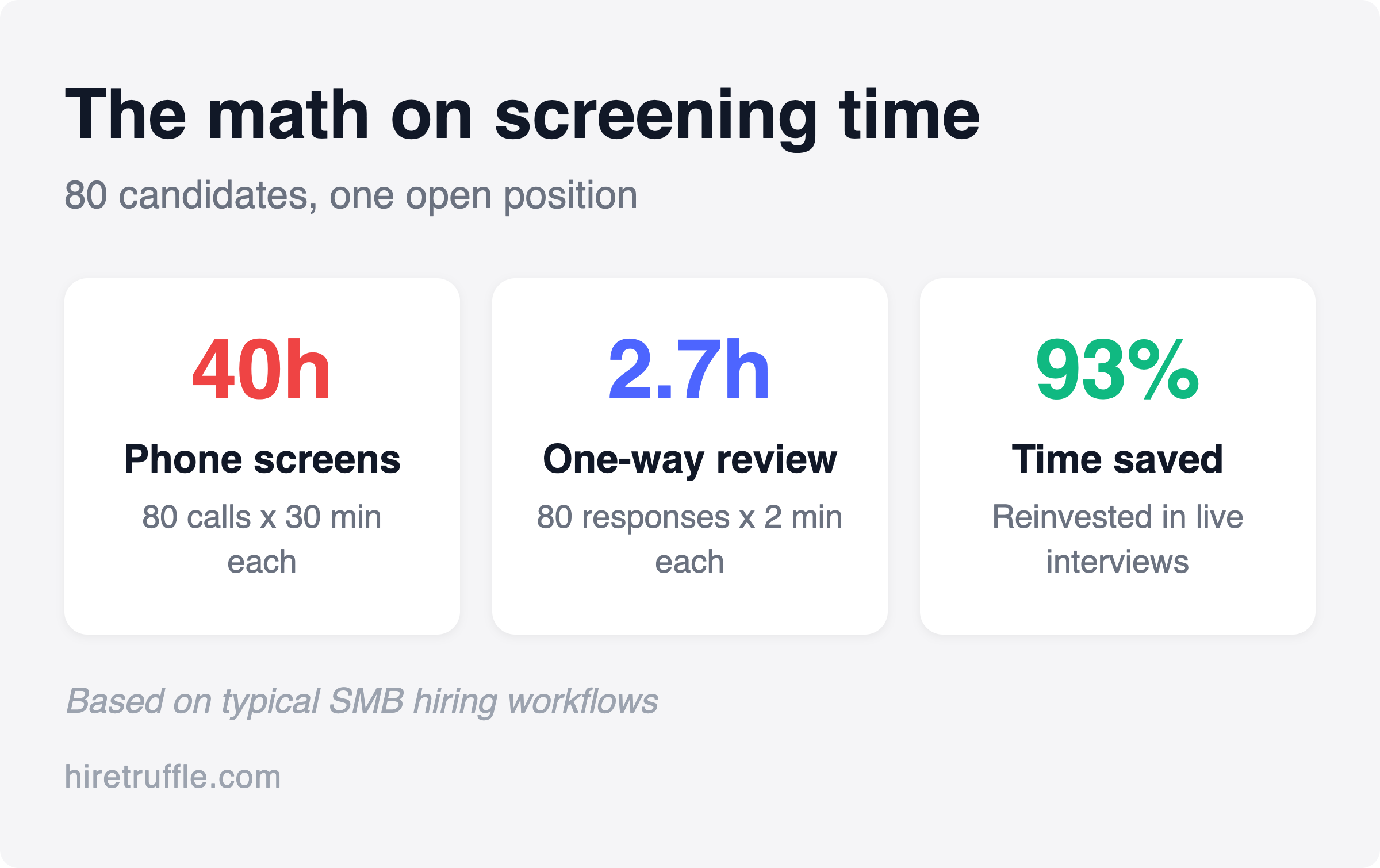
The math on screening time
Why companies use video interviews
Four things drive adoption, and they’re all interconnected.
Time
The math on phone screens is brutal. A recruiter running first-round screens for an open position might spend 15 to 20 hours on calls, plus the time coordinating schedules. Multiply that by a few open positions and it’s a part-time job on its own.
One-way interviews don’t eliminate that time entirely. Someone still has to review responses. But reviewing a recorded answer takes 3 to 5 minutes. Scheduling and completing a phone screen takes 30 to 45 minutes. The math shifts fast.
Consistency
Live phone screens vary. Different interviewers ask different questions. The same interviewer asks questions differently depending on how the conversation is going. One candidate gets a follow-up that clarifies their answer; another doesn’t. One call runs 40 minutes; the next runs 15.
One-way interviews apply the same questions, in the same order, to every candidate. Everyone gets the same information about the role. Everyone gets the same amount of thinking time. The variability doesn’t disappear entirely. Different people review responses differently. But the input is consistent.
Candidate flexibility
A first-round phone screen requires a candidate to be available at a specific time, often during working hours. If they’re currently employed, that’s a hurdle. They might need to take a long lunch, find a quiet spot away from colleagues, or use PTO.
One-way interviews remove that constraint. A candidate can complete the interview at 9pm after the kids are in bed. They can do it from their car during a break. They can take time to think through their answers without a recruiter waiting on the other end of the line. For candidates balancing existing jobs, caregiving responsibilities, or unusual schedules, this matters.
Seeing beyond the resume
A resume tells you what someone has done. It doesn’t tell you how they communicate, how they think through a problem, or what kind of presence they bring. Even a transcript of a phone screen loses something in the translation.
A video response gives you all of that. And it gives it to you from every candidate, not just the ones you happened to have strong chemistry with on a phone call.
The candidate experience: what to expect and why it’s designed this way
The most common reaction candidates have to one-way interviews is “this feels impersonal.” That reaction is understandable. The design intent behind the format is often misunderstood.
One-way interviews aren’t designed to replace human connection. They’re designed to give every candidate an equal shot at being seen before a human makes any decisions. In a typical phone-screen process, candidates who happen to schedule early get more attention. Candidates who have stronger verbal chemistry with a particular recruiter get further. One-way interviews don’t fix everything, but they do mean every candidate goes through the same evaluation, not just the ones who made the schedule.
The “impersonal” feeling is partly a familiarity issue. The format is newer, and unfamiliar formats feel colder until they become normal. Many companies now add a personal welcome video from the recruiting leader at the start of the interview, which changes the tone considerably. HR teams can also create videos with AI using tools like invideo Agent to showcase workplace culture, introduce teams, and help candidates better understand the company before joining.
If you’re completing a one-way interview as a candidate, a few things help:
You don’t need studio lighting or a professional setup. A reasonably quiet space with decent light (facing a window works) is all you need. Companies reviewing one-way interviews know you’re recording from home.
Read the question carefully before the thinking time starts. You can’t reread the question while you’re recording. Taking the thinking time seriously, even if it feels awkward to sit quietly for 30 seconds, will make your answer better.
Most platforms give you at least one retake. Use it if your first take was genuinely rough. Don’t redo a take just because you weren’t perfect. Imperfect answers that sound like you often read better than polished answers that sound rehearsed.
And no, you don’t need to be “on” the entire time. Thoughtful pauses are fine. You’re showing how you think, not how fast you talk.
How Truffle approaches one-way video interviews
Truffle is an AI screening platform that combines one-way video interviews, talent assessments, and resume screening. Use any on its own or combine all three.
When companies build one-way interviews with Truffle, the setup process is structured around the role, not just the format. You define what a good candidate looks like: key traits, what success looks like in the first 6 months, any must-have qualifications. That intake becomes the basis for the AI analysis after candidates complete the interview.
Once responses come in, the AI transcribes every answer and generates a match percentage showing how closely each candidate aligns with the criteria you defined. It surfaces key insights from each profile, and creates Candidate Shorts: curated clips of the most revealing moments from each interview so you can get a sense of a candidate in 30 seconds before deciding whether to watch the full thing.
The AI doesn’t decide who moves forward. You do. The analysis is there to help you prioritize your review time. When you sit down with 60 completed interviews, you’re not starting from scratch. You can see which candidates have the strongest alignment with your requirements, watch their Shorts, read the summaries, and make confident decisions without spending hours on raw footage.
Teams typically start with the self-serve plans from $49/month, credit-based, with one shared monthly pool of credits across resume screening, one-way interviews, and assessments. There’s a 7-day free trial with 30 credits and no credit card required if you want to run a test interview before committing.
- For a deeper look at how to design questions that get useful responses, see video interview tips for employers.
- Need question ideas? Check out one-way interview questions that reveal candidate fit.
- Want to combine video with structured evaluation? See our guide to video assessment.
And if you’re ready to go deeper on the one-way format specifically, the guide to one-way video interviews covers implementation in detail.
The bigger shift behind the format
Video interviews solve a scheduling problem. But the more interesting change they represent is structural.
Traditional hiring assumes that the people evaluating candidates and the candidates being evaluated need to be available at the same time. That assumption shapes everything: when positions get posted, how long hiring takes, which candidates make it through, and how much the process costs.
One-way interviews break that assumption. When screening is decoupled from scheduling, the candidate pool widens. People who can’t take calls during business hours get the same access as everyone else. The currently-employed, the caregivers, the ones in different time zones. The process doesn’t favor whoever had a free Tuesday afternoon.
That’s not a small thing. It changes who gets seen, and by extension, who gets hired.
The technology is just the mechanism. The shift is the idea that the first conversation between a company and a candidate doesn’t have to happen at the same time.
Frequently asked questions
Still have questions? Check out this FAQ.
Is a video interview the same as a Zoom call?
Not exactly. A live video interview on Zoom is one type of video interview. But “video interview” increasingly refers to one-way formats, where candidates record answers to preset questions without a live interviewer present. The two formats serve different purposes: live for conversation and follow-up, one-way for efficient first-round screening.
Do I need special equipment for a one-way video interview?
No. A standard laptop or phone with a built-in camera and microphone is fine. Most platforms run entirely in the browser. No downloads required. A reasonably quiet space with decent light is all you need. Hiring teams reviewing one-way interviews know candidates are recording from home and don’t expect professional production quality.
How long does a one-way video interview take?
Most one-way interviews run 10 to 20 minutes. The number of questions (typically 3 to 5) and the response time limits set by the employer determine the total length. Candidates can complete the interview at any time, on any device, without needing to schedule with anyone.
Can employers tell if you used AI to write your answers?
Some platforms include AI detection features that flag response patterns consistent with AI-generated text. Truffle’s AI Check surfaces this as a context signal so employers can follow up with questions if they want to learn more. It’s not a verdict or an automatic disqualification. Companies using these tools are primarily looking for candidates who can think on their feet. Authentic answers, even imperfect ones, tend to land better than polished AI-assisted responses.