



You post a position on a Monday. By Wednesday, you've got 40 candidates. Half of them aren't even close. Ten are maybes. Three look genuinely strong.
By Friday, two of those three have accepted offers somewhere else.
That's the talent shortage in action. Not a lack of people applying. A lack of qualified candidates willing to wait for your process to catch up.
The talent shortage has been building for years. Demographics are shifting. Skills gaps are widening. And the candidates you actually want? They have options. They're moving fast. If your hiring process isn't keeping pace, you're not just falling behind. You're actively pushing good people toward your competitors.
Most companies respond to a talent shortage by doing exactly the wrong thing. They add more interview rounds. They raise requirements. They build longer, more cautious processes designed to avoid mistakes. The result? The candidates with the most options leave first. And you're left picking from whoever had the patience to wait.
The fix isn't better filtering. It's speed.

What's actually driving the talent shortage
The talent shortage isn't one problem. It's four problems stacking on top of each other.
Demographics. Baby boomers are retiring faster than younger workers are entering the labor market. The Bureau of Labor Statistics projects the labor force participation rate will continue declining through 2030. There are simply fewer working-age people available for every open position than there were a decade ago.
Skills gaps. Roles are evolving faster than the workforce can keep up. A marketing manager hired in 2020 now needs to understand AI tools, analytics platforms, and content automation that didn't exist when they started. Nursing programs can't graduate students fast enough to replace retiring nurses. The gap between what positions require and what candidates can offer keeps growing.
Geographic mismatches. Remote work reshuffled the deck. Candidates in smaller markets now compete for positions at companies in major metros. That's great for candidates. But it also means a 150-person company in Ohio is now competing with firms in Austin and Denver for the same people. Your local labor pool isn't local anymore.
Expectation shifts. Candidates want speed, transparency, and flexibility. A 2025 Robert Half survey found that candidates who don't hear back within two weeks often move on entirely. They expect to know the timeline, the salary range, and the next steps before they invest serious time. If your process feels opaque or slow, they'll assume the worst.
These four forces aren't temporary. They're structural. Which means the talent shortage isn't a phase you wait out. It's the new baseline.
Which industries are hit hardest
Not every industry feels the squeeze equally. Some are dealing with a severe talent shortage. Others are drowning in volume but starving for quality.
Healthcare is the most visible example. Nursing shortages have reached critical levels in rural areas. The Health Resources and Services Administration projects a shortfall of tens of thousands of nurses through 2030. Hiring timelines for specialized roles can stretch past 90 days.
Skilled trades are similarly strained. Electricians, plumbers, and HVAC technicians are aging out of the workforce. Trade school enrollment hasn't kept pace with demand. Construction companies regularly report that they can't find enough qualified workers to take on new projects.
Technology has its own version of the problem. Despite layoffs in big tech making headlines, mid-market companies still struggle to hire experienced engineers, especially outside of coastal tech hubs. The candidates are there. They just have three other offers.
Hospitality and retail face high turnover compounded by candidate expectations. A restaurant manager posting a line cook position might get 80 candidates. But completion rates on multi-step applications are low. And the candidates who do complete the process often accept the first offer they get.
Imagine you're the HR manager at a 120-person manufacturing company. You have six open positions. For each one, you've received maybe two or three qualified candidates. And those candidates are interviewing at two or three other companies simultaneously. You don't just need to find them. You need to move faster than everyone else who found them too.
Your hiring process is probably making it worse
Here's where most companies get the talent shortage wrong. They treat it like a sourcing problem. "We need more candidates." So they post on more boards, pay for more sponsorship, expand their reach.
But the real bottleneck isn't the top of the funnel. It's the middle.
Think about what happens after a qualified candidate applies. They submit their resume. Someone reviews it (eventually). They get scheduled for a phone screen (days later). The phone screen happens (if both sides can find 30 minutes). Then there's a panel interview, maybe a skills test, then references, then an offer.
That process takes most companies two to four weeks. Some take longer.
Now think about the candidate's side. They applied to your position. They also applied to four others. The company that responds first, screens fastest, and makes a decision within a week? That's the one getting the offer accepted.
A study on hiring timelines consistently shows the same pattern: the longer your process takes, the more likely you are to lose your top candidates. Not because they failed your evaluation. Because they got tired of waiting.
Here's a scenario that plays out constantly. You review a candidate's resume on Monday. You like what you see. You send them a phone screen invite for Thursday. By Thursday, they've already done a one-way interview for a competitor, received feedback, and have a final interview scheduled. Your phone screen is their backup plan. And backup plans don't usually win.
Ghosting is the other side of this coin. Recruiters complain about candidates disappearing mid-process. But candidates ghost for a reason. They found something faster. A slow process doesn't just cost you hires. It damages your employer brand. Candidates talk. They post on Glassdoor. They tell friends. A reputation for slow, opaque hiring is hard to shake.
How to compete when talent is scarce
If the talent shortage is structural (and it is), the companies that win aren't the ones who find a magic sourcing channel. They're the ones who convert candidates faster.
Here's what that looks like in practice.
Cut steps, don't add them. Every additional step in your process is a point where candidates drop off. A phone screen followed by a panel interview followed by a case study followed by references is four chances for someone to accept another offer. Ask yourself: which of these steps actually changes your decision? If a step doesn't change who you'd hire, cut it.
Screen before you schedule. Phone screens exist because you need to verify fit before investing in a longer interview. But a phone screen requires synchronous time from both sides. That's a scheduling bottleneck by design. If you can screen faster without requiring both people to be available at the same time, you remove the biggest delay in your process.
Widen your criteria. The talent shortage gets worse when you require credentials that don't predict performance. Does a customer support manager really need a bachelor's degree? Does a project coordinator need five years of experience, or would three years plus strong communication be enough? When qualified candidates are scarce, requirements that filter on credentials instead of capability shrink your pool for no good reason.
Be transparent about timeline. Tell candidates exactly what your process looks like and how long it takes. "You'll hear from us within 48 hours" is a competitive advantage when three other companies said "we'll be in touch." Candidates choose the company that respects their time. In a talent shortage, that's not a nice-to-have. It's a differentiator.
Prioritize candidate experience. A clunky application portal that requires an account creation. A process that makes candidates repeat information they already submitted. These aren't minor annoyances. They're filters that select for desperation. The candidates with the most options are the first to abandon a frustrating process.
What faster screening actually looks like
Speed matters. But not at the cost of quality. The goal isn't to hire without thinking. It's to get to your shortlist faster so you can spend your time on the conversations that matter.
One-way interviews are one way companies are compressing their screening timeline. Instead of scheduling 30-minute phone screens with 20 candidates across two weeks, candidates record their responses on their own time. You review them when you're ready. No scheduling, no phone tag, no two-week delay before you've heard a single voice.
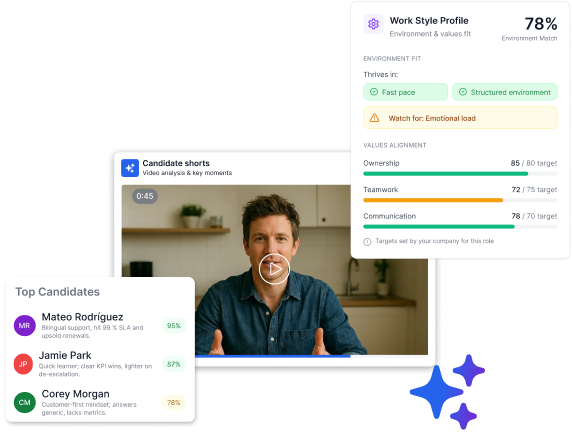
Truffle is a candidate screening platform that combines resume screening, one-way video interviews, and talent assessments. It takes one-way interviews further. When candidates complete their responses, AI analyzes every answer against the criteria you defined during intake. It generates AI Match scores showing how closely each candidate aligns with your requirements. It creates AI summaries with key takeaways so you can orient before watching any video. And Candidate Shorts surface the most revealing moments from each interview in roughly 30 seconds.
The result: you go from 50 candidates to a ranked shortlist in minutes instead of weeks. You still watch the video. You still make every decision. But you're making those decisions on day two instead of day fourteen. In a talent shortage, that's the difference between hiring your top candidate and watching them accept somewhere else.
A position that used to take three weeks of phone screens can now be shortlisted in an afternoon. That's not a marginal improvement. That's a structural advantage in a market where speed wins.
The talent shortage is the new normal
The demographic shifts aren't reversing. Skills gaps are accelerating, not closing. Remote work permanently expanded the competitive landscape for talent. These trends don't have an expiration date.
Which means the companies that adapt their hiring process will keep winning. And the ones that don't will keep asking why their offers get rejected.
But most people miss something about the talent shortage. It doesn't just reward speed. It rewards respect. The companies that treat candidates like human beings, that communicate clearly, move quickly, and don't waste anyone's time, build reputations that compound. Good candidates refer other good candidates. Glassdoor reviews improve. Your inbound pipeline gets stronger over time.
The talent shortage isn't a problem you solve once. It's a pressure that reshapes how you hire permanently. The question isn't whether you'll adapt. It's whether you'll adapt before the candidates you want have already moved on.
The TL;DR

You post a position on a Monday. By Wednesday, you've got 40 candidates. Half of them aren't even close. Ten are maybes. Three look genuinely strong.
By Friday, two of those three have accepted offers somewhere else.
That's the talent shortage in action. Not a lack of people applying. A lack of qualified candidates willing to wait for your process to catch up.
The talent shortage has been building for years. Demographics are shifting. Skills gaps are widening. And the candidates you actually want? They have options. They're moving fast. If your hiring process isn't keeping pace, you're not just falling behind. You're actively pushing good people toward your competitors.
Most companies respond to a talent shortage by doing exactly the wrong thing. They add more interview rounds. They raise requirements. They build longer, more cautious processes designed to avoid mistakes. The result? The candidates with the most options leave first. And you're left picking from whoever had the patience to wait.
The fix isn't better filtering. It's speed.
What's actually driving the talent shortage
The talent shortage isn't one problem. It's four problems stacking on top of each other.
Demographics. Baby boomers are retiring faster than younger workers are entering the labor market. The Bureau of Labor Statistics projects the labor force participation rate will continue declining through 2030. There are simply fewer working-age people available for every open position than there were a decade ago.
Skills gaps. Roles are evolving faster than the workforce can keep up. A marketing manager hired in 2020 now needs to understand AI tools, analytics platforms, and content automation that didn't exist when they started. Nursing programs can't graduate students fast enough to replace retiring nurses. The gap between what positions require and what candidates can offer keeps growing.
Geographic mismatches. Remote work reshuffled the deck. Candidates in smaller markets now compete for positions at companies in major metros. That's great for candidates. But it also means a 150-person company in Ohio is now competing with firms in Austin and Denver for the same people. Your local labor pool isn't local anymore.
Expectation shifts. Candidates want speed, transparency, and flexibility. A 2025 Robert Half survey found that candidates who don't hear back within two weeks often move on entirely. They expect to know the timeline, the salary range, and the next steps before they invest serious time. If your process feels opaque or slow, they'll assume the worst.
These four forces aren't temporary. They're structural. Which means the talent shortage isn't a phase you wait out. It's the new baseline.
Which industries are hit hardest
Not every industry feels the squeeze equally. Some are dealing with a severe talent shortage. Others are drowning in volume but starving for quality.
Healthcare is the most visible example. Nursing shortages have reached critical levels in rural areas. The Health Resources and Services Administration projects a shortfall of tens of thousands of nurses through 2030. Hiring timelines for specialized roles can stretch past 90 days.
Skilled trades are similarly strained. Electricians, plumbers, and HVAC technicians are aging out of the workforce. Trade school enrollment hasn't kept pace with demand. Construction companies regularly report that they can't find enough qualified workers to take on new projects.
Technology has its own version of the problem. Despite layoffs in big tech making headlines, mid-market companies still struggle to hire experienced engineers, especially outside of coastal tech hubs. The candidates are there. They just have three other offers.
Hospitality and retail face high turnover compounded by candidate expectations. A restaurant manager posting a line cook position might get 80 candidates. But completion rates on multi-step applications are low. And the candidates who do complete the process often accept the first offer they get.
Imagine you're the HR manager at a 120-person manufacturing company. You have six open positions. For each one, you've received maybe two or three qualified candidates. And those candidates are interviewing at two or three other companies simultaneously. You don't just need to find them. You need to move faster than everyone else who found them too.
Your hiring process is probably making it worse
Here's where most companies get the talent shortage wrong. They treat it like a sourcing problem. "We need more candidates." So they post on more boards, pay for more sponsorship, expand their reach.
But the real bottleneck isn't the top of the funnel. It's the middle.
Think about what happens after a qualified candidate applies. They submit their resume. Someone reviews it (eventually). They get scheduled for a phone screen (days later). The phone screen happens (if both sides can find 30 minutes). Then there's a panel interview, maybe a skills test, then references, then an offer.
That process takes most companies two to four weeks. Some take longer.
Now think about the candidate's side. They applied to your position. They also applied to four others. The company that responds first, screens fastest, and makes a decision within a week? That's the one getting the offer accepted.
A study on hiring timelines consistently shows the same pattern: the longer your process takes, the more likely you are to lose your top candidates. Not because they failed your evaluation. Because they got tired of waiting.
Here's a scenario that plays out constantly. You review a candidate's resume on Monday. You like what you see. You send them a phone screen invite for Thursday. By Thursday, they've already done a one-way interview for a competitor, received feedback, and have a final interview scheduled. Your phone screen is their backup plan. And backup plans don't usually win.
Ghosting is the other side of this coin. Recruiters complain about candidates disappearing mid-process. But candidates ghost for a reason. They found something faster. A slow process doesn't just cost you hires. It damages your employer brand. Candidates talk. They post on Glassdoor. They tell friends. A reputation for slow, opaque hiring is hard to shake.
How to compete when talent is scarce
If the talent shortage is structural (and it is), the companies that win aren't the ones who find a magic sourcing channel. They're the ones who convert candidates faster.
Here's what that looks like in practice.
Cut steps, don't add them. Every additional step in your process is a point where candidates drop off. A phone screen followed by a panel interview followed by a case study followed by references is four chances for someone to accept another offer. Ask yourself: which of these steps actually changes your decision? If a step doesn't change who you'd hire, cut it.
Screen before you schedule. Phone screens exist because you need to verify fit before investing in a longer interview. But a phone screen requires synchronous time from both sides. That's a scheduling bottleneck by design. If you can screen faster without requiring both people to be available at the same time, you remove the biggest delay in your process.
Widen your criteria. The talent shortage gets worse when you require credentials that don't predict performance. Does a customer support manager really need a bachelor's degree? Does a project coordinator need five years of experience, or would three years plus strong communication be enough? When qualified candidates are scarce, requirements that filter on credentials instead of capability shrink your pool for no good reason.
Be transparent about timeline. Tell candidates exactly what your process looks like and how long it takes. "You'll hear from us within 48 hours" is a competitive advantage when three other companies said "we'll be in touch." Candidates choose the company that respects their time. In a talent shortage, that's not a nice-to-have. It's a differentiator.
Prioritize candidate experience. A clunky application portal that requires an account creation. A process that makes candidates repeat information they already submitted. These aren't minor annoyances. They're filters that select for desperation. The candidates with the most options are the first to abandon a frustrating process.
What faster screening actually looks like
Speed matters. But not at the cost of quality. The goal isn't to hire without thinking. It's to get to your shortlist faster so you can spend your time on the conversations that matter.
One-way interviews are one way companies are compressing their screening timeline. Instead of scheduling 30-minute phone screens with 20 candidates across two weeks, candidates record their responses on their own time. You review them when you're ready. No scheduling, no phone tag, no two-week delay before you've heard a single voice.
Truffle is a candidate screening platform that combines resume screening, one-way video interviews, and talent assessments. It takes one-way interviews further. When candidates complete their responses, AI analyzes every answer against the criteria you defined during intake. It generates AI Match scores showing how closely each candidate aligns with your requirements. It creates AI summaries with key takeaways so you can orient before watching any video. And Candidate Shorts surface the most revealing moments from each interview in roughly 30 seconds.
The result: you go from 50 candidates to a ranked shortlist in minutes instead of weeks. You still watch the video. You still make every decision. But you're making those decisions on day two instead of day fourteen. In a talent shortage, that's the difference between hiring your top candidate and watching them accept somewhere else.
A position that used to take three weeks of phone screens can now be shortlisted in an afternoon. That's not a marginal improvement. That's a structural advantage in a market where speed wins.
The talent shortage is the new normal
The demographic shifts aren't reversing. Skills gaps are accelerating, not closing. Remote work permanently expanded the competitive landscape for talent. These trends don't have an expiration date.
Which means the companies that adapt their hiring process will keep winning. And the ones that don't will keep asking why their offers get rejected.
But most people miss something about the talent shortage. It doesn't just reward speed. It rewards respect. The companies that treat candidates like human beings, that communicate clearly, move quickly, and don't waste anyone's time, build reputations that compound. Good candidates refer other good candidates. Glassdoor reviews improve. Your inbound pipeline gets stronger over time.
The talent shortage isn't a problem you solve once. It's a pressure that reshapes how you hire permanently. The question isn't whether you'll adapt. It's whether you'll adapt before the candidates you want have already moved on.



Try Truffle instead.