Why candidates reject your job offers (and how to fix it)
You screened the pile, ran the interviews, and picked your person. Then they said no. Most declined offers trace back to something fixable in your process. Here are the seven reasons candidates say no, with a diagnosis and a fix for each.


AI summary
- A declined offer is usually a process failure, not a flaky candidate. Comp surprises, slow timelines, vague role scope, and counter offers all surface weeks before the offer if you ask about them early.
- Speed matters more than most owners think. Aim for four or fewer stages and about two weeks from application to offer. While you schedule a third interview, the candidate you want is accepting somewhere faster.
- Track every decline in a simple spreadsheet: pay, timeline, experience, counter offer, scope, flexibility, or stability. Fix the biggest category first, then check whether the next quarter's declines actually moved.
I’ve extended a lot of offers over my career, and I’ve had my share turned down. The ones that sting are the ones you never saw coming. The candidate who was enthusiastic on Thursday and gone by Monday.
Sometimes they don’t even say no. “Career catfishing” is when a candidate accepts an offer, sometimes signs the contract, and then never shows up. In a UK poll of 1,000 workers, 34% of Gen Z respondents admitted to doing exactly that.
When you’re the one doing the hiring, a declined offer isn’t a statistic. It’s three weeks of screening and interviewing you did at night, gone, and the role still open. The good news is that most rejection reasons are operational. You can diagnose them, and you can fix them.
And if you fix all seven of these and an offer still gets declined? It was probably them, not you.
Declined offers are process failures, not bad luck
Before you conclude that candidates are flaky, work through this list. Treat declines like a leak in a funnel: find where it’s leaking, fix that spot, and measure whether the fix held.
1. Your pay is below market, or just unclear
The diagnosis: The candidate goes quiet after the comp conversation. You hear “I got a higher offer elsewhere,” but the real problem is often earlier: you never shared a range, the bonus was vague, or the offer introduced surprises. A different title. Benefits that didn’t match what they assumed.
The fix: Share your range in the first conversation. Build a one-page summary covering base, any bonus, benefits, and start-date flexibility. Then pre-close before the formal offer: “If we land at $X to $Y with those benefits, are you ready to move forward?” You want comp confirmed in stage one, not discovered in stage four.
And if a bigger company can outbid your base salary, stop competing on base salary. Show the whole package instead. I wrote a separate guide on presenting total compensation so your offer gets compared on the real number.
2. Your process is too slow
The diagnosis: Five stages. Week-long gaps between them. When hiring is something you do between the jobs that actually pay the bills, those gaps happen by accident. The candidate doesn’t know you were slammed this week. They just know another company got them an offer first.
The fix: My benchmark is four or fewer stages and roughly two weeks from application to offer. Compress the front: candidate screening software like Truffle reads every resume and runs the first interview for you, so you’re not phone-screening 40 people to find 5 worth your time. Then decide within 24 hours of each interview. Speed reads as seriousness. Silence reads as indifference.
3. The interview experience put them off
The diagnosis: You showed up late or hadn’t read their resume. The conversation felt like an interrogation. You and the manager they’d report to gave different answers about the same role. Candidates treat the interview as a preview of working for you, because it is.
The fix: One person owns each candidate relationship (at a small company, that’s probably you), with an update every 48 hours even if the update is “still scheduling.” Before each stage, tell them the format, the length, and who they’ll meet. And evaluate everyone on the same criteria. Structured questions and talent assessments make the process feel fair to candidates and make your decision defensible to you.
4. Their current employer countered
The diagnosis: The candidate resigned, their boss asked for a day, and came back with a raise, a promotion, or a promise that things will change. This is the decline that blindsides owners most, and it happens to good candidates precisely because they’re good.
The fix: Pre-empt it. Ask in the interview: “If you resign, what do you think your employer will do to keep you?” Get them to think it through before the offer exists. When they accept, rehearse the resignation conversation with them and remind them of the reasons they told you they were leaving. It also helps to know the outcome data: SHRM reports that 57% of employees who accept a counter offer leave within 24 months anyway. I wrote a full playbook on handling counter offers if this keeps happening to you.
5. The role was never clearly defined
The diagnosis: The posting said “strategic,” the interviews revealed mostly execution. The title shifted late. When the candidate asked what success looks like at 90 days, they got a different answer from each conversation.
The fix: Write a 90-day scorecard with three to five outcomes and how you’ll measure them. Ask early: “What scope are you looking for, and what would be a dealbreaker?” Lock scope, title, and responsibilities before the final conversation, not during the offer call.
6. The flexibility didn’t survive contact
The diagnosis: Remote or hybrid expectations surfaced late. On-call, weekend, or travel requirements showed up as a surprise. You said “flexible” in the posting, but everything else about the interviews signaled “always on.”
The fix: Be specific from the posting onward. “In the office Tuesday through Thursday, core hours 10 to 3” is clear. “Hybrid flexible” is not. Put the constraints in writing (on-call frequency, travel, peak-season hours) and screen for schedule fit in the first stage, so flexibility can’t blow up the offer in the last one.
7. They got nervous about your stability
The diagnosis: Joining a small business feels riskier than joining a big one, and candidates price that in. Vague answers about how the business is doing, heavy variable comp with unclear attainability, or a role that sounds unsettled will all feed that fear.
The fix: Give them a stability narrative. Not spin, context: how the business is doing, why this role exists now, what it enables, and what success looks like at three and six months. If there’s genuine risk, say so. Candidates choose honest risk over polished uncertainty, and the ones who don’t weren’t going to last at a small company anyway.
Track declines like a funnel, not a story you tell yourself
You don’t fix offer rejections with gut feel. You fix them with categories and counts.
Keep a simple spreadsheet and tag every “no” within 24 hours: pay, timeline, experience, counter offer, scope, flexibility, or stability. If you hire the same roles repeatedly, review the distribution monthly. Pick the biggest category, change one thing in your process, and re-measure. If the distribution doesn’t move, the fix wasn’t real.
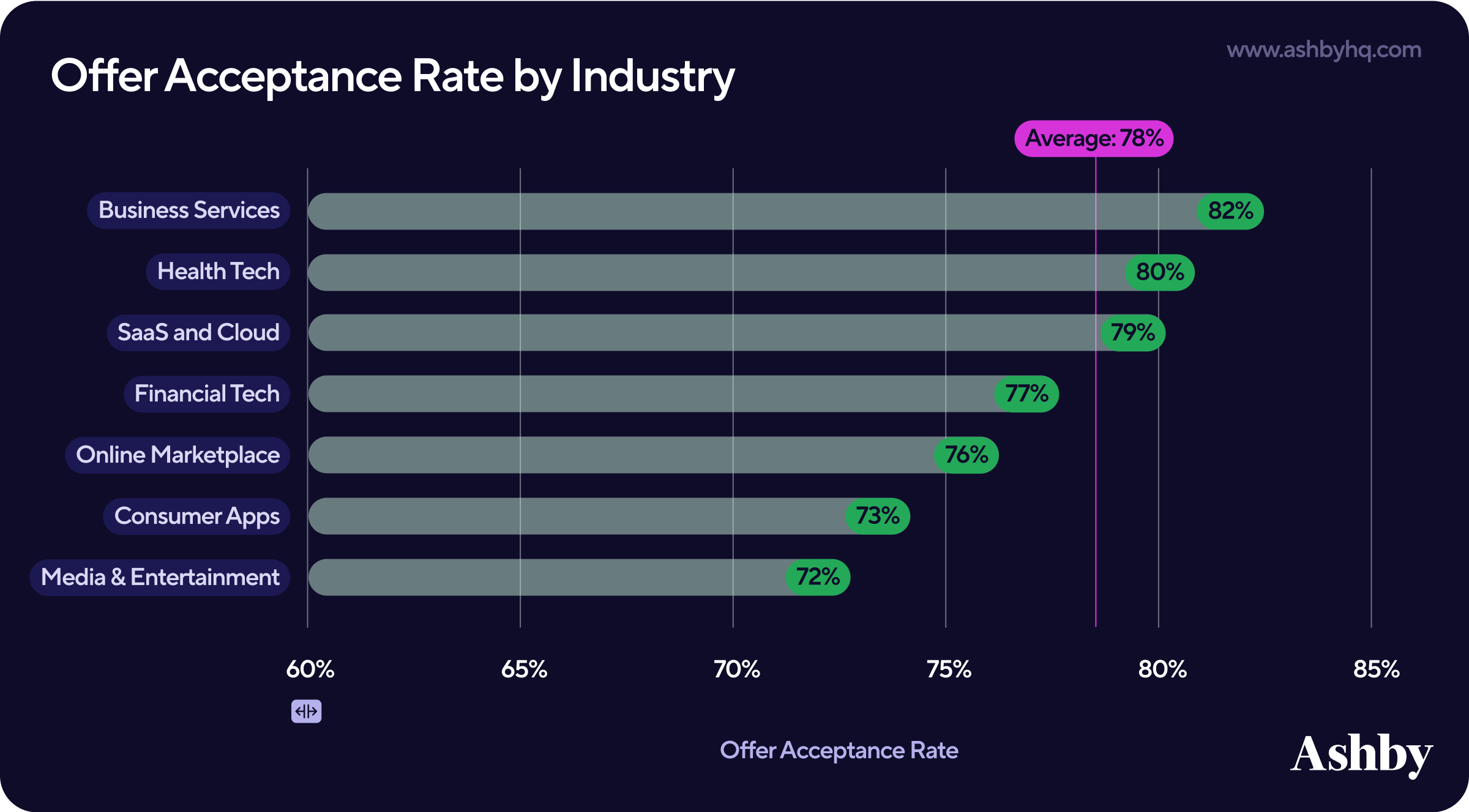
Three numbers tell you most of the story:
- Offer acceptance rate. Offers accepted divided by offers extended. Your headline number.
- Time to offer. Days from application to offer sent. If this is over three weeks, timeline is probably your biggest leak.
- Stage-to-stage time. The days between each step. This finds the bottleneck, which for owner-run hiring is usually your own calendar.
A post-decline script that gets real answers
“Any feedback?” invites a polite brush-off. Try something tighter:
“Thanks for letting me know. One quick question so we can improve: which of these best describes your decision, pay, timeline, the interview experience, a counter offer, role scope, flexibility, or stability? And if you’re open to it, what would have changed your mind?”
Log the answer in your spreadsheet. Over a quarter, anecdotes become a trend line, and the trend line tells you exactly where to focus.
Fix the front end and the offers close themselves
Most declined offers come down to misalignment that could have surfaced weeks earlier. The fix usually isn’t more money. It’s a faster, more transparent front end: expectations in writing from the first touch, a tight process, consistent evaluation, and a record of every decline so you know what’s actually broken.
There’s a bigger shift underneath this. The offer used to be the moment you finally sold the candidate. Now the selling happens in the first 48 hours, in how fast you respond, how clear the role is, and how fair the screening feels. By the time the offer arrives, the decision is mostly made.
If the pile of applications is what’s slowing your front end down, that part is solvable this week. Truffle’s 7-day free trial includes 30 credits and doesn’t ask for a credit card, enough to screen real candidates for your next role and get your time-to-offer under two weeks.
An earlier version of this article was published in June 2025 by Rachel Hubbard. Sean Griffith rewrote it in August 2026 for small teams that are always hiring.

.png)