VidCruiter vs HireVue: 2026 platform comparison
If you’re comparing VidCruiter vs Hirevue, you’re likely weighing two very different approaches to video interviewing: human-led coordination versus platform-led automation, with real tradeoffs in cost, compliance risk, and candidate experience. This guide gives you a straight, side-by-side evaluation built for decision-stage buyers.

AI summary
- The real decision isn’t features, it’s whether AI is merely assistive (humans decide, lower compliance) or evaluative (AI scoring materially drives advancement, higher documentation, validation, and bias-monitoring burden); VidCruiter sits in assistive, HireVue in evaluative, and Truffle positions itself as AI-assisted prioritization with human final decisions.
- Total cost of ownership diverges sharply once you include implementation and internal overhead: VidCruiter and HireVue both use custom, quote-based pricing you only get by contacting sales, and HireVue trends higher due to enterprise services and recurring governance work, while Truffle pitches credit-based plans from $49/month and a ~15-minute setup for high-volume early screening.
- Compliance risk is configuration-driven, not vendor-driven: using AI scores to prioritize candidates can trigger regimes like NYC Local Law 144 (annual bias audits, candidate notices) and Illinois’ AI Video Interview Act (disclosure, consent, sharing limits, deletion workflows), and changes to rubrics or scoring can force re-validation that your team, not the vendor, must sustain.
I’ve never made a good decision with more than six browser tabs open. That’s roughly the state most recruiters are in when they’re trying to choose between HireVue and VidCruiter, toggling between feature pages, G2 reviews, and pricing that may or may not require a sales call to decode.
This guide is the closed-tabs version. Here’s what actually differs between the two, where each one fits best, and when a smaller AI candidate screening software tool fits better.
Why teams compare VidCruiter and HireVue
Both platforms do one-way video interviews. Both use AI to surface candidates. Both have strong track records. But they serve different teams and philosophies.
VidCruiter targets mid-market recruiters who want flexibility and hands-on support. HireVue aims at enterprise teams who want AI to drive the screening process at scale.
The G2 reviews reflect this. VidCruiter sits at 4.8/5 with 240 reviews, scoring especially high on support (9.8/10). HireVue’s at 4.1/5 with 254 reviews, with heavier adoption among enterprise buyers (75.4% of its reviewers).
This isn’t a “one is better” situation. It’s a “which one fits your team” situation.
VidCruiter vs. HireVue at a glance
| Feature | VidCruiter | HireVue |
|---|---|---|
| Primary focus | One-way interviews, assessments, background checks | AI-driven video interviews and assessments |
| Pricing model | Modular, quote-based | Enterprise-focused, quote-based |
| Estimated annual cost (1-person team) | Custom (contact sales) | Custom (contact sales) |
| Implementation time | 2–4 weeks | 4–12 weeks |
| Support quality | 9.8/10 (G2) | 8.6/10 (G2) |
| G2 overall rating | 4.8/5 | 4.1/5 |
| Best for | Mid-size teams, flexible workflows | Large enterprises, AI-first hiring |
| ATS integrations | Workday, iCIMS, Taleo, Greenhouse | Workday, SAP SuccessFactors, iCIMS, Greenhouse |
| Compliance features | NYC Local Law 144 compliant | Bias audits available |
| Main differentiator | Modular features, strong support | AI-native design, game-based assessments |
Pricing and total cost of ownership
VidCruiter pricing
VidCruiter doesn’t list public pricing. Instead, it quotes based on the modules you choose. A typical setup for a small team covers one-way video interviews, basic assessments, and background screening. Pricing isn’t published; expect a custom quote that depends on volume and add-ons.
The advantage here is modularity. You’re not paying for video interview features you don’t use. If you only need video interviews this quarter, you don’t buy assessment modules. That flexibility keeps early-stage implementation lean.
The disadvantage is unpredictability. Your quote might not match another team’s, and negotiating down is possible but takes time. You can’t easily forecast costs without talking to sales.
HireVue pricing
HireVue doesn’t publish pricing either, and every contract is custom-quoted on hiring volume, modules, ATS integrations, and contract length. There’s no free trial. You’ll need to talk to sales to get a real number.
| HireVue cost | What it depends on |
|---|---|
| Entry / Essentials, annual | Contact sales |
| Mid-size enterprise, annual | Contact sales |
| Large enterprise (AI scoring, game-based assessments, high volume) | Contact sales |
| Per user, per month equivalent | Contact sales |
| One-time implementation | Contact sales |
| Free trial | None |
Two things to budget for. First, the real number tends to land well above the first quote once you add modules, integrations, and implementation. Second, you’re paying for the AI layer. Built-in scoring, automated assessments, and game-based evaluations are why the floor sits higher than most one-way interview tools. Enterprise teams can usually negotiate volume discounts.
Hidden costs to consider
Implementation takes longer than either vendor estimates. Both platforms require onboarding: setting up questions, configuring intake flows, connecting your ATS, training your team. Add 2-4 weeks to whatever timeline you’re given.
You’ll also spend time on configuration. VidCruiter’s modularity means you pick and choose, which is flexibility but also decision overhead. HireVue’s AI-first design means less customization needed but more reliance on their approach.
Support costs aren’t hidden, but they matter. VidCruiter reviewers consistently mention responsive support as a reason they chose it. HireVue support is good but less frequently cited as a differentiator.
Core candidate screening features compared
One-way video interviews
Both platforms do one-way video interviews well. Candidates record responses on their own time. Your team reviews asynchronously.
VidCruiter’s approach is straightforward. You set questions. Candidates answer. The platform transcribes and makes the recording available for review. It’s uncomplicated.
HireVue’s approach includes AI analysis built in from the start. The platform doesn’t just capture video. It surfaces key moments, generates summaries, and scores responses against criteria you defined. Less manual review required.
For recruiters drowning in 300 applications, HireVue’s built-in analysis saves time. For teams with smaller volumes or specific cultural questions, VidCruiter’s flexibility is more useful.
Live video interviews
VidCruiter includes scheduling tools for live interviews. You can move candidates from async to synchronous without jumping to another platform.
HireVue doesn’t offer live interviewing. It’s video-focused on the async side. If you need live video calls, you’d use Zoom or Teams and track the scheduling separately.
This matters if your process includes both one-way interviews and scheduled calls with finalists. VidCruiter keeps everything in one place. HireVue requires a second tool.
AI scoring and candidate evaluation
This is where the platforms diverge most.
VidCruiter’s AI analysis is available but less central. The platform transcribes, summarizes, and flags key information. You review and decide. AI is an assistant.
HireVue’s AI is the core product. The platform analyzes every response, generates scores, surfaces top candidates, and uses assessments to create a full candidate profile. AI is the primary reviewer. You’re the decision-maker on the shortlist.
For teams that trust AI and want minimal manual review, HireVue wins. For teams that want human judgment to lead and AI to support, VidCruiter fits better.
HireVue interview scheduling software features
HireVue doesn’t have dedicated scheduling software. But this is worth clarifying because recruiters often search for “HireVue interview scheduling software features” thinking the platform handles scheduling.
It doesn’t. HireVue is async interviews and assessments. If you need live interview scheduling, you integrate with Outlook, Gmail, or a dedicated scheduling tool like Calendly. HireVue handles the video side. Scheduling is separate.
VidCruiter, by contrast, includes scheduling built in. You can move candidates from async video to live calls within the same platform.
Automated scheduling capabilities
VidCruiter’s scheduling lets you set available times, send interview invitations, and have candidates pick slots. It’s not calendar integration into Outlook, but it’s functional and reduces back-and-forth.
HireVue doesn’t have this. You handle scheduling outside the platform.
Calendar and ATS sync
Both platforms integrate with major ATS systems. VidCruiter’s modular design means you can add integrations as needed. HireVue’s integrations are included.
VidCruiter works with Workday, iCIMS, Taleo, Greenhouse, and others. HireVue supports Workday, SAP SuccessFactors, iCIMS, and Greenhouse.
If you use a niche ATS, check integration availability before committing. Both platforms have strong coverage on the major systems.
What to validate before you sign
Ask both platforms explicitly about your ATS. Get it in writing. Don’t assume integrations work because they’re on a list. Request a technical spec sheet and timeline for the integration.
Also ask about scheduling. If your workflow includes live interviews with finalists, confirm how that integrates with your existing tools. Don’t find out post-implementation that you’re managing two separate systems.
ATS integrations and workflow fit
Native integrations
VidCruiter’s integration strategy is modular. You’re not forced to integrate everything. You can pull interview data into your ATS without pulling application data. That flexibility is useful for teams with unusual workflows.
HireVue integrates more comprehensively. Data flows both directions between HireVue and your ATS. Candidates pull from your applicant pool, and interview results push back as custom fields.
Zapier and API options
VidCruiter has some Zapier support but relies on direct ATS integrations for heavy lifting.
HireVue has Zapier support and API access. If you need custom workflows or want to connect HireVue to tools outside the major ATS ecosystem, the API matters.
What to validate before you sign
Define your workflow first. Map out where candidate data flows. From your career site to your ATS. From your ATS to the interview platform. From the interview platform back to your ATS. From your ATS to your offer letter software.
Once you’ve mapped that, confirm both platforms support every step. If your workflow requires custom fields or non-standard data flows, ask for API documentation. Test it in a sandbox if possible.
Ease of use for recruiters and candidates
Recruiter setup and learning curve
VidCruiter is easier to set up. The modular design means less to configure upfront. You can start with interviews, add assessments later. Most teams are recording candidate videos within a week.
HireVue has a steeper setup curve. More configuration, more intake questions, more AI criteria to define. Most teams need 2-4 weeks to get their first cohort through the system. But once it’s running, the platform handles more of the work.
Which is better depends on your timeline. Need to start screening this month? VidCruiter’s faster. Want to build a more sophisticated process? HireVue’s work upfront saves time later.
Candidate experience and completion rates
Both platforms report strong completion rates. Candidates like recording on their own time. No scheduling friction. No camera anxiety from live calls.
VidCruiter’s interface is clean and simple. Candidates record, submit, done. G2 reviews mention it’s easy for candidates to use.
HireVue’s interface is also user-friendly, but the platform sometimes requires assessment components. Game-based evaluations are engaging but add time. Some candidates report fatigue if the full process is long.
Completion rates vary by role and candidate pool. Technical roles have lower completion rates across both platforms. Entry-level roles have higher rates.
Compliance and AI bias considerations
NYC Local Law 144 requirements
NYC requires independent audits of Automated Employment Decision Tools (AEDTs) before use. Both platforms are compliant, but handle it differently.
VidCruiter has built-in transparency reporting and is compliant with Local Law 144 requirements.
HireVue provides bias audit access and can generate reports required by NYC law.
If you’re hiring in New York, get compliance documentation from both vendors. Make sure they can provide the audit reports you’ll need before you deploy.
Bias audits and transparency reports
HireVue’s AI-first approach made it a target for bias scrutiny in the hiring industry. To its credit, the company ended facial expression analysis in 2021 and now emphasizes transparent scoring. You can see how each candidate scored and why.
VidCruiter’s approach is more conservative. Less AI autonomy means less bias risk, but also less AI assistance.
Neither platform eliminates bias. Both platforms help you apply consistent criteria to all candidates. That consistency is better than subjective review, but it’s not “objective hiring.” Your criteria can be biased. The platform just applies them consistently.
Transparency matters more than claims of objectivity. Ask both vendors to show you a sample report. See the scoring. See the reasoning. That’s the audit trail you need.
VidCruiter platform overview
Best for
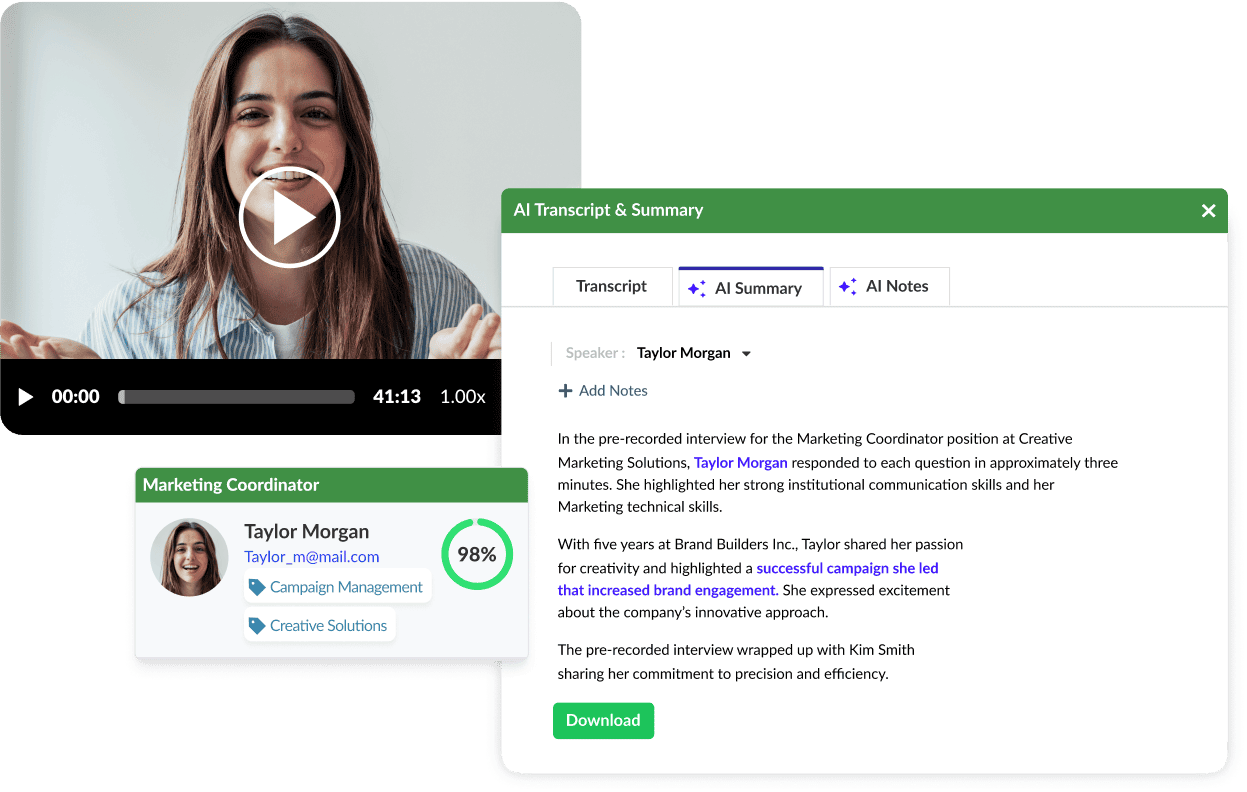
Mid-size teams with 15-50 open roles per year. Teams that want flexibility in screening workflows. Teams that value hands-on support over automation.
Also good for: Organizations with complex ATS setups that need modular integration. Teams trying out video screening for the first time and want a low-risk entry.
Not ideal for: Teams with 200+ roles per year where you need heavy AI automation. Enterprise organizations with standardized processes that benefit from HireVue’s AI-native design.
Key features
- One-way video interviews with custom questions
- Assessment modules (personality, situational judgment)
- Background screening
- Transcription and basic AI summaries
- ATS integrations (Workday, iCIMS, Taleo, Greenhouse)
- Live interview scheduling
- Modular pricing
Pros and cons
Pros:
- Strong customer support (9.8/10 on G2)
- Modular pricing means you pay for what you use
- Flexible workflow design
- Fast implementation (2-4 weeks)
- Live interview scheduling included
Cons:
- Less AI automation than HireVue
- Manual review required for every candidate
- Pricing unpredictability (quote-based)
- Smaller feature set if you need game-based assessments
- Shallower ATS data sync
HireVue platform overview
Best for
Enterprise teams with high volume hiring. Organizations that want AI to be the primary reviewer. Teams with standardized processes that benefit from automation.
Also good for: Large corporations standardizing candidate experience across regions. Teams that already use SAP SuccessFactors or SAP-based systems.
Not ideal for: Small teams (under 5 hires per quarter) where setup overhead isn’t justified. Organizations with non-standard hiring workflows. Teams uncomfortable with AI-driven screening.
Key features
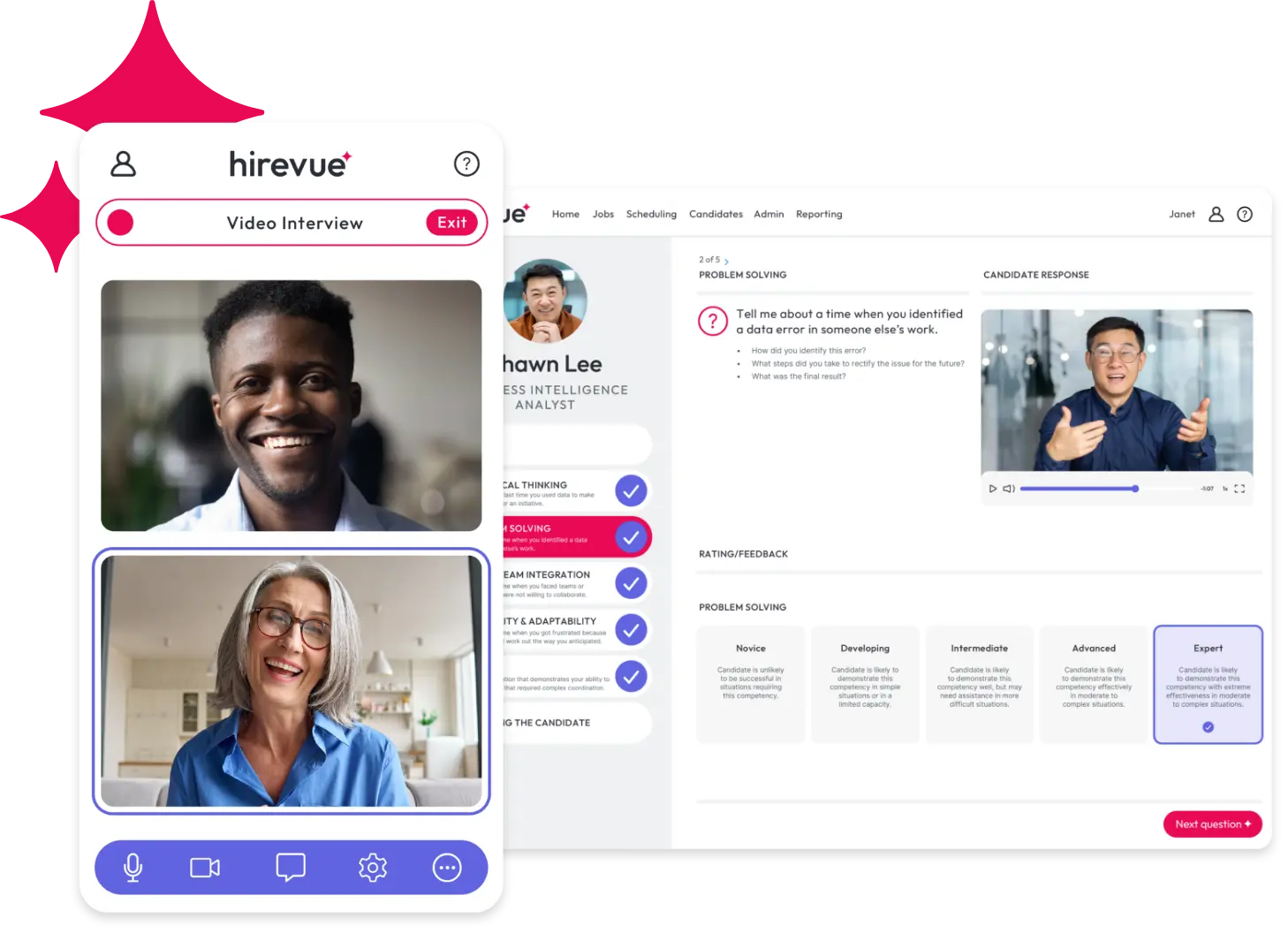
- AI-analyzed one-way video interviews
- Game-based assessments
- Candidate scoring and ranking
- Match scores against role criteria
- AI-generated summaries and highlights
- Bias audit reports
- Enterprise-grade integrations
- Extensive customization for large-scale deployment
Pros and cons
Pros:
- AI analysis saves hours of manual review per week
- Consistent evaluation across all candidates
- Game-based assessments are engaging
- Strong enterprise support and compliance
- Transparent scoring with explainability
- Cuts manual review time by half or more
Cons:
- Longer implementation timeline
- Higher total cost
- Less modular (you’re buying the full platform)
- Steeper learning curve for smaller teams
- Relies on AI automation (not ideal if you prefer human-first review)
- Less flexible for non-standard workflows
Which platform fits your team
Small to mid-size teams
If you have 1-3 people doing hiring and 50-100 applicants per role, VidCruiter is probably the better fit. Implementation is faster. Support is more personalized. Pricing is more aligned to your volume.
You’ll manually review candidates, but that’s okay. Your team size means you’re reviewing applications anyway. One-way video interviews reduce the phone screening burden without requiring heavy automation.
Enterprise and high-volume hiring
If you have 200+ roles per year or 500+ applicants per role, HireVue’s automation is worth the setup investment. The platform handles the initial triage, surfaces your best matches, and lets your team focus on conversations.
The longer implementation timeline and higher cost are justified because you’re screening thousands of candidates per year. AI-assisted initial review saves weeks of recruiter time.
When neither platform fits
Both platforms assume your primary workflow is one-way interviews. If you do live interviews first and screens video interviews second, these platforms don’t align with your process.
If your hiring is seasonal (one big push in Q4, quiet the rest of the year), the recurring cost of either platform might not be justified. You might be better served by hiring an agency or using a lower-touch solution.
If you need screening beyond video and assessments (work samples, coding tests, portfolio reviews), neither platform is a complete solution. You’d integrate them with other tools.
A simpler alternative for lean hiring teams
Both VidCruiter and HireVue require meaningful investment. Implementation time, training, ATS integration, ongoing fees.
There’s another way. Truffle is an AI screening platform that combines one-way video interviews with resume screening and assessments. It’s credit-based, with plans from $49/month and unlimited users. No per-video fees. No hidden implementation costs. Setup takes about 15 minutes.
FAQs about VidCruiter vs HireVue
What is the difference between HireVue and VidCruiter?
HireVue is AI-first and targets enterprise hiring at scale. VidCruiter is modular and flexible, targeting mid-market teams. HireVue emphasizes automation. VidCruiter emphasizes human control with AI assistance. Both do one-way video interviews, but HireVue includes heavier AI analysis and game-based assessments.
Can VidCruiter see your screen during an interview?
No. VidCruiter records video and audio responses. It doesn’t have screen-sharing or screen-recording capabilities. Candidates record themselves answering questions on camera. That’s it.
Can HireVue detect cheating during video interviews?
HireVue doesn’t detect cheating in the traditional sense. The platform analyzes video and audio for patterns. It checks consistency of responses. It can flag if responses seem overly polished or scripted, but it doesn’t identify cheating definitively.
If you’re concerned about candidates using notes or getting help during interviews, your question design matters more than the platform. Ask open-ended questions that require reasoning, not memorized answers. Ask follow-up questions based on their responses. No platform can catch prepared answers without human judgment in the conversation.
How long does implementation take for VidCruiter and HireVue?
VidCruiter typically takes 2-4 weeks from contract to first candidate recording.
HireVue typically takes 4-12 weeks from contract to first candidate recording, depending on your ATS complexity and customization needs.
Both timelines assume you’re ready to define questions, configure intake, and train your team during that window. Implementation delays usually happen because internal stakeholders need time to align on screening criteria, not because the platforms are slow.
This article was originally published in October 2025. The most recent update was in June 2026.