



The Ultimate Guide to Asynchronous Interviews (2026)
Most hiring teams are losing candidates not at the offer stage — but at the phone screen.
You post a role, 150 people apply, and your recruiter spends the next two weeks playing calendar ping-pong trying to schedule 30-minute calls with people who may not even be qualified. By the time you get through the first wave, strong applicants have already accepted offers elsewhere.
This isn't anecdotal: 35% of the average recruiter's workweek is consumed by interview scheduling alone — before a single screening question is asked (Yello Interview Scheduling Survey, 2024).
Asynchronous interviews fix this. They move the first-round screen off your calendar entirely — and off your candidates' calendars too. Done right, you go from 100 applicants to a ranked shortlist in 24 to 48 hours without a single scheduling email.
This guide gives you the full picture: what asynchronous interviews are, how to implement them without wrecking your candidate experience, which platforms are worth evaluating, and how to choose one that actually fits your team.
What asynchronous video interview platforms are (and how they work)
An asynchronous interview — also called a one-way video interview or on-demand interview — is a non-live interview format where candidates respond to preset questions on their own schedule. Instead of joining a live call, they receive a link, record their answers, and submit. You review on your own time.
This is where async sits in your funnel: it replaces or augments the first-round phone screen. For teams with frequent hiring needs — retail, restaurants, field sales, campus recruiting — it's the difference between a process that scales and one that breaks every time volume spikes. Teams using asynchronous screening report hiring cycles up to 70% faster than traditional phone-screen workflows (SelectSoftwareReviews, 2025).
The mechanics are straightforward:
- Create — Build your interview with preset questions, set time limits and retakes, and publish a link.
- Invite — Send the link via email, job board, or direct invite.
- Candidate records — They respond on their own schedule via video, audio, or text — no scheduling required.
- Team reviews — Your team watches, reads transcripts, and scores responses in batches.
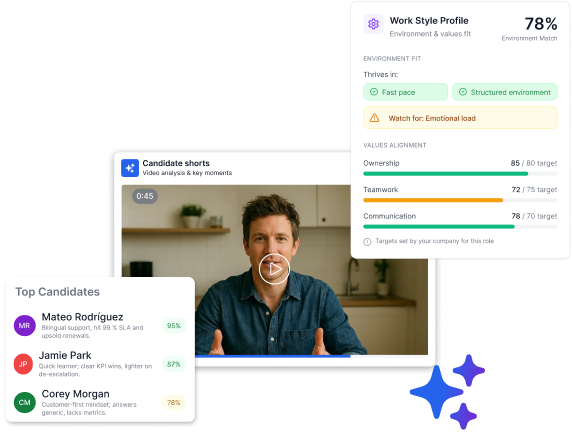
Modern platforms add an AI-assisted layer on top of this workflow. For example, Truffle transcribes responses, generates summaries, and produces a match percentage scored against the criteria you define — so you can prioritize review faster while keeping humans in control of every decision.
How to implement asynchronous interviews without hurting candidate experience
Async works when it's short, job-relevant, and clearly explained. When it's not, it feels like a cold hoop — and your completion rate will show it.
Start with structure before you touch any settings. Your initial screening interview should use preset interview questions that stand completely on their own — no live follow-up, no clarification. Every question needs to be specific enough to generate signal without a recruiter in the room to redirect.
A solid starting point is 3 to 5 questions:
- 1 warm-up (low-stakes, gets candidates comfortable)
- 2–3 situational or behavioral questions tied directly to the role
- 1 collaboration or values question
For technical roles, you can add role-specific technical assessments or file responses (work sample, short writing exercise). Keep early-stage interview assessments lightweight. Depth belongs in the live round.
Once you have the question set, configure the defaults that protect completion rate and signal quality:
- Preset interview questions: 3–6 total
- Thinking time: 2 minutes per question
- Time limits: 1–3 minutes per response
- Retakes: 1 allowed
- Total candidate time: 10–20 minutes end to end
Shorter is almost always better at the top of the funnel. Once you push past 20 minutes, drop-off climbs. "The single biggest predictor of completion isn't question count or format — it's total candidate time," says Dr. John Sullivan, Professor of Management at San Francisco State University and a leading recruiting strategist. The data backs him up: well-configured async interviews achieve 75–85% completion rates, while poorly designed ones can drop below 50% (HireVire / industry benchmark data, 2025).
Then choose the response format based on what the role actually demands:
- Video responses: best when communication presence is job-relevant (sales, customer-facing roles).
- Audio responses: reduces camera anxiety and can be a practical accessibility lever when on-screen presence isn't part of the job.
- File responses: stronger signal for writing, planning, design, or role-specific output.
Avoid generic prompts like "Tell me about yourself." They create noise, not signal. Async questions should be specific, situational, and self-contained.
Before publishing, run your full interview in preview mode. This is where you catch vague wording, confusing instructions, or timing that feels rushed.
Finally, set up review so it stays structured as volume increases:
- Build a rubric before the first submission lands.
- Have reviewers score independently before comparing notes (prevents anchoring).
- Start with transcripts to focus on content, then watch video for context.
- Set a 48-hour review SLA so candidates aren't left hanging.
- Close the loop with clear expectations (even "we'll be in touch within 5 business days" helps).
Now that the mechanics are set, the question becomes: what do you actually get in return?
Why asynchronous interviews matter: the benefits (and how to get them)
The real case for async isn't just "it saves time." It saves time without sacrificing the information you need to make a confident shortlist.
For hiring teams: speed without chaos
Async replaces repetitive phone screens and eliminates the scheduling bottleneck. It "automates" the busywork in the right sense of the word: the platform handles collection, transcription, and organization — and your team still makes every call.
In high-volume roles, that's a structural shift. Instead of spending two weeks coordinating 30-minute screens, you batch-review completed interviews in focused blocks and move candidates forward in days. The numbers explain why: 67% of recruiters spend 30 minutes to 2 hours scheduling each interview, and with 3–5 rounds per hire, that can consume 25–100 hours of coordination per role (Yello, 2024). Async eliminates that line item entirely for round one.
Async also creates consistency that live screens rarely achieve. Every candidate answers the same questions, in the same order, under the same constraints. That makes early-stage decisions easier to explain and easier to defend.
For candidates: flexibility that improves completion
Candidates can complete the interview after work, from their phone, without taking time off. That matters for frontline hiring, distributed teams, and anyone applying across time zones.
And when you design it well — clear instructions, a branded welcome message, and an automated completion confirmation — async can feel more professional than an overloaded recruiter squeezing in rushed screens between meetings.
On fairness: better tools, not magic
Async doesn't eliminate bias. Nothing does. But it gives you tools that reduce inconsistency:
- consistent prompts and time limits
- transcript-first review when you want to focus on content
- rubric-based scoring that keeps everyone using the same bar
Audio-only options can help too when visual presence isn't job-relevant. A 2025 study in the International Journal of Selection and Assessment confirmed that asynchronous video interviews produce reliable, structured performance signals when questions are standardized and rubrics defined in advance — making them comparable to structured live interviews for early-stage screening (Dunlop et al., 2025, IJSA).
More signal, earlier
For roles where output matters, additional attachments (work samples, portfolios, supporting documents) can turn an early screen from "they spoke well" to "they can do the work" — without adding another round or another scheduling step.
Leading asynchronous interview platforms: what you get (and what you don't)
Most asynchronous video interview platforms collect responses. Fewer help you review fast, collaborate cleanly, and produce a shortlist your hiring manager will actually act on.
"Most hiring teams buy a recording tool and then realize too late that the bottleneck was never recording — it was review," notes Bas van de Haterd, a recruitment technology researcher and co-author of Talent Acquisition Excellence. The market reflects that shift: platforms that only capture video are losing ground to those that transcribe, score, and summarize.
The market breaks into three buckets:
- SMB-first self-serve tools (Truffle, Willo, Hireflix): go live in minutes, transparent pricing, minimal overhead.
- Enterprise suites (HireVue, VidCruiter, Modern Hire, Talview, Outmatch): deeper controls for large-scale hiring, but longer implementations and sales-led pricing.
- Add-on video modules (Clovers, Spark Hire, myInterview, Jobma): useful in the right stack, often lighter outside it.
Here's a side-by-side look at the features that change outcomes:
| Platform | One-way video | Live video interviews | Transcripts | AI summaries / match % | Scorecard support | Secure share links | Bulk shareable links | Setup speed | Pricing transparency | Customer support |
|---|---|---|---|---|---|---|---|---|---|---|
| Truffle | Yes | No | Yes | Yes (match % + summaries) | Yes | Yes | Yes | Minutes | Yes Public | Chat + docs |
| Willo | Yes | Yes | Yes | Limited | Partial | Yes | Yes | Minutes | Yes Public | Chat |
| Hireflix | Yes | No | Limited | No | No | Yes | Yes | Minutes | Yes Public | |
| Spark Hire | Yes | Yes | Yes | Limited | Yes | Yes | Yes | Hours-days | Yes Public | Chat + phone |
| Jobma | Yes | Yes | Yes | Limited | Partial | Yes | Yes | Hours | Yes Public | Chat |
| myInterview | Yes | No | Yes | Limited | No | Yes | Yes | Minutes | Yes Public | Chat |
| HireVue | Yes | Yes | Yes | Yes | Yes | Yes | Yes | Weeks | No Sales-led | Dedicated CSM |
| VidCruiter | Yes | Yes | Yes | Partial | Yes | Yes | Yes | Days-weeks | No Sales-led | Dedicated CSM |
| Modern Hire | Yes | Yes | Yes | Yes | Yes | Yes | Yes | Weeks | No Sales-led | Enterprise |
| Talview | Yes | Yes | Yes | Yes | Yes | Yes | Yes | Weeks | No Sales-led | Enterprise |
| Outmatch | Yes | Yes | Yes | Yes | Yes | Yes | Yes | Weeks | No Sales-led | Enterprise |
| Clovers | Yes | Yes | Yes | Yes | Yes | Yes | Yes | Days | No Sales-led | Dedicated |
Pricing and features as of mid-2026. Verify directly with vendors before purchasing.
Where platforms differ most isn't recording quality. It's what happens after submission: transcripts, structured scorecards, and AI-assisted outputs like summaries and match percentages (scored against your criteria) that help you get to a shortlist without drowning in raw footage.
How to choose the right platform: selection criteria that actually matter
Start with ease of use and accessibility — for both sides. If candidates need to download an app, create an account, or troubleshoot browser issues, your completion rate will tell you immediately. Mobile-friendly and no-download isn't a nice-to-have. It's the baseline.
The must-have checklist:
- Mobile-friendly, no-download candidate flow
- Stable recording with clear time limits and thinking time controls
- Transcripts and video interview storage controls
- Scorecard and structured rubric support for reviewers
- Secure sharing with permissions (read-only, optional password, expiry)
- Integration with HR technologies (ATS, Zapier, or API)
- Interview builder that doesn't require IT help
- Pre-interview testing so you can preview the candidate experience before going live
On customization: response format, thinking time, and retakes shouldn't be one-size-fits-all. Video is right when presence is part of the job. Audio-only is often a better default when it isn't.
Collaboration is another make-or-break. If your hiring manager needs an account, training, and a login flow just to review candidates, you'll be back to chasing them in Slack. Truffle's secure share links, for example, are read-only, password-optional, and auto-expiring after 75 days — designed to remove that friction.
Run a two-week pilot before you commit. Set targets upfront:
- Completion rate: aim for 70%+ on a well-structured 3–5 question interview
- Median time-to-review: should drop measurably vs. phone screens
- Hiring manager response time: if they aren't reviewing within 48 hours, access and workflow are the problem
- Candidate feedback: ask a sample of completers what they'd change
Test one variable at a time (4 vs. 6 questions, video vs. audio) and document the impact. The platform that makes iteration fast is the one that will keep paying you back.
The bottom line
Asynchronous interviews work when the fundamentals are right: short interviews with job-relevant questions, a structured review workflow, and a platform that surfaces your top matches rather than dumping raw footage on your team.
The scheduling bottleneck is solvable. The consistency problem is solvable. Getting hiring managers to review candidates in 48 hours instead of a week is solvable. All three come down to choosing the right format, configuring it correctly, and picking a platform that makes review fast — not just recording easy.
AI surfaces. You decide. That principle should guide every platform evaluation and every rubric you build.
If you're running high-volume hiring with a lean team, the ROI on getting this right is significant. Recruiters who adopt screening and scheduling automation report saving 2 to 10 hours per week (Yello / Cronofy scheduling survey, 2024) — time that goes straight back into candidate engagement and hiring-manager alignment. Two weeks of phone screen scheduling becomes 24 to 48 hours of async review. A pile of applications becomes a ranked shortlist your hiring manager can act on the same day.
The setup is simpler than most teams expect. If you want to see what that looks like in practice, Demo.
The TL;DR

The Ultimate Guide to Asynchronous Interviews (2026)
Most hiring teams are losing candidates not at the offer stage — but at the phone screen.
You post a role, 150 people apply, and your recruiter spends the next two weeks playing calendar ping-pong trying to schedule 30-minute calls with people who may not even be qualified. By the time you get through the first wave, strong applicants have already accepted offers elsewhere.
This isn't anecdotal: 35% of the average recruiter's workweek is consumed by interview scheduling alone — before a single screening question is asked (Yello Interview Scheduling Survey, 2024).
Asynchronous interviews fix this. They move the first-round screen off your calendar entirely — and off your candidates' calendars too. Done right, you go from 100 applicants to a ranked shortlist in 24 to 48 hours without a single scheduling email.
This guide gives you the full picture: what asynchronous interviews are, how to implement them without wrecking your candidate experience, which platforms are worth evaluating, and how to choose one that actually fits your team.
What asynchronous video interview platforms are (and how they work)
An asynchronous interview — also called a one-way video interview or on-demand interview — is a non-live interview format where candidates respond to preset questions on their own schedule. Instead of joining a live call, they receive a link, record their answers, and submit. You review on your own time.
This is where async sits in your funnel: it replaces or augments the first-round phone screen. For teams with frequent hiring needs — retail, restaurants, field sales, campus recruiting — it's the difference between a process that scales and one that breaks every time volume spikes. Teams using asynchronous screening report hiring cycles up to 70% faster than traditional phone-screen workflows (SelectSoftwareReviews, 2025).
The mechanics are straightforward:
- Create — Build your interview with preset questions, set time limits and retakes, and publish a link.
- Invite — Send the link via email, job board, or direct invite.
- Candidate records — They respond on their own schedule via video, audio, or text — no scheduling required.
- Team reviews — Your team watches, reads transcripts, and scores responses in batches.
Modern platforms add an AI-assisted layer on top of this workflow. For example, Truffle transcribes responses, generates summaries, and produces a match percentage scored against the criteria you define — so you can prioritize review faster while keeping humans in control of every decision.
How to implement asynchronous interviews without hurting candidate experience
Async works when it's short, job-relevant, and clearly explained. When it's not, it feels like a cold hoop — and your completion rate will show it.
Start with structure before you touch any settings. Your initial screening interview should use preset interview questions that stand completely on their own — no live follow-up, no clarification. Every question needs to be specific enough to generate signal without a recruiter in the room to redirect.
A solid starting point is 3 to 5 questions:
- 1 warm-up (low-stakes, gets candidates comfortable)
- 2–3 situational or behavioral questions tied directly to the role
- 1 collaboration or values question
For technical roles, you can add role-specific technical assessments or file responses (work sample, short writing exercise). Keep early-stage interview assessments lightweight. Depth belongs in the live round.
Once you have the question set, configure the defaults that protect completion rate and signal quality:
- Preset interview questions: 3–6 total
- Thinking time: 2 minutes per question
- Time limits: 1–3 minutes per response
- Retakes: 1 allowed
- Total candidate time: 10–20 minutes end to end
Shorter is almost always better at the top of the funnel. Once you push past 20 minutes, drop-off climbs. "The single biggest predictor of completion isn't question count or format — it's total candidate time," says Dr. John Sullivan, Professor of Management at San Francisco State University and a leading recruiting strategist. The data backs him up: well-configured async interviews achieve 75–85% completion rates, while poorly designed ones can drop below 50% (HireVire / industry benchmark data, 2025).
Then choose the response format based on what the role actually demands:
- Video responses: best when communication presence is job-relevant (sales, customer-facing roles).
- Audio responses: reduces camera anxiety and can be a practical accessibility lever when on-screen presence isn't part of the job.
- File responses: stronger signal for writing, planning, design, or role-specific output.
Avoid generic prompts like "Tell me about yourself." They create noise, not signal. Async questions should be specific, situational, and self-contained.
Before publishing, run your full interview in preview mode. This is where you catch vague wording, confusing instructions, or timing that feels rushed.
Finally, set up review so it stays structured as volume increases:
- Build a rubric before the first submission lands.
- Have reviewers score independently before comparing notes (prevents anchoring).
- Start with transcripts to focus on content, then watch video for context.
- Set a 48-hour review SLA so candidates aren't left hanging.
- Close the loop with clear expectations (even "we'll be in touch within 5 business days" helps).
Now that the mechanics are set, the question becomes: what do you actually get in return?
Why asynchronous interviews matter: the benefits (and how to get them)
The real case for async isn't just "it saves time." It saves time without sacrificing the information you need to make a confident shortlist.
For hiring teams: speed without chaos
Async replaces repetitive phone screens and eliminates the scheduling bottleneck. It "automates" the busywork in the right sense of the word: the platform handles collection, transcription, and organization — and your team still makes every call.
In high-volume roles, that's a structural shift. Instead of spending two weeks coordinating 30-minute screens, you batch-review completed interviews in focused blocks and move candidates forward in days. The numbers explain why: 67% of recruiters spend 30 minutes to 2 hours scheduling each interview, and with 3–5 rounds per hire, that can consume 25–100 hours of coordination per role (Yello, 2024). Async eliminates that line item entirely for round one.
Async also creates consistency that live screens rarely achieve. Every candidate answers the same questions, in the same order, under the same constraints. That makes early-stage decisions easier to explain and easier to defend.
For candidates: flexibility that improves completion
Candidates can complete the interview after work, from their phone, without taking time off. That matters for frontline hiring, distributed teams, and anyone applying across time zones.
And when you design it well — clear instructions, a branded welcome message, and an automated completion confirmation — async can feel more professional than an overloaded recruiter squeezing in rushed screens between meetings.
On fairness: better tools, not magic
Async doesn't eliminate bias. Nothing does. But it gives you tools that reduce inconsistency:
- consistent prompts and time limits
- transcript-first review when you want to focus on content
- rubric-based scoring that keeps everyone using the same bar
Audio-only options can help too when visual presence isn't job-relevant. A 2025 study in the International Journal of Selection and Assessment confirmed that asynchronous video interviews produce reliable, structured performance signals when questions are standardized and rubrics defined in advance — making them comparable to structured live interviews for early-stage screening (Dunlop et al., 2025, IJSA).
More signal, earlier
For roles where output matters, additional attachments (work samples, portfolios, supporting documents) can turn an early screen from "they spoke well" to "they can do the work" — without adding another round or another scheduling step.
Leading asynchronous interview platforms: what you get (and what you don't)
Most asynchronous video interview platforms collect responses. Fewer help you review fast, collaborate cleanly, and produce a shortlist your hiring manager will actually act on.
"Most hiring teams buy a recording tool and then realize too late that the bottleneck was never recording — it was review," notes Bas van de Haterd, a recruitment technology researcher and co-author of Talent Acquisition Excellence. The market reflects that shift: platforms that only capture video are losing ground to those that transcribe, score, and summarize.
The market breaks into three buckets:
- SMB-first self-serve tools (Truffle, Willo, Hireflix): go live in minutes, transparent pricing, minimal overhead.
- Enterprise suites (HireVue, VidCruiter, Modern Hire, Talview, Outmatch): deeper controls for large-scale hiring, but longer implementations and sales-led pricing.
- Add-on video modules (Clovers, Spark Hire, myInterview, Jobma): useful in the right stack, often lighter outside it.
Here's a side-by-side look at the features that change outcomes:
| Platform | One-way video | Live video interviews | Transcripts | AI summaries / match % | Scorecard support | Secure share links | Bulk shareable links | Setup speed | Pricing transparency | Customer support |
|---|---|---|---|---|---|---|---|---|---|---|
| Truffle | Yes | No | Yes | Yes (match % + summaries) | Yes | Yes | Yes | Minutes | Yes Public | Chat + docs |
| Willo | Yes | Yes | Yes | Limited | Partial | Yes | Yes | Minutes | Yes Public | Chat |
| Hireflix | Yes | No | Limited | No | No | Yes | Yes | Minutes | Yes Public | |
| Spark Hire | Yes | Yes | Yes | Limited | Yes | Yes | Yes | Hours-days | Yes Public | Chat + phone |
| Jobma | Yes | Yes | Yes | Limited | Partial | Yes | Yes | Hours | Yes Public | Chat |
| myInterview | Yes | No | Yes | Limited | No | Yes | Yes | Minutes | Yes Public | Chat |
| HireVue | Yes | Yes | Yes | Yes | Yes | Yes | Yes | Weeks | No Sales-led | Dedicated CSM |
| VidCruiter | Yes | Yes | Yes | Partial | Yes | Yes | Yes | Days-weeks | No Sales-led | Dedicated CSM |
| Modern Hire | Yes | Yes | Yes | Yes | Yes | Yes | Yes | Weeks | No Sales-led | Enterprise |
| Talview | Yes | Yes | Yes | Yes | Yes | Yes | Yes | Weeks | No Sales-led | Enterprise |
| Outmatch | Yes | Yes | Yes | Yes | Yes | Yes | Yes | Weeks | No Sales-led | Enterprise |
| Clovers | Yes | Yes | Yes | Yes | Yes | Yes | Yes | Days | No Sales-led | Dedicated |
Pricing and features as of mid-2026. Verify directly with vendors before purchasing.
Where platforms differ most isn't recording quality. It's what happens after submission: transcripts, structured scorecards, and AI-assisted outputs like summaries and match percentages (scored against your criteria) that help you get to a shortlist without drowning in raw footage.
How to choose the right platform: selection criteria that actually matter
Start with ease of use and accessibility — for both sides. If candidates need to download an app, create an account, or troubleshoot browser issues, your completion rate will tell you immediately. Mobile-friendly and no-download isn't a nice-to-have. It's the baseline.
The must-have checklist:
- Mobile-friendly, no-download candidate flow
- Stable recording with clear time limits and thinking time controls
- Transcripts and video interview storage controls
- Scorecard and structured rubric support for reviewers
- Secure sharing with permissions (read-only, optional password, expiry)
- Integration with HR technologies (ATS, Zapier, or API)
- Interview builder that doesn't require IT help
- Pre-interview testing so you can preview the candidate experience before going live
On customization: response format, thinking time, and retakes shouldn't be one-size-fits-all. Video is right when presence is part of the job. Audio-only is often a better default when it isn't.
Collaboration is another make-or-break. If your hiring manager needs an account, training, and a login flow just to review candidates, you'll be back to chasing them in Slack. Truffle's secure share links, for example, are read-only, password-optional, and auto-expiring after 75 days — designed to remove that friction.
Run a two-week pilot before you commit. Set targets upfront:
- Completion rate: aim for 70%+ on a well-structured 3–5 question interview
- Median time-to-review: should drop measurably vs. phone screens
- Hiring manager response time: if they aren't reviewing within 48 hours, access and workflow are the problem
- Candidate feedback: ask a sample of completers what they'd change
Test one variable at a time (4 vs. 6 questions, video vs. audio) and document the impact. The platform that makes iteration fast is the one that will keep paying you back.
The bottom line
Asynchronous interviews work when the fundamentals are right: short interviews with job-relevant questions, a structured review workflow, and a platform that surfaces your top matches rather than dumping raw footage on your team.
The scheduling bottleneck is solvable. The consistency problem is solvable. Getting hiring managers to review candidates in 48 hours instead of a week is solvable. All three come down to choosing the right format, configuring it correctly, and picking a platform that makes review fast — not just recording easy.
AI surfaces. You decide. That principle should guide every platform evaluation and every rubric you build.
If you're running high-volume hiring with a lean team, the ROI on getting this right is significant. Recruiters who adopt screening and scheduling automation report saving 2 to 10 hours per week (Yello / Cronofy scheduling survey, 2024) — time that goes straight back into candidate engagement and hiring-manager alignment. Two weeks of phone screen scheduling becomes 24 to 48 hours of async review. A pile of applications becomes a ranked shortlist your hiring manager can act on the same day.
The setup is simpler than most teams expect. If you want to see what that looks like in practice, Demo.


Try Truffle instead.